Pillory linden of Großpörthen: 900-year-old tree with a grim history
Nestled beside the village church in Großpörthen — a hamlet roughly five kilometres south-east of Zeitz — stands a winter lime whose trunk measures

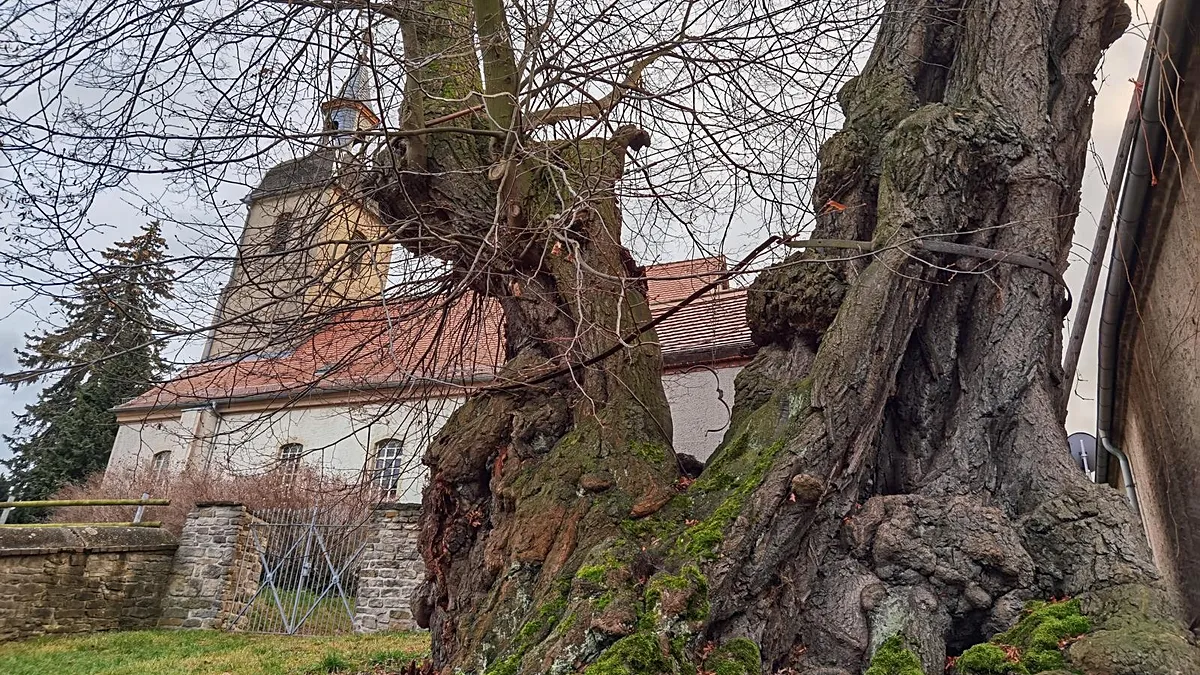
Table of Contents
A Nine-Century Sentinel in Saxony-Anhalt
Poinews.com – Nestled beside the village church in Großpörthen — a hamlet roughly five kilometres south-east of Zeitz — stands a winter lime whose trunk measures approximately 9.85 metres around and whose canopy rises to about twelve metres. German dendrologists place its age somewhere between 700 and 900 years, which would make it the thickest surviving winter lime in the country.
A Living Record of Public Punishment
The tree’s distinctive name traces back to its long association with local justice. A corroded iron ring, once clamped around a condemned person’s neck, remains fixed to the bark. Such neck irons appear in German-speaking legal records from the fourteenth century onward and were central to what contemporaries called shame or honour punishment. The practice flourished through the late Middle Ages and into the early modern era, with references persisting in German statutes well past the eighteenth century.
The underlying aim was reputational destruction: by locking an offender in public view, the community stripped away social standing. Depending on locale and sentence, physical beating could accompany the display, and some convicts were forced to carry placards spelling out their crime. The catalogue of offences punished this way stretched from minor theft and verbal abuse to slander, public disorder, violations of moral codes, and fraud connected with measures and weights.
Why Pinning Down an Exact Age Is Nearly Impossible
No single figure can be assigned to the Großpörthen lime. Centuries of growth reshape a trunk’s geometry, and this particular specimen grows on a slope — a position that has produced marked thickening and irregular bulging in both the bole and the root zone. The German Dendrological Society therefore offers only a broad bracket: seven to nine centuries.
Survival After Catastrophic Damage
A substantial section of the trunk reportedly snapped away around the middle of the twentieth century. Despite that loss, the tree has regenerated and is currently assessed as healthy.
Context Among Germany’s Ancient Trees
The Großpörthen lime now ranks as the nation’s second-oldest known specimen. The title previously held by a summer lime in Upstedt, Lower Saxony, passed recently to a yew of roughly 1,100 years growing on an Alpine pasture in the Allgäu region. The Upstedt tree occupies a historic village square that served as a communal gathering spot from the early second millennium; by the thirteenth century it had been formally designated a court tree. Unlike its Großpörthen counterpart, however, no documentary evidence links the Upstedt lime to pillory use.
Related Reading
Frequently Asked Questions
What is Pillory linden of Großpörthen?
Pillory linden of Großpörthen is the main topic of this guide. The article explains the context, practical details, and next steps readers should understand.
Why does Pillory linden of Großpörthen matter?
Pillory linden of Großpörthen matters because readers are looking for a useful answer, not just a short summary. Good content should match search intent and help them decide what to do next.