Uzbekistan wins home gold at record-breaking Chess Olympiad in Samarkand
Samarkand hosted the largest Chess Olympiad ever staged, with nearly 400 national teams gathering for almost two weeks of competition. The home crowd had a

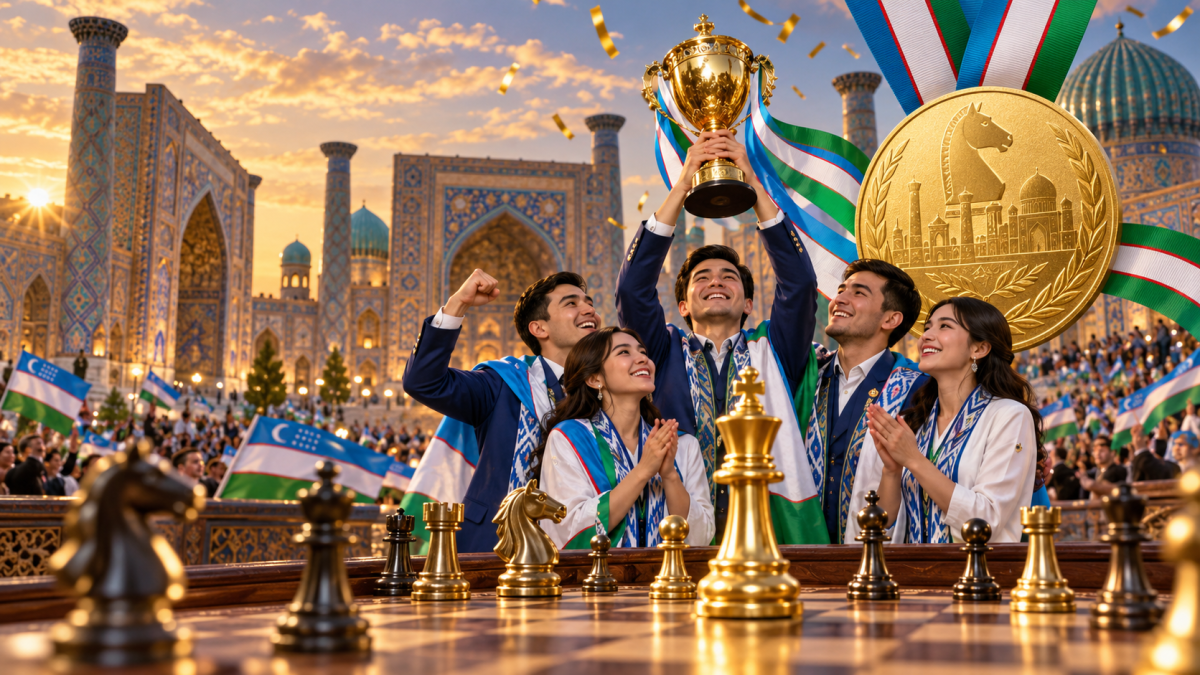
Table of Contents
Uzbekistan claims a historic home triumph at Chess Olympiad
Poinews.com – Samarkand hosted the largest Chess Olympiad ever staged, with nearly 400 national teams gathering for almost two weeks of competition. The home crowd had a result to celebrate at the finish: Uzbekistan secured the Open gold medal after beating Ukraine in the final round.
The victory gave Uzbekistan its second Chess Olympiad title, following its breakthrough gold in Chennai, India, in 2022. The team had also collected bronze in Budapest two years later, underlining the country’s growing strength in elite team chess.
“This is our second Olympiad victory. Winning it at home feels different,” Uzbek grandmaster Javokhir Sindarov said. “I think we played the tournament at the highest level.”
Uzbekistan ended the 11-round event with 20 of a possible 22 match points, winning 10 matches and suffering only one defeat. Its route to gold included victories over defending champions India, China and the top-seeded United States. Germany, which later took bronze, was the only team to beat the hosts.
A format built around national teams
Organised by the International Chess Federation, or FIDE, the Chess Olympiad is chess’s foremost international team event. Rather than entering solely as individuals, leading players represent their countries. In each match, four players from one nation play four opponents from another team simultaneously. Their individual scores are added together to determine the match result.
Teams face a changing set of opponents across 11 rounds, making consistency essential. A strong finish can reshape the medal table, while one difficult match can prove decisive in a closely contested tournament. Uzbekistan combined high-level individual performances with a series of major team wins to finish ahead of the field.
Nodirbek Abdusattorov was central to that effort. Competing on Uzbekistan’s first board, a position that generally brings the strongest opponent from each rival side, he went through the Olympiad without losing a game. His performance also earned him an individual gold medal.
“I think we can now confidently say that Uzbekistan is unrivalled in the world of chess,” Abdusattorov said after the victory.
India claimed silver in the Open competition, while Germany completed the podium in third place. Germany’s medal carried particular significance, as it was the country’s first Open-team Olympiad medal since its silver-winning campaign in Istanbul in 2000.
“I think it’s by far the best Olympiad we’ve had in recent years, at least as long as I’ve been playing,” German grandmaster Vincent Keymer said.
European teams featured prominently near the top of the standings. Hungary, France and Spain all finished inside the top 10, alongside Azerbaijan and Armenia, reflecting the depth of competition across the continent and beyond.
China takes women’s gold
The Women’s competition produced a different set of medal winners. China won gold, Kazakhstan took second place and India, the defending champions, finished with bronze.
Indian grandmaster Koneru Humpy was part of India’s medal-winning lineup. The Olympiad’s size and international reach give players an unusually visible platform, with many national teams, spectators and chess followers focused on the same event at once.
“There is a lot of attention from all the spectators and followers, and this is one of the widely followed tournaments from all over the world,” Humpy said.
The Samarkand field comprised 205 Open teams and 189 Women’s teams. Hundreds of games took place in the same competition hall over the course of the event, creating a rare setting in which established chess powers and emerging national sides competed side by side.
Sindarov’s world-title challenge approaches
For Sindarov, the Olympiad success is not the only major moment on his calendar. Later this year, he will challenge India’s Gukesh Dommaraju for the world championship in Geneva. The match is scheduled from 22 November to 12 December.
Sindarov earned his opportunity by winning the Candidates Tournament. Both he and Gukesh will be 20 years old when their title match begins, making it the youngest World Championship contest in chess history. The meeting will put two members of a new generation of elite players at the centre of the sport’s biggest individual prize.
The tournament in Samarkand also brought a leadership change within international chess. During FIDE’s General Assembly, Timur Turlov, then president of the Kazakhstan Chess Federation, was elected president of FIDE. At 38, he became the youngest person ever elected to the role.
“The interest in the game is definitely rising year over year,” Turlov said. “It’s not just a professional sport. It’s a sport which is getting more and more popular almost everywhere.”
With the medals awarded and the event concluded, attention turned to the next host. The Olympiad flag was presented to representatives of the United Arab Emirates, where Abu Dhabi will stage the 47th Chess Olympiad in 2028.
Related Reading
Frequently Asked Questions
What is Uzbekistan wins home gold at record?
Uzbekistan wins home gold at record is the main topic of this guide. The article explains the context, practical details, and next steps readers should understand.
Why does Uzbekistan wins home gold at record matter?
Uzbekistan wins home gold at record matters because readers are looking for a useful answer, not just a short summary. Good content should match search intent and help them decide what to do next.