Tens of thousands of people take to streets of Paris to march for Pride
Thousands of demonstrators filled Paris streets for this year’s Pride march, gathering in a show of support for LGBTQ+ rights as concerns grow over the

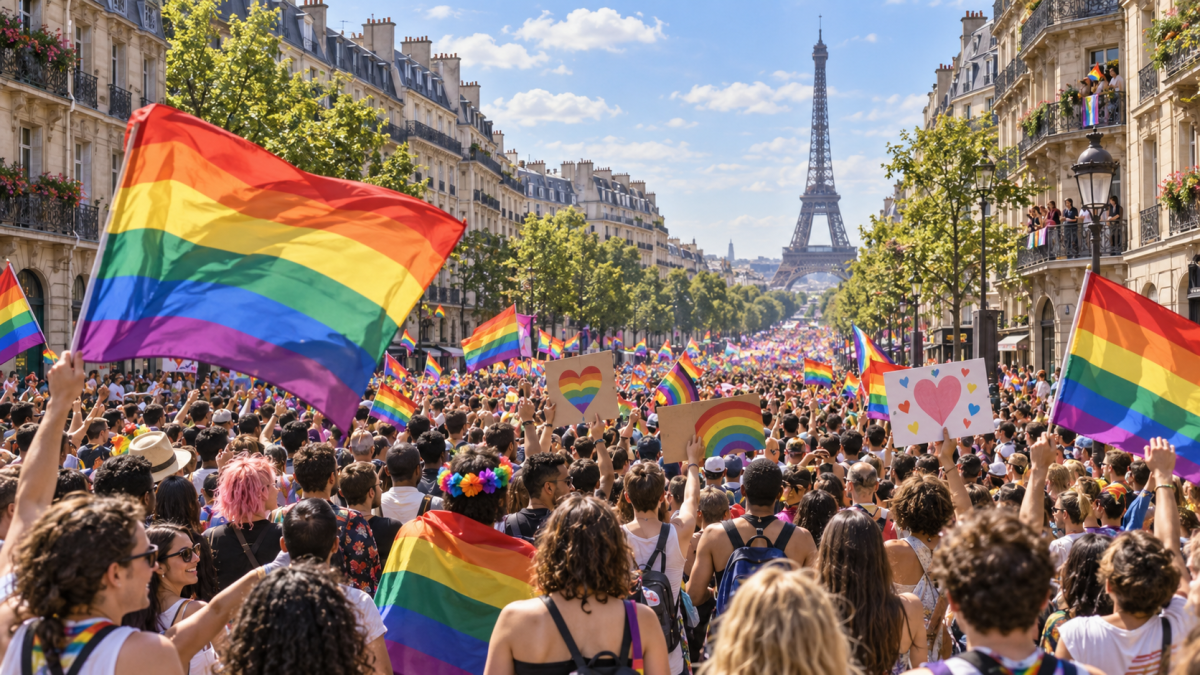
Table of Contents
Paris Pride March Draws Thousands in Defence of LGBTQ+ Rights
Poinews.com – Thousands of demonstrators filled Paris streets for this year’s Pride march, gathering in a show of support for LGBTQ+ rights as concerns grow over the political influence of the far right ahead of France’s presidential election.
The procession began at Place d’Italie in the south of the capital and travelled toward Place de la Bastille in eastern Paris, where a concert was scheduled to close the day. Around 50 associations joined the event, bringing campaigners, community groups and allies together around calls for equality, safety and continued political action.
A call for mobilisation
Alexandre Schon, co-president of Inter-LGBT, the organisation behind the march, placed the event in the context of the approaching election. He urged LGBTQ+ people and their supporters to engage in the political debate and defend a society founded on mutual support.
“We are just a few months away from the presidential election, so we are calling on LGBT+ people and allies to mobilize for a future based on solidarity.”
Schon also warned that opposition to the far right should be a central priority for those attending the march.
“We must stand up against the far right.”
His comments reflected broader unease over the durability of rights that have been won through decades of activism. Schon said LGBTQ+ communities could become future targets, pointing to pressure on LGBT+ rights in other countries, including the United States and Senegal.
“We could be the next targets.”
The march therefore served as both a public celebration of identity and an assertion that legal recognition alone does not remove the need for vigilance. Pride events often bring together music, culture and community, but their roots remain closely tied to protest and demands for equal treatment.
Political figures join the procession
Several politicians from the left took part in the Paris march, among them Jean-Luc Mélenchon, leader of France Unbowed, known as LFI, and Green MP Sandrine Rousseau. Their presence underscored how LGBTQ+ rights have become part of the wider political discussion in France as the country moves closer to a presidential vote.
After joining the event, Mélenchon used X to argue that sexual orientation and gender identity should be treated with understanding rather than prejudice. He called for changes to make gender recognition simpler.
“Sexual orientation or the sense of belonging to a gender are not choices. As long as one hasn’t understood that, one is not a fully realized human being. Rights must follow. Gender freedom must be declarative. The process must be simplified.”
Paris Mayor Emmanuel Grégoire also highlighted the risks that remain for LGBTQ+ people and community venues. His remarks focused on the gap between the visibility of Pride and the reality of discrimination, threats and violence that can still affect people in everyday life.
“LGBTQIA+ venues are still being threatened, attacked, discriminated against, subjected to violence and intimidation.”
In a separate message on X, Grégoire called for LGBTQ+ spaces to be protected and for associations to receive stronger resources. Such organisations can provide practical support, organise cultural and political events, and help maintain the local networks that many people rely on when facing exclusion or hostility.
A march postponed by extreme heat
Paris Pride is normally held in June, but this year’s event was moved to October because of France’s June heatwave. The postponement changed the calendar, not the meaning of the march. Its traditional June timing is connected to the Stonewall riots in New York during the night of 27 to 28 June 1969, a defining mobilisation in the history of the LGBT+ movement.
Remembering that history gives the Paris event a significance beyond a single annual gathering. Pride marches have long been spaces where participants celebrate progress while drawing attention to unfinished struggles, from equal protection and social acceptance to the safety of LGBTQ+ venues and individuals.
The scale of the march has varied sharply depending on the estimate used. Organisers said last year’s event attracted 500,000 participants, while police put the number below 100,000. This year’s gathering again brought thousands into the capital, turning the route between Place d’Italie and Bastille into a highly visible statement of solidarity.
For many who took part, the march was an opportunity to affirm that LGBTQ+ rights are not an abstract political issue. The calls heard in Paris linked the defence of those rights to the protection of community spaces, the work of associations and the expectation that public life should allow people to live openly and safely.
As France approaches its presidential election, the message from the march was clear: Pride remains a place of celebration, but it is also a demand that equality, dignity and freedom remain firmly protected.
Related Reading
Frequently Asked Questions
What is Tens of thousands of people take?
Tens of thousands of people take is the main topic of this guide. The article explains the context, practical details, and next steps readers should understand.
Why does Tens of thousands of people take matter?
Tens of thousands of people take matters because readers are looking for a useful answer, not just a short summary. Good content should match search intent and help them decide what to do next.