
Discovering the birthplace of apples in Kazakhstan’s wild forests
High in the Tian Shan range, where south-eastern Kazakhstan meets Kyrgyzstan, forests of wild apple trees continue to grow on the mountain slopes. These trees

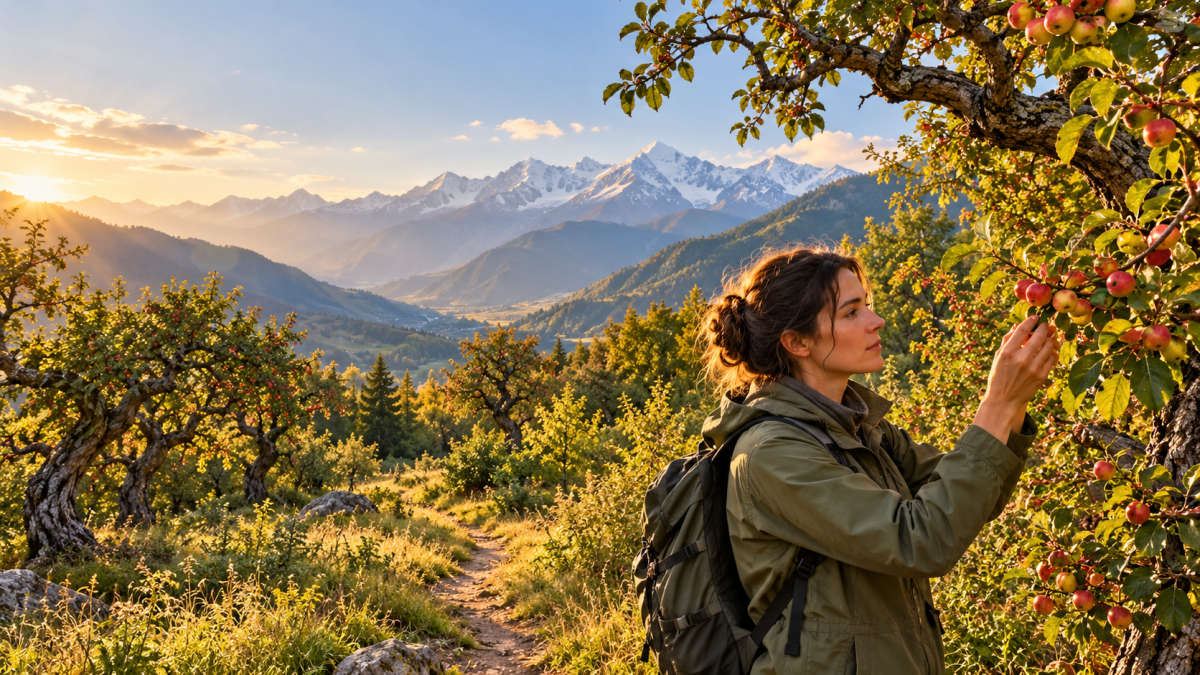
Table of Contents
In Kazakhstan’s Mountains, Wild Apples Reveal Their Ancient Roots
Poinews.com – High in the Tian Shan range, where south-eastern Kazakhstan meets Kyrgyzstan, forests of wild apple trees continue to grow on the mountain slopes. These trees are not simply a striking part of the Central Asian landscape: they belong to a species regarded as a foundational ancestor of the cultivated apples eaten around the world.
The wild Sievers apple, known scientifically as Malus sieversii, has survived for centuries in this mountainous environment. Its story connects Kazakhstan’s forests with orchards, markets and kitchens far beyond Central Asia, tracing a long route shaped first by wildlife and later by human travel.
A genetic link to modern apples
Research into apple genetics has helped explain how cultivated varieties developed. Two wild species were especially important in that transformation: Central Asia’s Malus sieversii and Europe’s Malus sylvestris. Together, their genetic influence can be found in the apples that were gradually selected and grown in orchards over generations.
The Sievers apple takes its name from Johann August Carl Sievers, a German botanist who described the wild apple forests he encountered in the region during the 18th century. Much later, the Soviet scientist Nikolai Vavilov examined Central Asian forests in the 1930s and identified Kazakhstan as the homeland of this remarkable apple species.
“In the 1930s, scientist Nikolai Vavilov studied the forests of Central Asia and established that Kazakhstan is the home of the Sievers apple,” said Gulnara Sitbayeva, Doctor of Biological Sciences.
Genetic findings have reinforced that conclusion. Scientists examined more than 10,000 cultivated apple varieties and found that 46% of the samples contained genetic material linked to the Sievers apple. That evidence supports its role as a progenitor of the modern cultivated apple.
“In one study, scientists analysed more than 10,000 cultivated apple varieties. The fact that 46% of the samples contained genetic material from the Sievers apple provided evidence that it is a progenitor of modern cultivated apples,” she added.
From mountain forests to the Silk Road
Before people began moving apples between regions, birds and animals dispersed their seeds across the Tian Shan slopes. Their movement helped wild apple populations spread through the mountains. Human journeys later extended that process, as apples travelled along Silk Road routes that linked Central Asia with distant communities.
This history remains closely tied to Almaty, Kazakhstan’s largest city, which sits beneath the mountains where wild apple trees have long flourished. In Kazakh, the word alma means apple, and Almaty is traditionally associated with a place abundant in apples. The fruit is woven into the city’s identity rather than serving only as a reference in its name.
Apple imagery appears throughout Almaty in public art, decorative features, murals, sculptures and urban spaces. The motifs offer a visible reminder that the surrounding landscape has helped shape local culture. Over time, cultivated orchards also developed around the region, producing varieties that gained recognition well beyond Kazakhstan.
The enduring appeal of Aport
Among the best-known apples associated with the area is Aport, a variety created through selective breeding. It became famous for its unusually large fruit and recognisable fragrance. For growers, however, Aport also requires careful handling because of its delicate skin.
Ivan Sergeev and his family have cultivated Aport apples for nearly two decades. Their orchard includes both the celebrated cultivated variety and wild Sievers trees, offering a practical contrast between an apple shaped by breeding and one that remains part of the wild mountain ecosystem.
“The aroma of Aport apples is like French perfume. These apples also have very delicate skin, so we harvest the entire crop by hand,” he said.
“My orchard also has Sievers apple trees. The main difference between Sievers and Aport is that Sievers is a wild apple, and the tree can live for 250 to 300 years. Aport trees live for around 40 to 70 years.”
The difference in lifespan illustrates the distinct character of the two trees. Aport is valued for the qualities developed through cultivation, while the wild Sievers apple is notable for its durability and deep connection to the region’s natural heritage.
Harvests, festivals and spring blossom
Apple orchards around Almaty are now also destinations for visitors. During harvest time, some farms welcome people to walk among the trees and pick fruit directly from the branches. The experience brings together agricultural tradition and seasonal tourism while giving visitors a close view of the landscape behind the city’s apple identity.
Almaty’s annual Alma Fest is another major celebration of the crop. Farmers bring apples from their orchards, and visitors can sample the fruit in many forms, including fresh juice, dried slices, jams and other products. More than 200 tonnes of apples were brought to this year’s festival, underlining the scale of the event and the continuing importance of apple growing in the area.
The season of blossom is equally significant. When wild Sievers apple trees flower, their display is considered one of Kazakhstan’s most impressive natural sights and is often compared with Japan’s renowned sakura season. In the Zhetisu region, spring brings a festival dedicated to the blooming trees.
A traditional yurt camp is established for the event, accompanied by national craft exhibitions and workshops. Visitors can watch traditional sports and join other national games, turning the flowering season into a celebration of both nature and cultural heritage.
From the forests of the Tian Shan to the orchards surrounding Almaty, Kazakhstan’s apples carry a story that spans ecology, science, trade and tradition. The wild Sievers apple remains a living link to that history, growing in the same mountain region that helped give rise to one of the world’s most familiar fruits.
Related Reading
Frequently Asked Questions
What is Discovering the birthplace of apples in Kazakhstan?
Discovering the birthplace of apples in Kazakhstan is the main topic of this guide. The article explains the context, practical details, and next steps readers should understand.
Why does Discovering the birthplace of apples in Kazakhstan matter?
Discovering the birthplace of apples in Kazakhstan matters because readers are looking for a useful answer, not just a short summary. Good content should match search intent and help them decide what to do next.