Catching the unknown: The drone designed to hunt other drones
: The drone designed to hunt other drones The Growing Drone Threat in German Airspace Catching the unknown - A recent disruption at Munich airport underscored

Catching the unknown: The drone designed to hunt other drones
The Growing Drone Threat in German Airspace
Poinews.com – A recent disruption at Munich airport underscored the increasing challenges posed by drones. On Saturday morning, a suspected drone sighting caused the diversion of approximately 26 flights, with additional delays rippling through departure schedules. This incident is part of a broader trend, as data from Germany’s air navigation authority, Deutsche Flugsicherung (DFS), reveals 37 drone encounters were recorded in the first three months of 2026 alone. Yet a critical question remains unanswered: who was responsible for these flights?
Tracking the Source: A Challenge in Drone Incidents
In most cases, investigators struggle to determine the operator’s intent behind a drone’s flight. Whether the drone was operated by a casual hobbyist, an untrained pilot, or a potential adversary often remains unclear. Without retrieving the aircraft or identifying its controller, tracing the drone’s origin can be difficult. This uncertainty has prompted the development of advanced solutions to address the problem.
The A1-Falke Interceptor: A New Approach
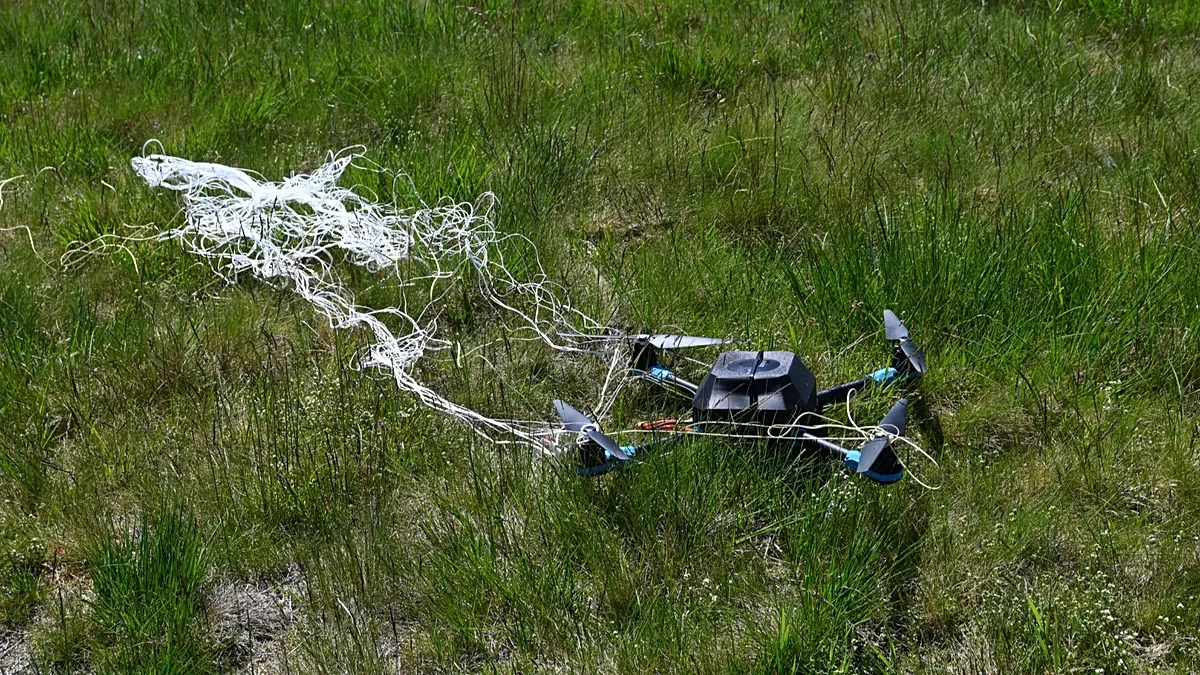
A German company, Argus Interception, has partnered with US-based radar manufacturer Echodyne to create a system designed to neutralize rogue drones. Their A1-Falke interceptor drone does not rely on shooting down targets but instead deploys a net to capture the aircraft mid-air. This method ensures the drone lands safely, preserving its integrity for further analysis. The system’s dual net payloads allow for a second attempt if the first capture fails, enhancing its effectiveness in high-stakes scenarios.
Testing the System in Action
During a recent demonstration near Hamburg, the A1-Falke system was put to the test. A target drone was launched over a training field, followed by the interceptor taking flight. Within moments, a sharp explosion echoed as the net ensnared the drone, bringing it to a controlled stop. Sven Steingräber, co-founder of Argus Interception, explained the system’s purpose: “It was built for situations where a drone strike might be too risky, such as near airports, power plants, or bustling city centers.” The goal, he emphasized, is to intercept drones without causing harm to people or property.
Radar and Interception: A Synergistic Partnership
The collaboration between Echodyne and Argus Interception relies on complementary technologies. Echodyne’s radars act as the system’s “eyes,” identifying and tracking suspicious drones in real time. Once a target is detected, the data is relayed to a command center, which then directs the A1-Falke interceptor. The larger radar system, EchoShield, is capable of monitoring wide airspace areas, while the smaller EchoGuard operates on a more limited scale. Together, they form a layered defense against unauthorized drone activity.
Autonomous Tracking and Human Control
Mounted on the A1-Falke is a specialized radar, EchoFlight, which enables the interceptor to track its target in mid-air. “Once the interceptor is airborne, it locks onto the intruding drone and follows its path,” said Eben Frankenberg, CEO of Echodyne. This air-to-air tracking system allows the A1-Falke to maneuver precisely, ensuring a successful capture. Despite the use of artificial intelligence to assist in navigation, the final decisions are made by human operators, balancing automation with control.
The Strategic Importance of Drone Interception
Steingräber highlighted the growing awareness of drones as tools for surveillance and sabotage. “Modern conflicts often begin with intelligence gathering rather than direct attacks,” he noted. This underscores the need for systems that can intercept drones without triggering chaos. The A1-Falke’s ability to capture and transport drones to secure locations offers a non-lethal alternative, crucial for protecting sensitive sites. “We can retrieve the drone, examine its data, and identify the operator’s intent,” he said, stressing the importance of this capability in both military and civilian contexts.
Ensuring Precision and Safety
The system’s design prioritizes precision over force. By avoiding the use of explosives, the A1-Falke minimizes the risk of debris or collateral damage. This makes it ideal for use in urban areas or near critical infrastructure, where a drone strike could have catastrophic consequences. The ability to control the drone’s landing point also allows authorities to manage the situation with minimal disruption. “This approach gives us the flexibility to respond to threats proportionally,” Frankenberg added, emphasizing the system’s adaptability.
From Detection to Capture: A Seamless Process
The process begins with Echodyne’s radars detecting the drone’s presence, followed by the command center analyzing its trajectory. Once the target is confirmed, the A1-Falke is deployed to intercept. The net’s deployment is a calculated move, designed to ensnare the drone without causing it to crash into nearby structures. This level of control is vital for maintaining safety in environments where even a minor mishap could escalate into a major incident.
Setting the Stage for Future Applications
As drone technology becomes more accessible, the threat it poses to security and infrastructure grows. The A1-Falke system represents a proactive response to this challenge, offering a solution that is both efficient and humane. By combining cutting-edge radar detection with precise interception capabilities, the system bridges a gap in drone management. “This is about more than just stopping a drone,” Steingräber said. “It’s about understanding its purpose and preventing potential disasters before they happen.”
Implications for Aviation and Public Safety
The development of the A1-Falke underscores the evolving nature of air safety. With drones increasingly entering commercial and military airspace, traditional methods of detection and response are no longer sufficient. This new system provides a scalable solution, capable of adapting to different environments. Its success in Hamburg demonstrates the potential for widespread adoption, particularly in regions where drone activity is on the rise. As Steingräber pointed out, the ability to capture drones rather than destroy them is a key advantage, enabling authorities to gather critical intelligence and mitigate risks effectively.
From the moment a drone is spotted, the A1-Falke system ensures a swift and controlled resolution. This not only prevents immediate harm but also supports long-term investigations into drone usage. With continued advancements in technology, such systems may become a standard part of air defense strategies, safeguarding both people and property from the unknown dangers of the skies.