
Greenpeace warns: sea advances, Portuguese coast at risk
A comprehensive new assessment from Greenpeace highlights how Portugal's extensive coastline is increasingly vulnerable to climate pressures combined with

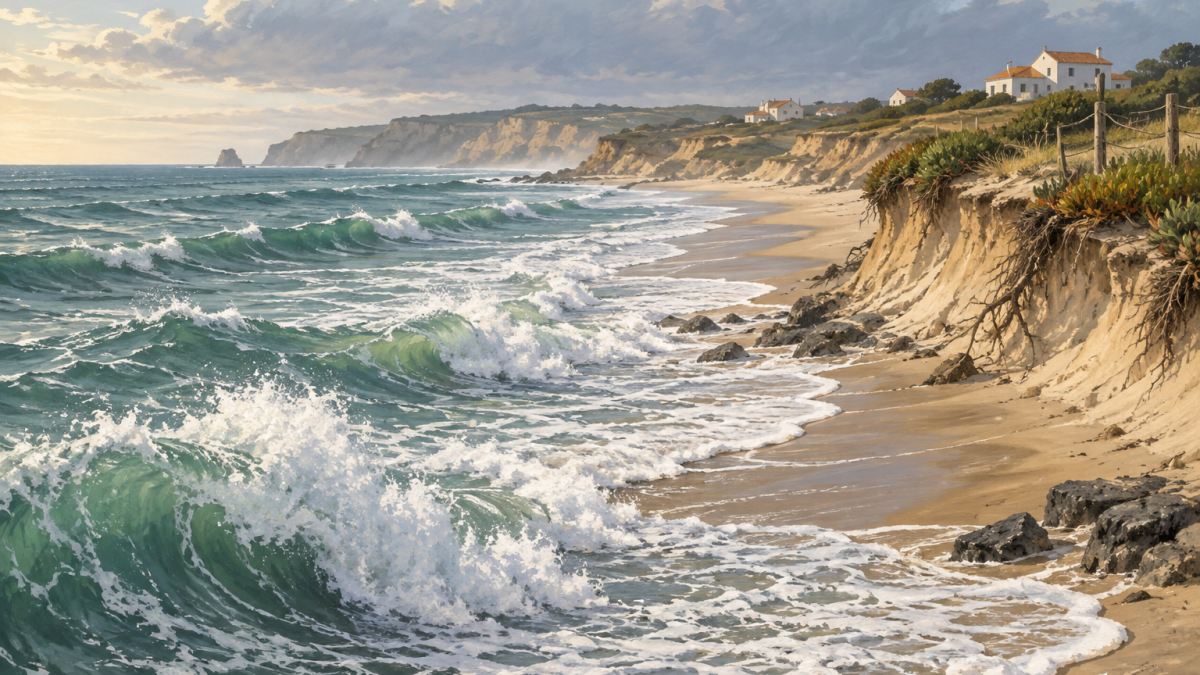
Table of Contents
Portuguese Shorelines Face Mounting Threats as Sea Levels Rise
Poinews.com – A comprehensive new assessment from Greenpeace highlights how Portugal’s extensive coastline is increasingly vulnerable to climate pressures combined with decades of human development. The organization’s latest publication, titled “Destruction All Along the Coast – A portrait of a Portuguese coastline at risk,” outlines multiple dangers threatening the nation’s coastal communities and ecosystems.
Portuguese citizens are already observing visible changes this season. Many popular beaches have noticeably shortened, with sand disappearing at accelerating rates. While coastal retreat is not unprecedented, severe storms earlier this year intensified existing problems. According to Greenpeace findings, shoreline erosion typically spans 10 to 20 meters, though certain locations experience losses reaching 40 meters.
Projections Point to Dramatic Losses
Evaluating Portugal’s 2,500-kilometer stretch of coast from northern to southern boundaries, the report projects that nearly 40 percent of beaches may vanish before the century ends. Greenpeace characterizes the country as having “become the epicentre” of climate consequences due to its lengthy coastline and accelerated sea-level rise exceeding worldwide averages.
The human impact is substantial. More than 100,000 residents currently inhabit zones vulnerable to flooding. Toni Melajoki Roseiro, who leads Greenpeace Portugal, emphasizes urgency: “We cannot keep waiting for a beach to disappear, for a cliff to collapse or for an infrastructure to be at risk before we act.” She advocates for immediate political action to safeguard citizens, wildlife, and shared territory.
Regional Variations in Coastal Decline
Data from the Portuguese Environment Agency reveals that over a quarter of the mainland shoreline has experienced inland sea advancement of up to two meters annually in certain zones. Cascais presents particularly concerning figures, with mean sea levels climbing 9.7 centimeters across twenty-five years.
Looking northward, Espinho records annual retreat of 5.2 meters, while Viana do Castelo has surrendered 30 percent of its beach territory since 1990. Póvoa de Varzim confronts elevated erosion and flooding dangers. Moving toward central regions, Aveiro emerges as critically vulnerable, with Costa Nova potentially losing up to 40 meters within two decades. The Mondego estuary faces inundation of 18 percent by 2100.
The Lisbon metropolitan area and Setúbal Peninsula show significant degradation. Costa da Caparica has shed approximately 200 meters of sand since 1960. Almada carries flood threats to 12 percent of its urban landscape. Lisbon neighborhoods including Algés, Alcântara, and the Baixa district regularly experience water overflow during winter months.
Contributing Factors Beyond Climate Change
While global warming dominates discussions, the report identifies additional pressures. Urban sprawl, tourism growth, intensive building in ecologically sensitive zones, and shoreline artificialization have weakened natural protective systems. Dunes and salt marshes—critical barriers against erosion, flooding, and saltwater penetration—have been diminished or destroyed, amplifying catastrophe potential.
Recent storms illustrated these compounding issues. Heavy precipitation, elevated water levels, insufficient soil absorption, and depleted beach sediments combined to create widespread flooding. Costa de Lavos in Figueira da Foz documented 50 meters of retreat over ten years, while Faro beach narrowed by 25 meters since 1950.
Algarve and Alentejo Under Pressure
Southern Portugal faces severe challenges. The Alentejo coast, increasingly burdened by tourism and urbanization, could lose up to half its beaches by 2100. The Algarve region may see roughly 40 percent of its shorelines disappear. Vilamoura, Quarteira, Vale do Garrão, and Praia da Rocha represent the most critical erosion zones with unstable cliffs. Meanwhile, Tavira Island, the Ria Formosa, Barrinha de Alvor, and Praia do Ancão remain particularly sensitive coastal ecosystems.
Legislative Gaps Remain
Portugal possesses adequate legal frameworks, including the Legal Framework for Territorial Management Instruments (RJIGT). However, implementation inconsistencies and insufficient inter-agency coordination undermine effectiveness when critical decisions must be made.
“We cannot keep waiting for a beach to disappear, for a cliff to collapse or for an infrastructure to be at risk before we act”, argues Toni Melajoki Roseiro, director of Greenpeace Portugal.
Roseiro believes that, given all the knowledge already available, political decisions now need to be taken to “protect people, nature and a territory that belongs to everyone”.
Related Reading
Frequently Asked Questions
What is Greenpeace warns?
Greenpeace warns is the main topic of this guide. The article explains the context, practical details, and next steps readers should understand.
Why does Greenpeace warns matter?
Greenpeace warns matters because readers are looking for a useful answer, not just a short summary. Good content should match search intent and help them decide what to do next.