Germany to order soldiers to Lithuania amid volunteer shortage
Germany is preparing to use compulsory assignments to staff parts of its future permanent military presence in Lithuania after voluntary recruitment did not

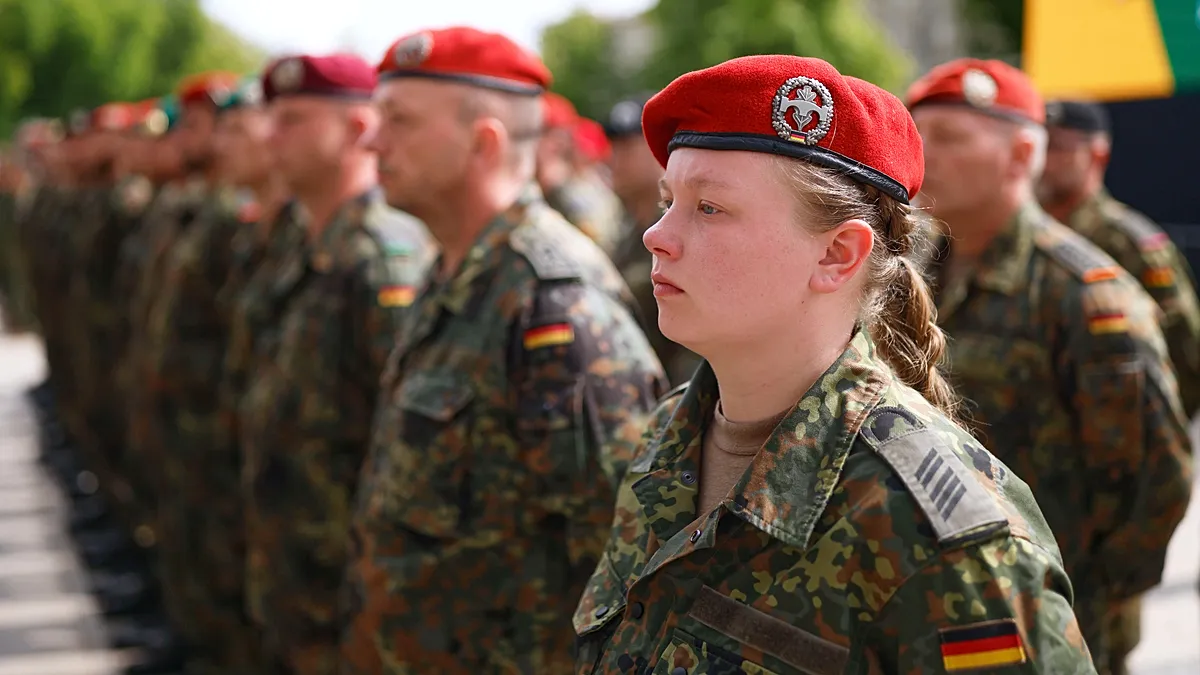
Table of Contents
Germany prepares compulsory postings to reinforce Lithuania brigade
Poinews.com – Germany is preparing to use compulsory assignments to staff parts of its future permanent military presence in Lithuania after voluntary recruitment did not produce enough specialists for every planned role. The first affected Bundeswehr personnel could receive orders to deploy from late September, and as many as 1,000 soldiers may ultimately fall within the scope of the measure.
The decision concerns the 45th Panzer Brigade, which Germany intends to establish permanently in Lithuania by the end of 2027. The formation is expected to comprise roughly 4,800 German soldiers and will be based mainly in Rūdninkai, a location about 30 kilometres from the Belarusian border.
Its deployment forms part of NATO’s presence on the alliance’s eastern flank. A permanent German brigade in Lithuania would represent a significant long-term commitment, requiring not only combat troops but also the technical, logistical and specialist personnel needed to make a large force operational on a daily basis.
Volunteer numbers remain high, but gaps persist
The Ministry of Defence has confirmed that compulsory postings are being considered because volunteer applications have not covered all required positions. Nearly 80% of the brigade’s posts are presently occupied by volunteers, leaving a smaller but important group of vacancies that cannot simply be left unfilled if the unit is to meet its planned timetable.
“According to current forecasts and in view of the continued influx of volunteer applications, the proportion of compulsory appointments is expected to be in the mid three-figure range,”
The ministry indicated that the number of soldiers assigned without volunteering is therefore expected to be several hundred rather than the full potential total of 1,000. Recruitment could still reduce that figure as further applications are received.
“Maintaining the Bundeswehr’s operational readiness is the top priority and is the decisive criterion in all measures.”
Officials also said service members’ individual circumstances would be considered wherever possible when decisions are made. Still, compulsory deployment can create practical consequences for troops and their families, particularly because it provides less certainty and preparation time than an assignment accepted voluntarily.
“In all decisions to be taken, the personal interests of service personnel will be taken into account as far as possible.”
Parliamentary briefing and legal options
Representatives on Germany’s Defence Committee are due to receive a briefing on Monday about the next steps. Soldiers selected for a mandatory posting will be given additional notice and can challenge the decision through the courts.
The planned use of compulsory assignments highlights the difficulty of building a new permanent overseas force while retaining the specialist skills required across the Bundeswehr. A brigade is more than its frontline units: it depends on maintenance teams, communications staff, medical personnel, supply systems and other supporting capabilities. Shortfalls in any of those areas can affect a unit’s ability to function as intended.
Germany already has forces in Lithuania with a staffing level of roughly 92%. These include the multinational battlegroup that has been based there since 2017. The challenge is more pronounced for formations scheduled to relocate later, as they must be assembled and prepared before their move.
Two battalions still face major personnel shortages
Panzer Battalion 203 and Panzergrenadier Battalion 122 are not expected to transfer to Lithuania until 2027. Even with that later deadline, around 40% of the personnel required for those units are still missing. The planned compulsory postings are intended to help close such gaps and keep the broader brigade project on track.
Panzer Battalion 203 has, however, seen substantial interest from volunteers. During the “Freedom Shield” exercise last June, its commander, Lieutenant Colonel Oliver Kaufmann, stressed the importance of deploying soldiers who understand and support the mission.
“I can speak for my battalion, and the majority of soldiers are willing to go to Lithuania voluntarily, and that is exactly what I want: I want soldiers by my side who are convinced of the mission and who, as part of the Panzer Battalion 203 team, take on this responsible task,”
Kaufmann said the battalion had “actually a very high proportion of volunteers.” His remarks illustrate the difference between broad willingness within some units and the more specific problem of ensuring that every necessary post, including specialist roles, is filled.
The brigade’s permanent stationing is designed to place German forces closer to NATO’s eastern border and to provide a sustained presence rather than relying solely on rotating deployments. Rūdninkai’s proximity to Belarus adds particular strategic importance to the assignment, while also increasing the need for a fully staffed, ready force.
For the Bundeswehr, the coming months will test whether continued volunteer applications can limit the use of mandatory postings. For Lithuania and NATO, the key measure will be whether Germany can meet its 2027 target with a brigade capable of carrying out its role from the moment it is fully established.
Related Reading
Frequently Asked Questions
What is Germany to order soldiers to Lithuania?
Germany to order soldiers to Lithuania is the main topic of this guide. The article explains the context, practical details, and next steps readers should understand.
Why does Germany to order soldiers to Lithuania matter?
Germany to order soldiers to Lithuania matters because readers are looking for a useful answer, not just a short summary. Good content should match search intent and help them decide what to do next.