Child’s play: French artist Saype’s giant ephemeral frescoes takeover Swiss alpine resort
Much of Saype's art works revolve around child's play but that doesn't mean to say there's anything simple about it. Childhood observations lie at the heart

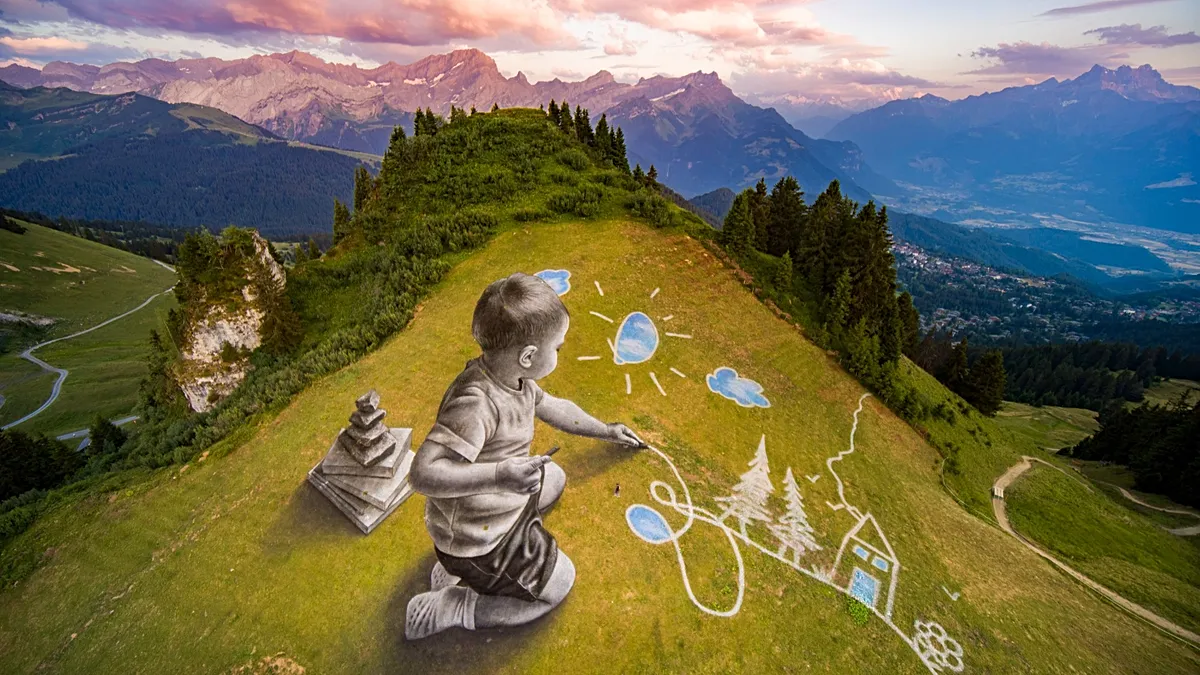
Table of Contents
Child s Play: French Artist Saype’s Giant Ephemeral Frescoes Takeover Swiss Alpine Resort
Poinews.com – Much of Saype’s art works revolve around child’s play but that doesn’t mean to say there’s anything simple about it. Childhood observations lie at the heart of what the French artist describes as a child’s ongoing adventure to become the ‘author of his own destiny,’ but they’re also meant to remind us that possibilities are endless. That’s precisely why Saype has picked the peaks of a Swiss ski resort, Villars-Gryon-Diablerets, to show off his latest pieces; enormous ephemeral frescoes, composed with environmentally-friendly paints and materials.
A Child’s Play of Colors and Nature
Saype, who’s real name is Guillaume Legros, said: “This is the kind of artwork I create all over the world, and it’s part of a series that began four years ago in Villars, where I’ve been crafting a story that spans several years—and it’s usually the children who, year after year, develop or create the story themselves.” Largely made by using chalk and charcoal, Saype’s creations are both compelling and immense. Nature also plays an intrinsic part in the works, highlighting the fragility of the environment and the art’s temporary status.
“The challenge is twofold. It’s physical because there’s a bit of a slope…and there’s the weather, I had to deal with thunderstorms, wind, rain, so that’s always what makes it complicated for me,” explains Saype.
From New York to Nairobi, Saype’s stunning creations have been exhibited around the world on various canvases including grass, earth, sand and snow. Each piece is intended to slowly but deliberately disappear, to emphasise the challenges facing societies and humanity. The ephemeral nature of these works mirrors the fleeting moments of childhood itself, capturing experiences that are precious precisely because they don’t last forever.
The Evolution of Saype’s Artistic Vision
Saype’s second fresco, created at the Bretaye pass, depicts a child drawing the sun and clouds; this drawing is part of a diptych, the other fresco being located a little further down in the resort. “This is the first time I’ve used colour in my drawings. Kids have been inspired by the cosmos, by adventures, and by their observations—and for the first time, they’re putting that into drawings, and the drawings come to life.
That’s why I added colour—it feels as though the sky is reflected in the drawings, and my idea is to convey that the cosmos acts as a kind of window onto the world,” says Saype. Time is running out however if you want to catch sight of Saype’s latest ephemeral creations. The extremely dry conditions in Switzerland have meant the grass has hardly grown but predicted wet weather and storms will fast alter the outlook.
For Saype, the end is always bittersweet but something still worth celebrating. “I love that moment because, ultimately, it’s when nature reclaims what I’ve created. But basically, I think it’ll be visible until the end of August without too many problems.”
Why Saype’s Work Matters Today
The concept of child s play extends beyond mere recreation in Saype’s artistic philosophy. His works invite viewers to reconnect with their inner child, to see the world through fresh eyes unburdened by adult cynicism. The temporary nature of these giant frescoes serves as a metaphor for life itself—beautiful, meaningful, yet inevitably transient.
Visitors to the Swiss alpine resort can witness this unique intersection of art and nature, where the mountains provide a dramatic backdrop for these living canvases. The location was carefully chosen not only for its natural beauty but also for its connection to Saype’s earlier work in the region, creating a continuity that spans multiple years and generations of young participants.
Frequently Asked Questions
When can visitors see Saype’s frescoes? The frescoes are expected to remain visible until the end of August 2026, depending on weather conditions.
What materials does Saype use for his artworks? Saype primarily uses environmentally-friendly paints, chalk, and charcoal to create his ephemeral frescoes on natural surfaces.
Where else has Saype exhibited his work? Saype has created works in numerous locations worldwide, from New York to Nairobi, on various surfaces including grass, earth, sand, and snow.
What makes Saype’s art unique? His works are ephemeral by design, meant to gradually disappear and be reclaimed by nature, emphasizing the temporary nature of both art and childhood experiences.
For more information about Saype’s artistic journey and upcoming exhibitions, visit euronews.com/culture to explore additional articles about contemporary art and cultural events.