The solar system will fall apart far sooner than anyone thought, scientists say
The solar system will fall apart far sooner than scientists once expected, according to new simulations of the Sun’s final evolution. The research suggests

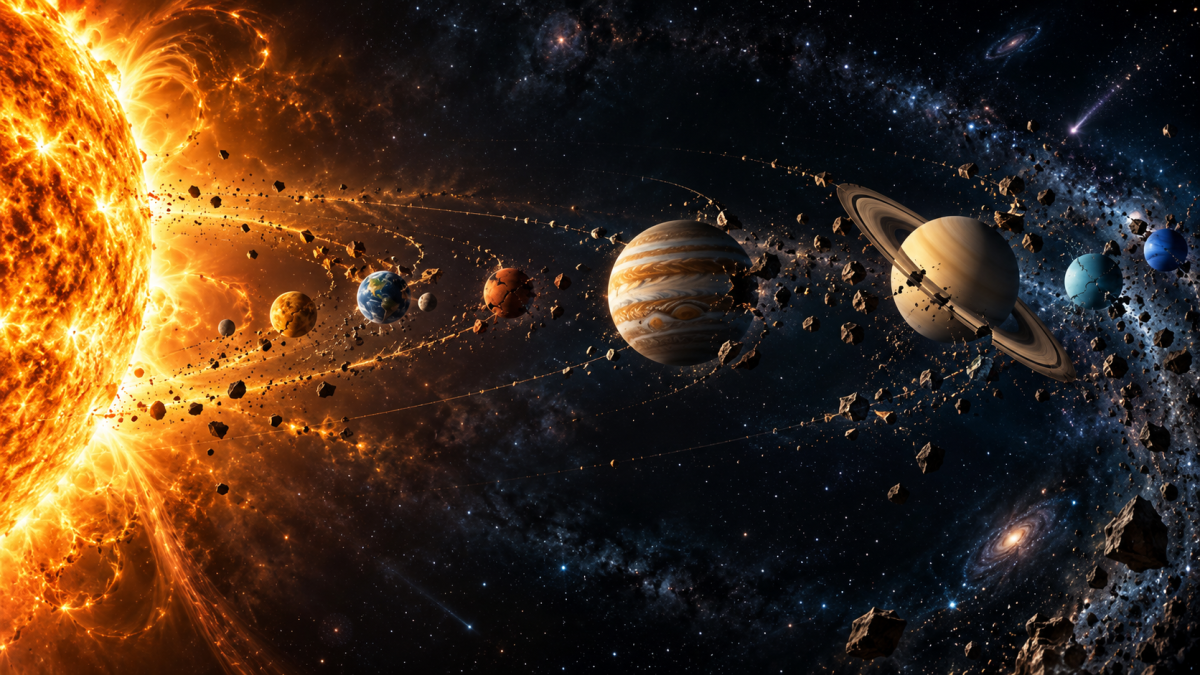
Table of Contents
How the Solar System Could Fall Apart After the Sun Dies
Poinews.com – The solar system will fall apart far sooner than scientists once expected, according to new simulations of the Sun’s final evolution. The research suggests that the outer planets could become unstable about one billion years after the Sun turns into a white dwarf.
For a long time, astronomers considered Jupiter, Saturn, Uranus and Neptune exceptionally stable. Earlier estimates indicated that their orderly orbits might last for around a quintillion years, with disruption more likely to come from a passing star tens of billions of years in the future.
The new study, published in The Astrophysical Journal Letters, reaches a different conclusion. It argues that the Sun’s own uneven loss of material near the end of its life may plant the conditions for orbital chaos among the surviving giant planets.
The Sun’s red giant phase will reshape the planets
The Solar System is about 4.57 billion years old, and the Sun is expected to remain in its current phase for roughly another five billion years. Once it runs out of hydrogen fuel in its core, it will expand into a red giant.
Mercury, Venus and Earth are expected to be engulfed during that expansion. Mars is likely to remain beyond the Sun’s expanded outer atmosphere, while the giant planets will survive at much greater distances.
After shedding its outer layers, the Sun will become a white dwarf: a compact stellar remnant that cools slowly over immense periods. As the Sun loses mass, its weaker gravitational pull will allow the surviving planets’ orbits to expand.
Why the outer planets may become unstable
Previous models generally treated solar mass loss as smooth and gradual. Under that assumption, Jupiter, Saturn, Uranus and Neptune would move outward while preserving a relatively stable arrangement.
The latest calculations examine what happens if that mass loss is irregular. Random bursts of expelled material, described as stochastic kicks, could cause subtle changes in the gravitational relationships between the outer planets.
Those small disturbances may grow over time. Jupiter and Saturn exert powerful gravitational influences, and even modest orbital shifts can affect Uranus and Neptune over billions of years. In this scenario, the solar system will fall into a less predictable state long before outside stars are expected to interfere.
Instability does not mean an immediate planetary collision
The researchers estimate that instability could begin roughly one billion years after the white dwarf forms. That remains unimaginably distant for people today, but it is dramatically earlier than the previously proposed timescale of near-permanent stability.
When the solar system will fall into orbital instability, the planets would not necessarily collide or be expelled at once. Instead, their long-established gravitational balance could break down, allowing close encounters, major orbital changes, collisions or eventual ejections over later periods.
Researchers at the California Institute of Technology used hundreds of N-body simulations to test possible futures for the Sun and the four giant planets. The models tracked how their positions and velocities changed over billions of years under different patterns of solar mass loss.
FAQ: The Solar System’s distant future
Will the Sun destroy Earth?
Earth is expected to be engulfed when the Sun expands into a red giant in about five billion years. The possible instability affecting the outer planets would happen much later, after the Sun has become a white dwarf.
Which planets could survive the Sun’s red giant stage?
Mars is expected to avoid direct engulfment, and Jupiter, Saturn, Uranus and Neptune are expected to survive the Sun’s expansion. Their eventual orbits, however, may become unstable after the Sun loses much of its mass.
Does this mean the Solar System is in danger now?
No. These changes concern events billions of years in the future. The study revises predictions about the distant fate of the planetary system, not the present-day safety of Earth or the other planets.