War is likely to drag on into winter according to Zelenskyy following talks with US envoys
War is likely to drag on into the cold months, President Volodymyr Zelenskyy told reporters in Kyiv on Sunday, closing out a marathon day of negotiations with

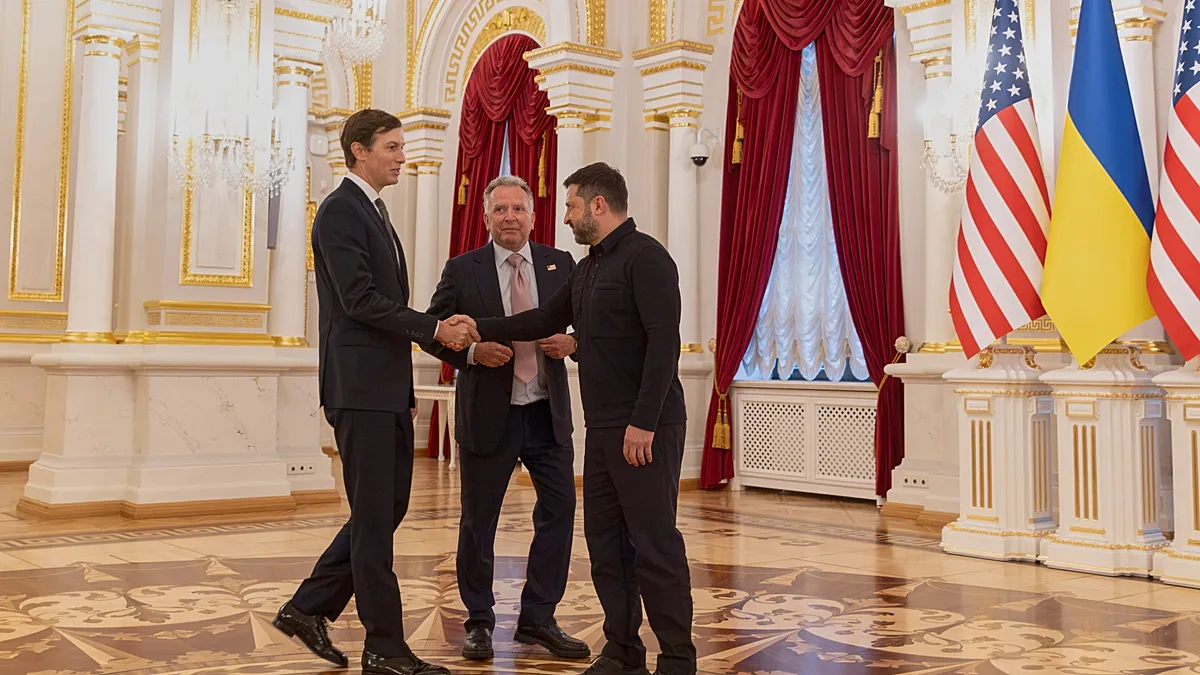
Table of Contents
Zelenskyy: War Likely to Drag Into Winter After US Talks
Poinews.com – War is likely to drag on into the cold months, President Volodymyr Zelenskyy told reporters in Kyiv on Sunday, closing out a marathon day of negotiations with two senior envoys of the Trump administration. The Ukrainian leader’s assessment was blunt: no ceasefire timetable emerged, no territorial concession was tabled, and the grinding attrition that has defined the conflict since February 2022 will, for the foreseeable future, continue through the winter freeze. His remarks followed the first-ever visit to the Ukrainian capital by Jared Kushner and Steve Witkoff, the pair President Donald Trump has installed at the helm of his peace architecture.
“We very much hope that we will be able to reach agreements with our American partners, and we are counting on the support of our European partners if the war continues in winter — and this is how it appears at the moment.”
The final clause carried the weight of the entire weekend. Zelenskyy did not spin the session as a watershed. He offered instead a sober read: the diplomatic gears are turning, yet they have not produced a result capable of pulling Ukrainian soldiers from the mud before the first snowfall. In practical terms, war is likely to drag through another season of frozen trenches and artillery barrages unless a breakthrough arrives in the coming weeks.
What the American Delegation Carried Out of Kyiv
Witkoff, a longtime business ally of Trump’s, characterised the Kyiv session as “substantive” and “meaningful,” adding that the American side felt “very encouraged.” He stopped short of naming any concrete deliverable. Kushner, Trump’s son-in-law and a figure whose foreign-policy role has long blurred the line between family loyalty and statecraft, offered a softer formulation: the trip had surfaced “some new ways to advance forward,” and the delegation had “learned a lot.” Neither man announced a breakthrough. Neither named a date by which negotiations would conclude.
“We think we have the ingredients to get to that place. We’ve had a very meaningful discussion, substantive, important, and we are very encouraged and we look forward to continuing this as long as it takes.”
The pairing of positive adjectives with an absence of specifics pointed to a process still in its exploratory phase rather than one approaching a signed document. The diplomatic track, in short, remains behind the military track, which has been accelerating through the summer.
The Moscow Leg and Parallel Tracks
The Kyiv session was the second stop on a two-city diplomatic sprint. The day before Sunday, Witkoff and Kushner had sat across from President Vladimir Putin in Moscow. The Kremlin’s readout was characteristically terse: the Americans had “put forward a number of ideas on possible routes to a settlement,” and nothing further was disclosed. A White House official, by contrast, told reporters that the Moscow conversation had produced “substantive plans which will be announced in the coming weeks.” The gap between those two characterisations — one opaque, one forward-looking — underscores how little the two capitals have yet agreed on what a settlement would actually look like.
Putin has spent the summer repeating that Moscow intends to occupy the remainder of eastern Ukraine. Ukrainian strikes have intensified over the same period, suggesting that neither side believes the other will blink before the winter freeze sets in. War is likely to drag on along the military front even as diplomats trade pleasantries in adjacent rooms.
European Partners and the Symbolism of Arrival
Zelenskyy made clear that the American conversation was only one thread in a wider European tapestry. Additional sessions with British, German, and French representatives were still under way on Sunday, and the Ukrainian president outlined a further round of talks with European national security advisors. He closed that point with a line aimed at both the room and the cameras: “Here we are all on the same side.” The message was calibrated for European publics, weary of a conflict that has now consumed four years, as much as for any sceptic in Washington who might question whether Europe’s continued financial and military commitment is warranted if American patience shortens.
Logistics added an unintended layer of symbolism to the weekend. Both delegations reached Kyiv by rail, a necessity born of circumstance rather than preference. Ukraine’s airspace has been sealed since February 2022, when Russia launched its full-scale invasion. Although Zelenskyy stated that “everything” had been prepared “to make our airports operational,” ongoing Russian missile and drone strikes on airfield infrastructure mean that commercial and diplomatic flights remain suspended. The train, in other words, became the only viable artery for high-level diplomacy — a small, grim reminder of what the war has already cost in ordinary mobility.
Frequently Asked Questions
When did the Kyiv talks take place? The negotiations with Kushner and Witkoff concluded on a Sunday following a prior session in Moscow the day before. Zelenskyy addressed reporters at the close of the Kyiv session.
Did the talks produce a ceasefire or peace agreement? No. Both sides used positive language — “encouraged,” “substantive,” “meaningful” — but no ceasefire timetable, territorial concession, or signed document was announced. Zelenskyy himself indicated the war is likely to drag into winter.
Who are Jared Kushner and Steve Witkoff, and why were they in Kyiv? Kushner is President Trump’s son-in-law; Witkoff is a longtime business partner of the president. Both have been placed at the centre of Trump’s peace architecture and made their first-ever visit to Kyiv as part of a two-city diplomatic sprint that began in Moscow.
What role do European partners play in the ongoing process? Zelenskyy confirmed that parallel sessions with British, German, and French representatives were under way, followed by further talks with European national security advisors. He stressed that Europe’s continued financial and military support remains essential if the conflict persists through winter.
Why did the delegations travel by train? Ukraine’s airspace has been closed to civilian and diplomatic flights since Russia’s full-scale invasion in February 2022. Ongoing strikes on airfield infrastructure keep commercial operations suspended, making rail the only viable route for high-level delegations.