A fraught push for peace, and a race to fund Ukraine
Efforts to restart talks on the war in Ukraine are gaining renewed attention, but the underlying divisions between Kyiv, Moscow and their partners remain

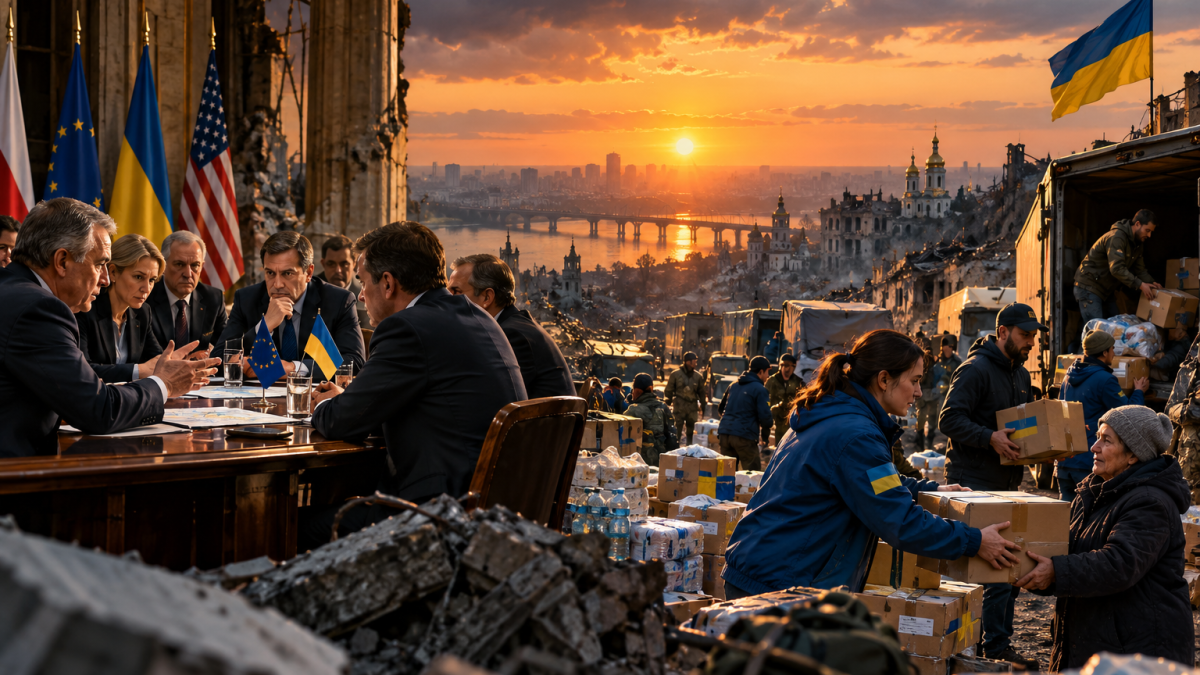
Table of Contents
Diplomacy and financing pressures converge over Ukraine
Poinews.com – Efforts to restart talks on the war in Ukraine are gaining renewed attention, but the underlying divisions between Kyiv, Moscow and their partners remain largely unchanged. At the same time, European leaders are facing an urgent financial question: how to secure the enormous additional support Ukraine says it will need in 2027.
Following a meeting in St Petersburg on Wednesday between Russian President Vladimir Putin and US envoy Steve Witkoff, the Kremlin indicated that it could be ready, in principle, to resume trilateral discussions involving Russia, Ukraine and the United States in the middle of November. Abu Dhabi has emerged as one possible location.
Yet the prospect of another negotiating round has been met with caution. Russia has previously expressed openness to dialogue while maintaining far-reaching demands that Ukraine and its European supporters have rejected. Signals after the St Petersburg meeting suggest that the basic gap between the sides has not narrowed.
Kremlin aide Yuri Ushakov indicated that ideas brought by Witkoff after discussions with President Volodymyr Zelenskyy and European leaders in Oslo contained little that Moscow viewed as useful. Witkoff, for his part, described Putin as a “humanitarian” after an American detainee was released.
Questions over the shape of future talks
Any renewed process would unfold against the backdrop of serious legal and political disputes. Putin is wanted by the International Criminal Court in connection with allegations concerning the unlawful deportation and transfer of at least 20,000 Ukrainian children. Russia rejects the court’s jurisdiction, while Ukraine and many of its allies have made accountability a central element of their position.
A separate meeting involving US President Donald Trump, Putin and Chinese President Xi Jinping has also been considered. Such a gathering could address Ukraine’s future without Kyiv participating directly, although it remains uncertain whether it will occur or how it would relate to the mooted trilateral negotiations.
Ukraine’s stated position remains that a ceasefire could be possible along the existing front line without accepting Russia’s sovereignty over occupied Ukrainian territory. Zelenskyy reiterated that view in comments to Fox News, drawing a distinction between halting active hostilities and legally recognising territorial changes imposed by force.
Ukraine could accept a ceasefire along the current front lines without recognising Russian sovereignty over occupied territory.
That distinction is essential for Kyiv. A ceasefire can freeze fighting, but it does not automatically resolve questions of borders, security guarantees, reconstruction or the status of people living under occupation. These unresolved issues help explain why a fresh burst of diplomatic activity has not yet produced evidence of a lasting settlement.
Finland’s president enters the discussion
Finnish President Alexander Stubb has become one of the European figures mentioned in connection with possible future peace efforts. Alongside Norway’s leader, Stubb played a prominent part in this week’s Oslo discussions, and his name has been floated as a potential European Union representative for negotiations.
Russia has signalled that it could accept his involvement, but Kremlin spokesperson Dmitry Peskov attached a condition: Stubb should not merely echo the European position on Ukraine. The demand underlines the political tensions already surrounding the possible format of negotiations and who gets to define their terms.
Criticism of Washington’s approach has also intensified. Retired US Army lieutenant general Ben Hodges accused Trump of aligning himself with Russia and weakening Ukraine’s capacity for self-defence.
“He was never going to support Ukraine, and was going to take the Russian side, the signs were all there.”
Hodges added that he does not trust the US administration. His remarks reflect wider concern among some supporters of Ukraine that diplomatic pressure could produce a settlement weighted towards Moscow’s demands rather than one accepted by Kyiv.
Europe confronts a €70 billion funding challenge
The diplomacy is now closely linked to the European Union’s internal battle over its next long-term budget. An extraordinary summit initially intended to move budget discussions forward has been expanded into a two-day meeting on 26 and 27 November, with Ukraine added to the agenda.
Zelenskyy has requested an additional €70 billion in military and financial aid for 2027. EU leaders have agreed that the funding shortfall must be addressed, but Brussels is pressing other partners—including the United Kingdom, Canada, Norway, Australia and Japan—to contribute more so that the bloc does not shoulder the largest share alone.
The European Commission’s next task is to establish how much of the €70 billion must be covered by the EU. That assessment will shape the financing choices available to member states. Joint borrowing is widely viewed as the most likely route, although high borrowing costs make it politically and financially difficult.
The issue is especially sensitive because it is arriving during an already contentious debate over the EU’s next multiannual budget. Member states remain divided between the so-called Frugals, who favour tighter spending, and the Friends of Cohesion, who place greater emphasis on common investment and support for less affluent regions.
Costa seeks a budget compromise
European Council President António Costa is expected to present a fresh compromise before the November summit. The broader budget negotiations have made little visible progress, despite the pressure created by the approaching deadline.
“For Europe’s stability, we must approve our next long-term budget by the end of this year.”
Costa’s proposal is expected to focus closely on new own resources: EU-wide revenue measures designed to provide the budget with additional income. The debate over these measures goes beyond accounting. It concerns whether the Union can develop more predictable shared funding at a time when security, defence and support for Ukraine are demanding greater resources.
Diplomats remain split over whether Ukraine financing and the EU budget should be negotiated together or separately. Combining them could create leverage for a broader agreement, but it could also make compromise harder by tying two politically charged subjects to one another.
France’s presidential election next year adds another source of uncertainty to the discussion. With national politics affecting leaders’ room for manoeuvre, the coming weeks may determine whether the EU can unite behind a credible funding plan while diplomatic initiatives over the war continue to test the limits of international consensus.
Related Reading
Frequently Asked Questions
What is A fraught push for peace?
A fraught push for peace is the main topic of this guide. The article explains the context, practical details, and next steps readers should understand.
Why does A fraught push for peace matter?
A fraught push for peace matters because readers are looking for a useful answer, not just a short summary. Good content should match search intent and help them decide what to do next.