Dutch police clash with hundreds of far-right protesters at anti-immigration rally
Riot police moved to clear hundreds of far-right demonstrators from central The Hague on Saturday after an anti-immigration rally descended into violence

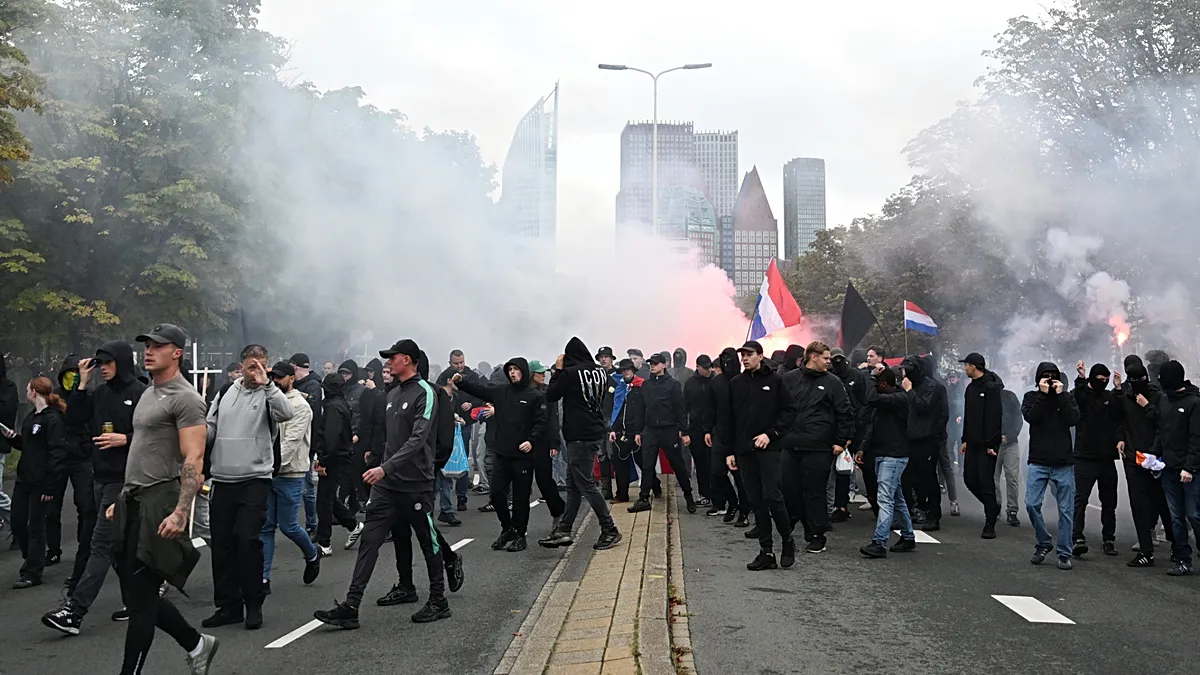
Table of Contents
Police use water cannon as anti-immigration protest turns violent in The Hague
Poinews.com – Riot police moved to clear hundreds of far-right demonstrators from central The Hague on Saturday after an anti-immigration rally descended into violence, with officers facing fireworks, projectiles and hate-filled chants.
About 500 people gathered for the “We Are The People” demonstration at the Malieveld, a large park near the city centre. The event was organised in opposition to Dutch government policies on immigration and asylum. What began as a political protest escalated into confrontations that required a substantial police response.
Authorities deployed baton charges, police dogs and water cannon in an effort to break up the crowd. Mounted officers also took part in the operation, making several arrests as they restored control of the area.
March prohibited after disorder breaks out
Demonstrators had planned to continue through The Hague in a march, but local authorities stopped the procession from going ahead. Once clashes began at the Malieveld, the crowd was ordered to disperse.
The violence included the throwing of fireworks and other objects at police. Some participants were heard shouting anti-Semitic slogans and making Nazi salutes, turning the event into a public-order incident with a clear hate-speech element as well as an anti-immigration message.
The use of specialised units underscored the scale of the disorder. Water cannon and mounted policing are measures generally used to push back crowds and create space for officers when ordinary dispersal orders fail to bring a volatile gathering under control.
Protesters voice fears over migration
Among those at the rally was 31-year-old mechanic Thijs Jansen, who expressed his concerns about immigration in stark terms.
“We’re losing our country. We’re literally losing our country to mass migration,”
The statement reflected the central grievance of the protest, which focused on immigration and asylum policy. But the violence directed at officers, along with anti-Semitic chanting and Nazi gestures, went far beyond peaceful political expression and prompted strong condemnation from the government.
Public demonstrations can provide a place for citizens to challenge policy and voice anxieties. Dutch authorities, however, can impose restrictions on routes and gatherings when there are public-safety concerns. In this case, the planned march was banned and police ultimately intervened after disorder emerged at the park.
Justice minister calls for firm action
Justice Minister David van Weel criticised the scenes in a post on X, describing them as “disgusting” and arguing that violence targeting law enforcement and the use of hate speech should be met with an “extremely firm” response.
“Thanks to all the police officers who are once again standing up for our democratic rule of law,”
Van Weel’s message placed the police response in the context of protecting democratic order. The intervention was not solely about ending an unauthorised march; it also followed attacks on officers and behaviour that included openly anti-Semitic expression.
Saturday’s events also renewed attention on a pattern of unrest linked to right-wing demonstrations in The Hague. A year earlier, violence at another such protest saw rioters set a police vehicle alight and target the headquarters of the centrist D66 party.
D66 is currently led by Prime Minister Rob Jetten. The earlier attack on the party’s offices demonstrated how political tensions can spill from a street demonstration into intimidation aimed at political institutions and their representatives.
A test for public order and political debate
The Hague is the seat of the Dutch government and a central location for national political activity, making disorder in the city particularly significant. Demonstrations there often take place close to institutions associated with decision-making, public administration and democratic representation.
The latest rally brought together two distinct issues that authorities must address at once: the right to demonstrate and the need to prevent violence, intimidation and hate speech. Debate over asylum and migration remains politically charged, but the scenes at the Malieveld showed the risks when a demonstration crosses into direct confrontation with police.
For residents and visitors, the immediate effect was a major police operation in a prominent public space. For the authorities, the incident will likely reinforce the importance of conditions placed on demonstrations, including route restrictions, dispersal orders and the readiness to intervene when officers or members of the public are endangered.
Saturday’s clash leaves a familiar challenge for Dutch public life: allowing contentious political views to be expressed while ensuring that rallies do not become vehicles for violence or extremist symbolism. The arrests and police response at the Malieveld marked the most immediate answer to that challenge, while the wider debate over immigration and asylum policy continues.
Related Reading
Frequently Asked Questions
What is Dutch police clash with hundreds of far?
Dutch police clash with hundreds of far is the main topic of this guide. The article explains the context, practical details, and next steps readers should understand.
Why does Dutch police clash with hundreds of far matter?
Dutch police clash with hundreds of far matters because readers are looking for a useful answer, not just a short summary. Good content should match search intent and help them decide what to do next.