Portuguese and Spanish unions in talks over ‘Iberian general strike’
Trade union leaders in Portugal and Spain are discussing whether a planned Spanish general strike on 11 November could become a coordinated mobilisation

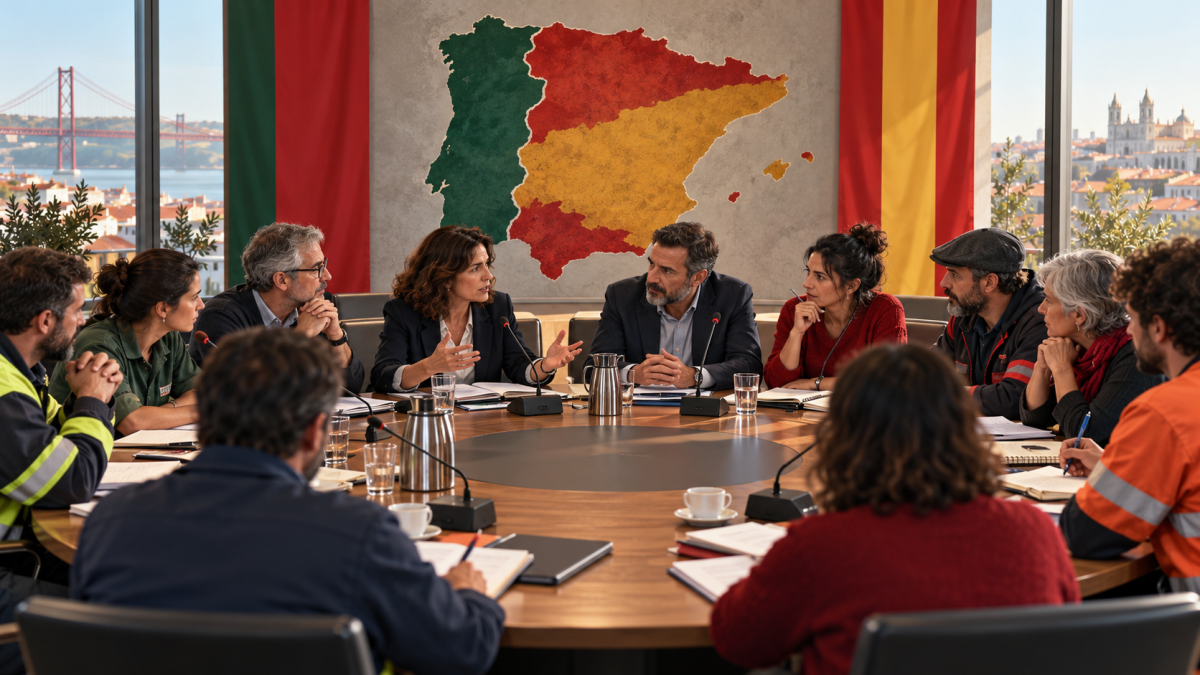
Table of Contents
Portuguese and Spanish unions explore coordinated action on 11 November
Poinews.com – Trade union leaders in Portugal and Spain are discussing whether a planned Spanish general strike on 11 November could become a coordinated mobilisation across the Iberian Peninsula. The prospect would bring workers in both neighbouring countries into a shared day of industrial action focused on pressure over housing and the rising cost of living.
Unai Sordo, secretary-general of Spain’s Comisiones Obreras (CCOO), said Portuguese unions are considering their own general strike for the same date. In Spain, the stoppage already has the support of the country’s two main union confederations, CCOO and the General Workers’ Union (UGT).
The idea is to turn two potentially separate national actions into what Sordo described as an “Iberian general strike”. Any decision, however, remains with Portugal’s labour organisations.
“It is up to the Portuguese to decide whether, in the end, we join forces in a mobilisation across the Iberian Peninsula that would also be historic.”
A shared date, but separate decisions
The 11 November strike in Spain has been expected for several weeks. It was set for 18 days before the snap election called by Prime Minister Pedro Sánchez, following parliament’s rejection of government measures intended to address the housing crisis.
That political timetable has given the planned strike added significance. Housing affordability has become a prominent concern in major Spanish cities, where many residents say paid work no longer guarantees they can secure a home to rent.
Portugal faces closely related pressures. Demonstrations in Lisbon and Porto have highlighted the difficulty of finding decent, reasonably priced housing in the country’s larger urban areas. The concerns expressed by protesters mirror those heard across the border: rents and living costs have risen to levels that many workers struggle to meet.
A joint day of action would not erase the different political and union structures in each country. Portuguese organisations would determine their own demands and strategy. But a strike occurring simultaneously in both nations could underline the extent to which housing insecurity and household financial pressure have become cross-border issues on the peninsula.
Housing protests spread from Madrid
Recent mobilisation in Portugal drew inspiration from protests that began in late September at Puerta del Sol, one of Madrid’s best-known public squares. Thousands of people later spent nights camping in central areas of Lisbon and Porto, bringing the debate over affordable homes visibly into city centres.
These actions have centred on a straightforward complaint: employment is increasingly insufficient to make rent affordable in large cities. For workers, students and families seeking accommodation, the issue is not simply whether homes exist, but whether available properties can be rented without consuming an unsustainable share of income.
The unions’ discussions therefore sit within a wider wave of public frustration. A general strike is a different form of pressure from a street protest, involving organised workplaces and labour confederations rather than only demonstrations in public squares. If Portuguese unions choose the same date, the message could be amplified by the combined scale of action in both countries.
The “Saramago strike” remark
Sordo referred humorously to a possible coordinated stoppage as the “Saramago strike”, invoking José Saramago, the only Portuguese author to receive the Nobel Prize in Literature. Saramago spent almost two decades living in Lanzarote, in Spain’s Canary Islands, and maintained close ties to progressive movements during his life.
“If they hold [the strike] in Portugal, we are going to call it the Saramago strike.”
The reference captures the cultural links between Portugal and Spain while also stressing the symbolic ambition behind the proposal. An Iberian-wide mobilisation would be unusual in its scope, but its practical outcome depends on whether Portuguese unions formally call workers out on 11 November.
For now, the Spanish strike remains scheduled, while discussions continue on the Portuguese side. The central question is whether unions in both countries can transform shared anger over housing and living costs into a single coordinated day of action.
Related Reading
Frequently Asked Questions
What is Portuguese and Spanish unions in talks?
Portuguese and Spanish unions in talks is the main topic of this guide. The article explains the context, practical details, and next steps readers should understand.
Why does Portuguese and Spanish unions in talks matter?
Portuguese and Spanish unions in talks matters because readers are looking for a useful answer, not just a short summary. Good content should match search intent and help them decide what to do next.