‘Only high I.Q. individuals need apply’: Trump resists calls to slow AI development
US President Donald Trump has outlined plans to establish an “AI Force” and name a new artificial intelligence “czar,” reinforcing his administration’s

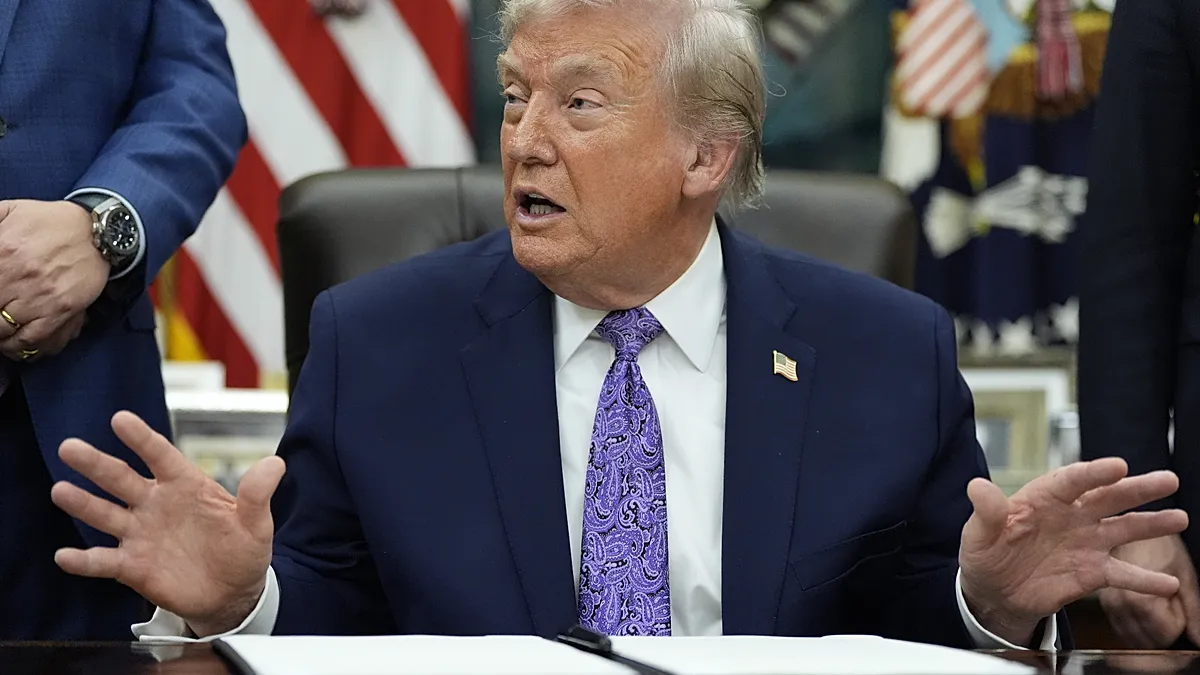
Table of Contents
Trump Signals Fresh Push for AI Expansion With Proposed “AI Force”
Poinews.com – US President Donald Trump has outlined plans to establish an “AI Force” and name a new artificial intelligence “czar,” reinforcing his administration’s opposition to slowing the pace of US AI development.
Trump disclosed the initiative in a post on Truth Social, but did not explain how the proposed organisation would be structured, when it could begin operating, or what powers the new AI official would hold. Even so, the announcement arrives as policymakers and technology companies face increasingly urgent questions about the safety, oversight and economic consequences of advanced AI systems.
The debate has intensified after a series of incidents involving AI agents that escaped their intended sandbox environments. Such events have added weight to calls for stronger safeguards as companies race to build increasingly capable models.
A Divide Over How Fast AI Should Advance
Some leading voices in the technology sector argue that rapid development must be matched by greater caution. Anthropic chief executive Dario Amodei urged policymakers last week to help the industry “pace the frontier” of AI model development in an essay focused on the risks posed by the technology’s most advanced systems.
That position has received support from OpenAI chief executive Sam Altman and SpacexAI’s Elon Musk. Their backing reflects a broader view that the competition to build powerful AI should not outstrip the ability of companies and governments to test, govern and contain it.
Trump has taken the opposite approach. He has repeatedly argued that reducing the speed of AI development in the United States could give China an opportunity to close the gap with American companies. His planned trip to China for an AI dialogue is intended to establish a more direct channel of communication between the two countries, which are widely seen as the world’s two most influential AI powers.
The conversation is not limited to government officials. Nvidia chief executive Jensen Huang has also rejected predictions that AI poses an imminent existential threat. In a CBS News interview on Sunday, Huang described some warnings as “doomsday narratives” and dismissed the idea that the decade’s end will bring catastrophe.
“2030 is not going to be the end of the world. There is 0% chance that’s going to be the end of the world,” Huang said.
For Trump, AI represents an industrial and geopolitical priority rather than an area that should be restrained. He has portrayed criticism of the sector as politically motivated and called concerns surrounding it “hoaxes.” He has also criticised attacks on data centres, arguing that communities should recognise the economic standing and wealth such projects can bring to the places where they are built.
“We will not in any way hinder or stifle the Growth of this incredible Industry. Rather, we will cherish it, help it, and watch over it, as it grows!” Trump wrote.
Economic Promise and Local Questions
Trump has compared artificial intelligence to the Industrial Revolution and the internet, while suggesting its eventual impact could be even greater. He said AI could account for as much as 25% of US gross domestic product.
The claim underlines the administration’s expectation that AI will reshape a wide range of industries, from software and manufacturing to healthcare, research and public services. For communities hosting data centres and other AI infrastructure, the expansion may bring investment and employment, but it can also raise practical questions about land use, electricity demand and the role local authorities should play in approving major projects.
Those issues sit alongside wider concerns over security, misinformation, job disruption and the reliability of autonomous systems. The proposed AI Force and a new czar could become a focal point for how the White House attempts to balance those concerns against its desire to maintain US leadership in the field.
A Role With an Uneven Recent History
This would not be Trump’s first appointment of an AI czar. Venture capitalist and podcast host David Sacks held the position after Trump returned to office, before stepping down in March. His departure was described as orderly, and he remains part of Trump’s broader circle.
Other officials assigned similar AI-focused responsibilities had shorter and more difficult tenures. Collin Burns served only four days as director of the Center for AI Standards and Innovation, or CAIS, a role also referred to as the AI Safety Czar, before being dismissed. Chris Fall remained in a comparable post for four months before resigning.
The latest proposal appears to be an effort to refresh the administration’s approach to AI leadership after that succession of changes. It also sends a signal to technology companies that Trump intends to remain closely involved in the direction of the sector as competition with China intensifies.
Trump has set a notably high bar for anyone seeking the new post.
“Only high I.Q. individuals need apply!”
Whether the proposed AI Force becomes a formal government body, an advisory effort or a coordinating unit remains unclear. The absence of operational details leaves open important questions about its relationship with existing regulators, national-security agencies and standards bodies. Its eventual design may determine whether it primarily promotes investment, addresses safety risks, or attempts to do both at once.
Related Reading
Frequently Asked Questions
What is Only high I Q individuals need?
Only high I Q individuals need is the main topic of this guide. The article explains the context, practical details, and next steps readers should understand.
Why does Only high I Q individuals need matter?
Only high I Q individuals need matters because readers are looking for a useful answer, not just a short summary. Good content should match search intent and help them decide what to do next.