‘Excellent profit’: Meet the Bavarian hop farmer securing his harvest and income with solar ‘hats’
For Josef Wimmer, a fourth-generation hop grower in Bavaria's Hallertau region, the phrase excellent profit is no longer a distant aspiration but a measurable

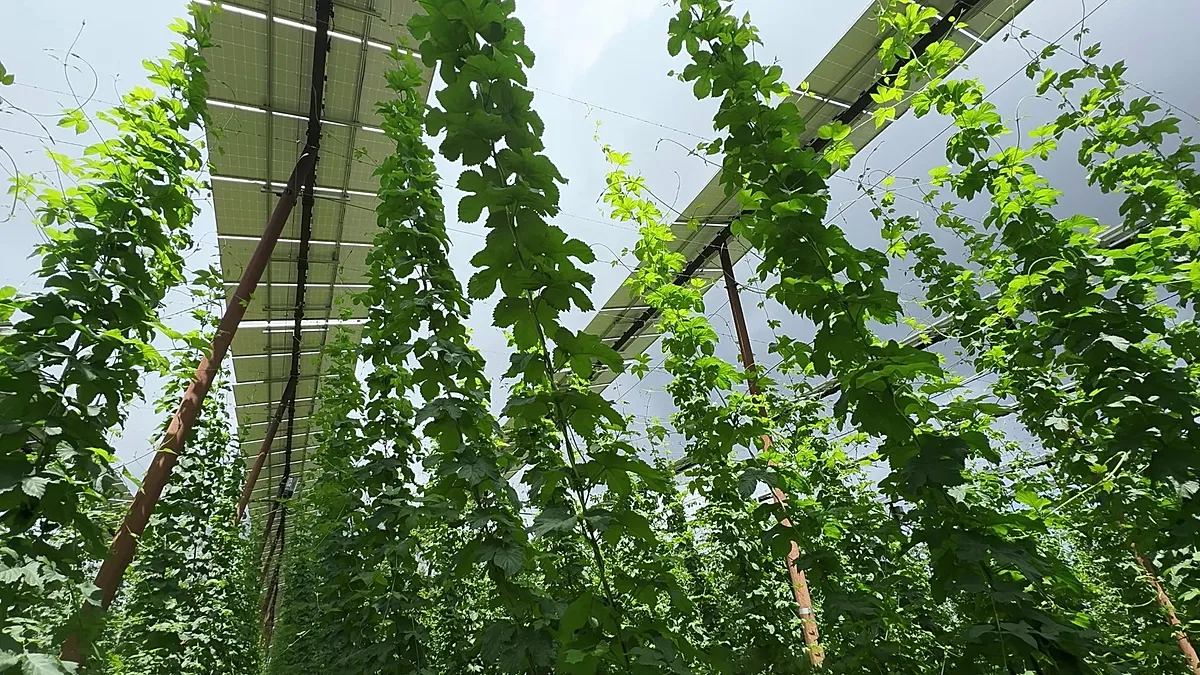
Table of Contents
Excellent Profit: Solar ‘Hats’ Save Bavarian Hop Farms
Poinews.com – For Josef Wimmer, a fourth-generation hop grower in Bavaria’s Hallertau region, the phrase excellent profit is no longer a distant aspiration but a measurable reality. By suspending photovoltaic panels seven metres above his trellises, he has turned what was once a climate-vulnerable crop into a dual-purpose energy asset. Yet his story sits against a grim backdrop: Germany’s hop sector has shed roughly 40 per cent of its farms over the past twenty years, leaving just over 900 specialist businesses as of 2026. The structural collapse of small and family-run operations has even acquired a German label – Höfesterben – capturing how climate stress, collapsing beer prices, and shrinking demand are hollowing out one of Europe’s oldest agricultural traditions.
Climate Pressure on Germany’s Hop Belt
Bavaria accounts for 86 per cent of national hop production and approximately one third of global output, making the region’s vulnerability a matter of international consequence. The Hallertau, the world’s largest contiguous hop-growing zone with roots stretching back to at least 860 AD, still hosts 722 of Germany’s remaining hop farms. Rising temperatures, prolonged water shortages, and drying soils are squeezing yields precisely when the crop most needs consistent moisture during June through August.
“The years are getting hotter and drier,” Wimmer told Euronews Earth from his small hamlet of Neuhub near Osseltshausen. Heat suppresses alpha-acid synthesis – the compound responsible for beer’s aromatic bitterness – while drought-driven soil degradation can trigger catastrophic yield losses. For a farmer whose cultural identity is woven into school holidays timed around harvest and crowned with “hop queens,” the stakes extend well beyond the balance sheet.
Wimmer’s Agri-PV Solution
The remedy took shape after Wimmer installed rooftop solar in 2009 and watched its performance for a decade. Around 2016 he conceived of shading his hops with elevated photovoltaic modules, reasoning that the plant – naturally shade-tolerant – would benefit from reduced direct radiation while the panels simultaneously generated farm-scale electricity. Neighbours were sceptical; local councillors, district officials, and eventually ministers from Munich queued up to inspect the structure after every major storm. To date, nothing has been blown away.
“There were voices saying ‘Wimmer’s lost it now, that’ll never work!’ When we started building, we became the hot spot of the Hallertau. Everyone came by to have a look.” – Josef Wimmer
The initial installation covered five hectares and delivers two megawatts at peak output. Wimmer now plans to extend the canopy across more than 20 hectares and integrate a one-megawatt battery storage unit. A five-kilometre power cable is being laid to connect the array to a substation capable of feeding surplus energy into the grid.
Engineering the right balance proved far from trivial. Bernhard Gruber, a former Airbus engineer who joined the project after two years of planning and permitting negotiations, modelled daily and seasonal solar geometry alongside hourly power-price fluctuations. The original 20-degree panel tilt produced excessive shade in the upper canopy zone, encouraging bushy vegetative growth at the expense of cone formation. After iterative adjustments, Gruber settled on a 45-degree angle: slightly less direct irradiance for the modules, but materially more cones from the hops.
The counterintuitive result is that the steeper configuration earns Wimmer excellent profit despite generating fewer kilowatt-hours than a near-flat array would. Meanwhile, a moisture sensor embedded among the trellises – sampling both surface and subsurface levels – confirms that soil has become measurably wetter since installation. Evaporation drops, rainfall water is retained longer, and the crop receives precisely the hydration it demands during peak growth months.
“Long approval procedures are a problem,” Gruber noted. “They put some farmers off going for agri-PV on a larger scale, because the bureaucratic effort is simply too great.” He urged regulators to streamline decisions for specialty crops like hops, arguing that the agricultural and energy benefits justify faster permitting pathways.
Practical FAQ
Can any hop farmer replicate Wimmer’s system? In principle yes, but scale matters. The five-hectare prototype required roughly two years of planning, environmental review, and grid-connection negotiations before construction began. Smaller holdings may find the capital outlay and permitting burden disproportionate unless regional cooperatives pool resources.
How much shade do hops actually need? Wimmer’s trial-and-error process showed that too much shade (the original 20-degree tilt) suppresses cone production. The final 45-degree configuration allows enough direct light for photosynthesis while cutting peak-temperature stress. Exact angles will vary with latitude, trellis height, and local microclimate.
What energy output can a farmer expect? Wimmer’s five-hectare array peaks at two megawatts. Expansion beyond 20 hectares plus one megawatt of battery storage is planned, though actual net revenue depends on feed-in tariffs, time-of-use pricing, and the proportion of energy consumed on-farm versus exported.
Is agri-PV approved for other specialty crops? Gruber’s team has modelled outcomes for several high-value horticultural and viticultural systems. The core trade-off – panel tilt versus crop light demand – is universal, but optimal geometry shifts with species. Regulators in Bavaria have signalled openness to case-by-case approvals once safety and grid-impact assessments are complete.
Related Reading
Frequently Asked Questions
What is Excellent profit?
Excellent profit is the main topic of this guide. The article explains the context, practical details, and next steps readers should understand.
Why does Excellent profit matter?
Excellent profit matters because readers are looking for a useful answer, not just a short summary. Good content should match search intent and help them decide what to do next.