Mount Etna lightning strike kills hiker from the US
A Mount Etna lightning strike killed a 29-year-old American visitor on Sunday as a violent thunderstorm swept over Sicily's most active volcano. The man was

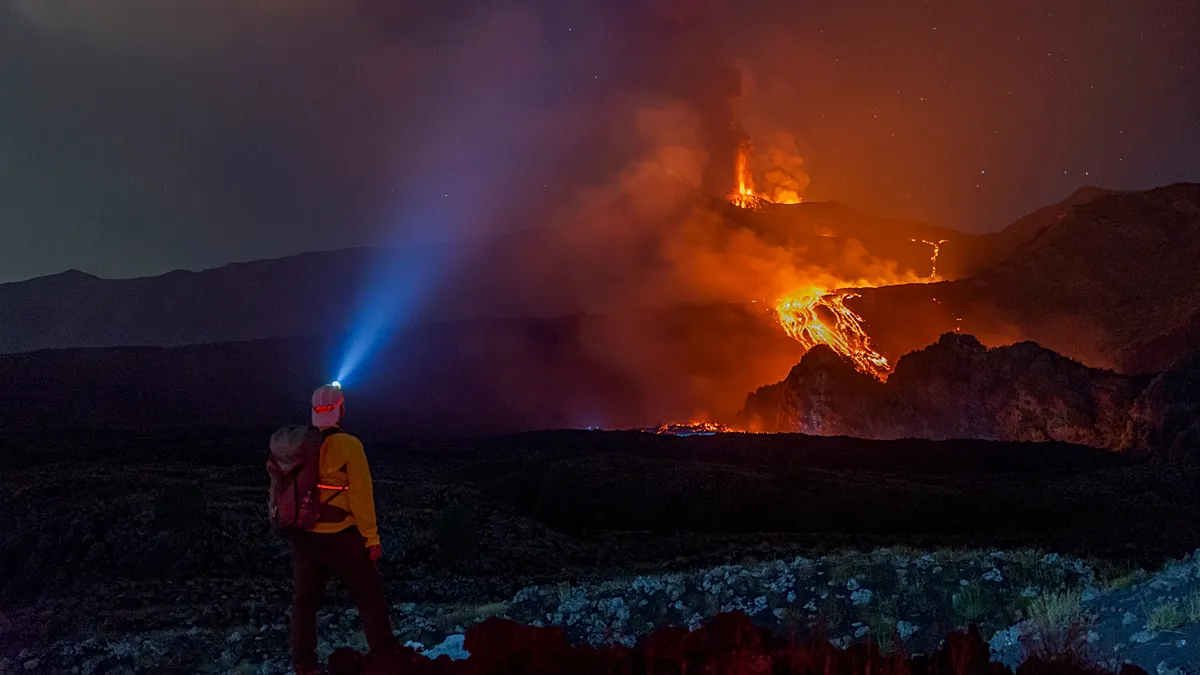
Table of Contents
Lightning Strike on Mount Etna Kills American Hiker
Poinews.com – A Mount Etna lightning strike killed a 29-year-old American visitor on Sunday as a violent thunderstorm swept over Sicily’s most active volcano. The man was hiking alone in the remote Rocca Capra sector of the Valle del Bove, roughly 1,400 metres above sea level, when the bolt hit him. Authorities have not yet released his name, and no family members had been located as of the latest updates.
Rescue Effort and Aftermath
Emergency services received the initial call just before 8 pm. A Drago 142 helicopter from the Italian fire brigade was dispatched to the scene. Crews attempted on-scene resuscitation before winching the victim aboard. He was flown to Cannizzaro hospital in Catania in cardiac arrest. Doctors worked for nearly an hour before confirming his death at approximately 9:30 pm. His body was transferred to the hospital morgue.
Preliminary reports indicate the hiker may have been walking in a zone temporarily closed to visitors because of Etna’s heightened eruptive activity in recent weeks. Police have opened an investigation into the circumstances of the fatality and are working to identify the victim and notify next of kin.
Volcanic Context: Etna’s Active Eruptive Phase
The tragedy unfolded amid intense volcanic activity. The National Institute of Geophysics and Volcanology (INGV) confirmed that a new lava vent had opened in the Valle del Bove after the partial collapse of the eastern flank of the Rittmann summit cone. The vent, situated at roughly 2,350 metres elevation, produced a lava flow extending about 500 metres before stalling and cooling. A second vent near 1,900 metres remained active, channeling molten rock downslope to approximately 1,600 metres. Explosive bursts continued from the Voragine summit crater, sending the eruption plume to around 6,000 metres and drifting south-east. Volcanic tremor readings stayed elevated and steady, confirming the volcano remained in an active eruptive phase. INGV stated it was monitoring conditions closely.
Air Traffic Disruptions at Catania
Atmospheric ash from the ongoing eruption forced authorities to extend the closure of airspace sector B1 and cap arrivals at Catania-Fontanarossa airport. Through noon on Tuesday, no more than ten inbound flights per hour were permitted, while departures faced no restrictions. Travellers were advised to confirm flight status with their carrier before travelling to the terminal. Earlier in the eruptive episode, ash emissions had already triggered multiple cancellations and schedule changes.
A Parallel Tragedy in South Tyrol
The same weekend saw another lightning fatality in the Italian Alps. A 42-year-old man was found dead on Piz Starlex in South Tyrol after apparently being struck during his descent. A drone located his body late in the evening at roughly 2,600 metres altitude. Mountain rescue organisations remind hikers that thunderstorms represent one of the gravest hazards in alpine terrain. Exposed ridgelines, summits, and rocky couloirs carry particular risk. The standard guidance is to descend from high ground and seek shelter without delay the moment lightning is visible or thunder is heard. August, peak hiking season, is consistently the busiest month for mountain rescue operations across Italy.
If you hear thunder or see lightning while on a mountain, treat it as an immediate signal to leave exposed terrain. Move to lower ground, avoid isolated trees and metal objects, and if caught in the open, crouch low with feet together to minimise ground current.
Frequently Asked Questions
Was the hiker in a restricted area? Preliminary reports suggest he may have been walking in a zone closed to visitors due to Etna’s recent eruptive behaviour, though police have not confirmed this detail.
What is the current volcanic status of Mount Etna? INGV reports multiple active vents, ongoing explosive bursts from the Voragine crater, and elevated tremor readings. The volcano remains in an active eruptive phase and is being monitored closely around the clock.
Are flights affected at Catania airport? Yes. Airspace sector B1 remains closed, and arrivals are capped at ten flights per hour. Departures are unrestricted. Passengers should verify their flight status with the airline before travelling to the terminal.
What should hikers do if a storm approaches on a mountain? Descend from