Magyar says EU must decide whether to ‘survive or win’ and slams Brussels’ lack of leadership
Magyar says EU must decide whether the bloc will merely endure or assert itself as a competitive force on the world stage. Speaking at the Bled Strategic

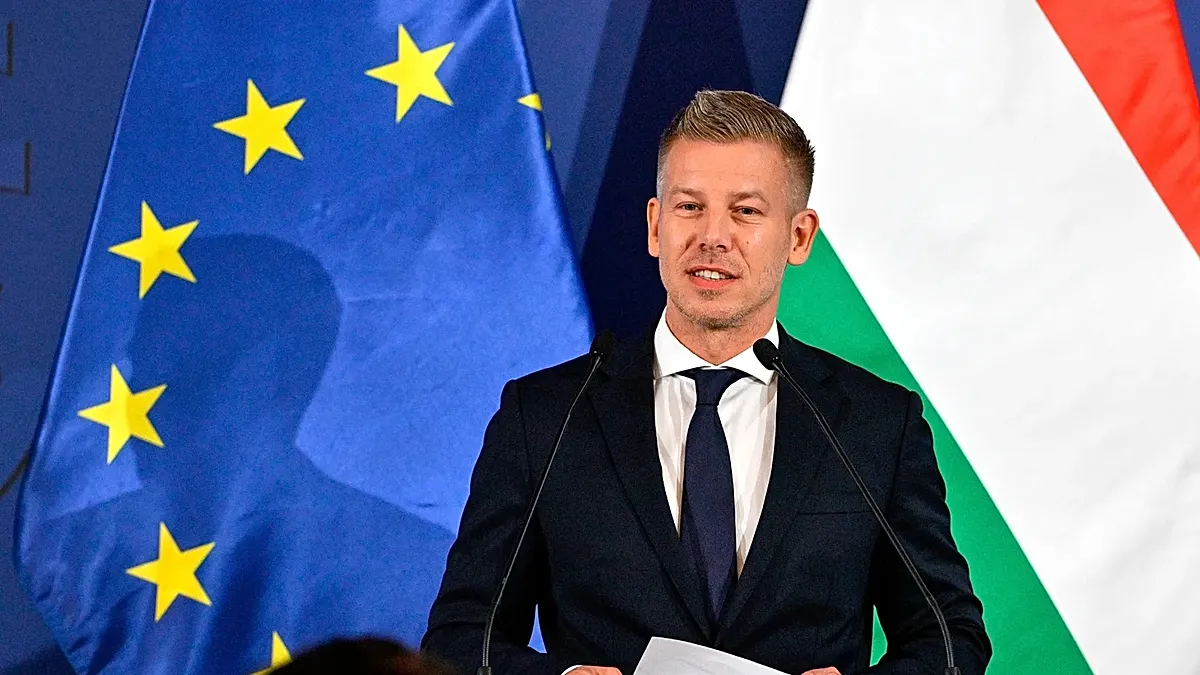
Table of Contents
Magyar Says EU Must Decide: Survive or Win
Poinews.com – Magyar says EU must decide whether the bloc will merely endure or assert itself as a competitive force on the world stage. Speaking at the Bled Strategic Forum in Slovenia, Hungary’s prime minister Péter Magyar delivered what he framed as a binary diagnosis of European governance: the institution is drowning in procedural inertia while external rivals act with speed and purpose. Magyar, who assumed office following a decisive electoral shift away from his predecessor’s long tenure, told an audience of Central European leaders that Brussels faces a choice between passive survival and active global competition.
A Regional Forum Sharpened by Rivalry
The remarks were delivered alongside Slovenia’s Janez Janša, Croatia’s Andrej Plenković, and Czech Prime Minister Andrej Babiš — four centre-right leaders who used the forum to discuss tighter regional cooperation and sharper economic positioning against non-European powers. It was within that context that Magyar turned his critique toward what he described as a structural failure at the apex of EU governance.
“There is a lack of political leadership, to be honest, in the European Union.”
He identified the Commission’s administrative machinery as the principal obstacle. Magyar recounted being advised by a senior figure in the European Council to simply ignore the bureaucracy — not to reply to its queries, because doing so would allow the apparatus to consume and neutralise any initiative before it gained traction.
“I was told by a member of the European Council not to deal at all with the bureaucracy, not to reply to them, because they will kill initiatives. They will eat them. And it’s not a good sign. I think we should concentrate again on the reality.”
The China Factor and the Binary Framing
Magyar argued that while European institutions debate procedural questions, Beijing is already positioning capital for nuclear power plants and automotive manufacturing facilities across the continent. The implication he drew was stark: the EU’s self-absorption in internal governance leaves a widening window for external actors to reshape European industrial geography.
“There is a feeling already in Brussels as well that we should change, and in my view we should decide whether the European Union would only like to survive or to win.”
The framing carries added political weight because Magyar sits within the European People’s Party, the same centre-right grouping that includes Commission President Ursula von der Leyen. His critique therefore lands not as an outsider’s complaint but as an internal challenge from within the bloc’s largest parliamentary family. When Magyar says EU must decide, the audience in Brussels hears a fellow party member demanding course correction rather than a partisan attack.
The Migration Fine That Won’t Go Away
Beyond institutional reform, Magyar took aim at a specific financial penalty that has become a recurring irritant in Budapest-Brussels relations. In 2024 the EU imposed a lump-sum fine of €200 million on Hungary, coupled with a daily penalty, after the government of Viktor Orbán failed to implement a 2020 ruling by the European Court of Justice. The court had determined that Hungary violated EU law by denying asylum seekers the right to fair treatment under the common asylum framework.
The practical consequence: Hungary owes roughly €1 million per day for as long as the non-compliance persists. Magyar expressed frustration at what he characterised as a one-sided dynamic.
“It’s quite difficult to explain to Hungarians why Hungary is treated so unfairly in Brussels on these issues. We have a court ruling; we have to pay €1 million a day just for defending the common European borders. It’s not fair, and nobody is ready to resolve this issue.”
Under the Orbán administration, Hungary erected a physical barrier along its southern border with Serbia to stem irregular migration flows. Applicants were directed to file asylum claims at Hungary’s consulate in Belgrade, where the overwhelming majority were turned down. Cumulative EU fines levied against Hungary over migration-related disputes have approached €1 billion, a figure that fuels domestic resentment and gives Magyar a ready-made grievance to mobilise politically.
Resetting the Relationship
Magyar’s electoral platform centred on a wholesale recalibration of Budapest’s posture toward its Western partners in both the EU and NATO. Once his government was formed, the first concrete deliverable was a negotiated arrangement with the European Commission releasing previously frozen funds, signalling a shift from confrontation to conditional cooperation. Magyar says EU must decide its own trajectory, but he made clear that Hungary would no longer accept a passive role in that deliberation.
FAQ
Where did Magyar deliver the “survive or win” remarks? At the Bled Strategic Forum in Slovenia, a recurring gathering of Central European leaders focused on defence, trade, and geopolitical positioning.
What specific EU penalty is Magyar contesting? A 2024 lump-sum fine of €200 million plus a daily penalty of approximately €1 million, imposed after Hungary failed to implement a 2020 European Court of Justice ruling on asylum-seeker treatment.
Why does Magyar’s critique carry extra weight in Brussels? He belongs to the European People’s Party, the same centre-right grouping that includes Commission President Ursula von der Leyen, making his challenge an internal one rather than an external partisan attack.
What role does China play in Magyar’s argument? He points to Beijing’s active positioning of capital for nuclear power and automotive manufacturing in Europe as evidence that EU institutional paralysis creates openings for external actors to reshape the continent’s industrial landscape.