Frecciarossa starting tests for new Rome and Milan high-speed rail links to Munich
The sight of a Trenitalia Frecciarossa locomotive rolling through Austrian and German rail corridors marks a turning point in continental rail integration

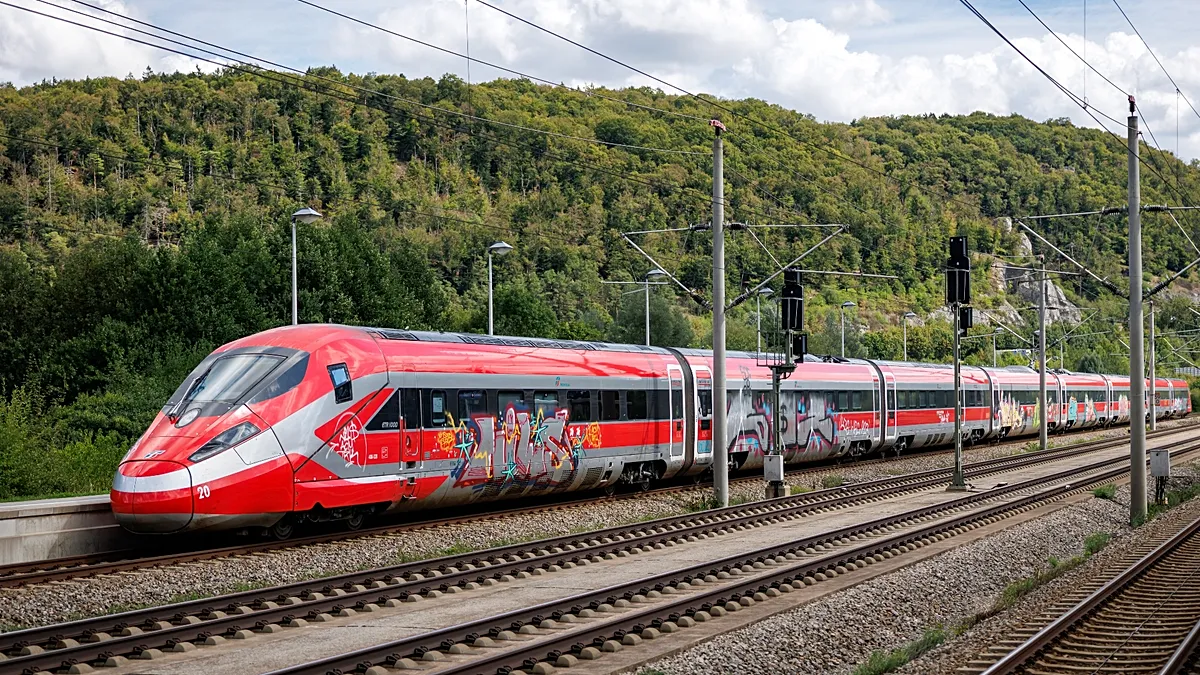
Table of Contents
Italian High-Speed Trains Enter German and Austrian Networks as Munich Links Take Shape
Poinews.com – The sight of a Trenitalia Frecciarossa locomotive rolling through Austrian and German rail corridors marks a turning point in continental rail integration. Ferrovie dello Stato, Italy’s state-owned railway group, has confirmed that its flagship high-speed rolling stock has entered the international certification phase, with test runs now underway on networks operated by Deutsche Bahn and Österreichische Bundesbahnen (ÖBB). The exercise represents the final technical hurdle before passenger services linking Milan and Rome to Munich can begin operating commercially.
For decades, the Brenner corridor between northern Italy and southern Germany has been a bottleneck of mixed freight and slow passenger traffic. The arrival of fully interoperable Italian high-speed trains on German and Austrian infrastructure signals that this corridor is being reimagined as a genuine high-speed artery rather than a congested freight artery.
Service Timeline and Route Architecture
FS has stated that passenger operations between Milan–Munich and Rome–Munich are slated to commence in summer 2027, contingent on the successful completion of the approval process for the new trains. Once the Brenner Base Tunnel opens its full capacity, journey times are expected to shrink by roughly one hour compared with current surface-rail itineraries.
From December 2028, the full timetable will feature ten daily connections between Italy and Germany. The commercial offering will allocate four of those services to the Milan–Munich corridor and four to the Rome–Munich corridor, with the remaining connections reserved for later extensions toward Naples and Berlin.
The Milan–Munich itinerary, carrying an end-to-end travel time of approximately six and a half hours, will call at Brescia, Verona, Rovereto, Trento, Bolzano, and Innsbruck before crossing into Bavaria. The longer Rome–Munich routing, at roughly eight and a half hours, threads through Florence, Bologna, Verona, Rovereto, Trento, Bolzano, and Innsbruck. Both paths converge on the Brenner crossing, making the tunnel’s completion date a critical dependency for the entire programme.
The Brenner Base Tunnel as Enabler
The Brenner Base Tunnel, currently under construction beneath the Alpine ridge, will provide a dedicated high-speed rail tube separate from the existing surface line. Its completion is projected to remove the single largest time penalty on the corridor. Until the tunnel is fully operational, services will run over the existing surface route with longer journey times; the one-hour reduction cited by FS applies once the base tunnel is in regular service. This phased approach allows operators to begin revenue operations earlier while still delivering the full timetable once infrastructure catches up.
Partnership and Technical Interoperability
The programme is executed jointly with Deutsche Bahn and ÖBB, the respective national carriers of Germany and Austria. A key element of the Trenitalia–Deutsche Bahn agreement is the sharing of technical expertise so that Frecciarossa units can adapt to differing power-supply voltages, signalling protocols, and train-control systems encountered across borders. This knowledge exchange is designed to compress the certification timeline and contain the costs that would otherwise accompany each new national rollout.
Parallel to the construction of prototype units, structured training programmes for German and Austrian driving staff were launched. Crews must be familiarised with the specific handling characteristics, braking profiles, and cab-ergonomics of the Italian-built trains before they can be certified to operate them on domestic networks.
The Frecciarossa platform itself is engineered to European interoperability technical specifications (TSI), meaning it has been designed from the outset to operate not only on Italian tracks but also on the rail networks of France, Germany, Spain, Austria, Switzerland, the Netherlands, and Belgium. This multi-country design philosophy eliminates the need for country-specific variants and allows a single fleet to serve an expanding web of international routes.
Leadership Statements
“The start of test runs in Germany and Austria is a step towards delivering a project that confirms our ambition to make the train the benchmark mode of transport for mobility across Europe,” said FS chief executive and general manager Gianpiero Strisciuglio. “Thanks to our partnership with Deutsche Bahn and ÖBB, we are moving towards creating the High-Speed ‘European Metro’, offering passengers a service able to bring regions, people and economies closer together,” Strisciuglio explained.
Strisciuglio further noted that Frecciarossa “is thus continuing its international growth path, taking the FS Group’s technological and industrial excellence abroad and helping to develop an increasingly integrated European rail network”.
“A further step confirming the growth of the FS Group and its ability to win new markets abroad, while providing better services and infrastructure in Italy. More jobs, more connections, more Italy in Europe,” said Matteo Salvini, Italy’s Minister for Infrastructure and Transport, commenting on the milestone.
Wider European Rail Context
The German and Austrian test phase follows earlier international deployments. Frecciarossa units have already entered service in France and Spain, extending the Italian high-speed brand into the western European network. The stated long-term ambition is to reach the United Kingdom via the Channel Tunnel by 2029, which would place Italian-built high-speed trains on every major western European corridor.
The Munich connection also has knock-on effects beyond the headline cities. By capturing through-traffic demand, the new services are expected to feed onward connections to destinations such as Frankfurt and Krakow, effectively turning the Brenner corridor into a feeder for a broader Central-European high-speed web. Passengers travelling from southern Italy to eastern European cities will gain a single-ticket, high-speed option that previously required multiple transfers and slower regional services.
The programme thus sits at the intersection of national industrial policy, European infrastructure strategy, and commercial rail competition. Its success will determine whether the Brenner corridor transitions from a freight-dominated bottleneck into a true high-speed passenger artery, and whether the Frecciarossa brand can sustain its expansion across the continent’s rail map.
Related Reading
Frequently Asked Questions
What is Frecciarossa starting tests for new Rome?
Frecciarossa starting tests for new Rome is the main topic of this guide. The article explains the context, practical details, and next steps readers should understand.
Why does Frecciarossa starting tests for new Rome matter?
Frecciarossa starting tests for new Rome matters because readers are looking for a useful answer, not just a short summary. Good content should match search intent and help them decide what to do next.