IRGC mines set tankers ablaze as Tehran threatens expanded attacks
Two oil tankers caught fire and stopped in the Strait of Hormuz after striking mines placed by Iran’s Islamic Revolutionary Guard Corps Navy, the IRGC said

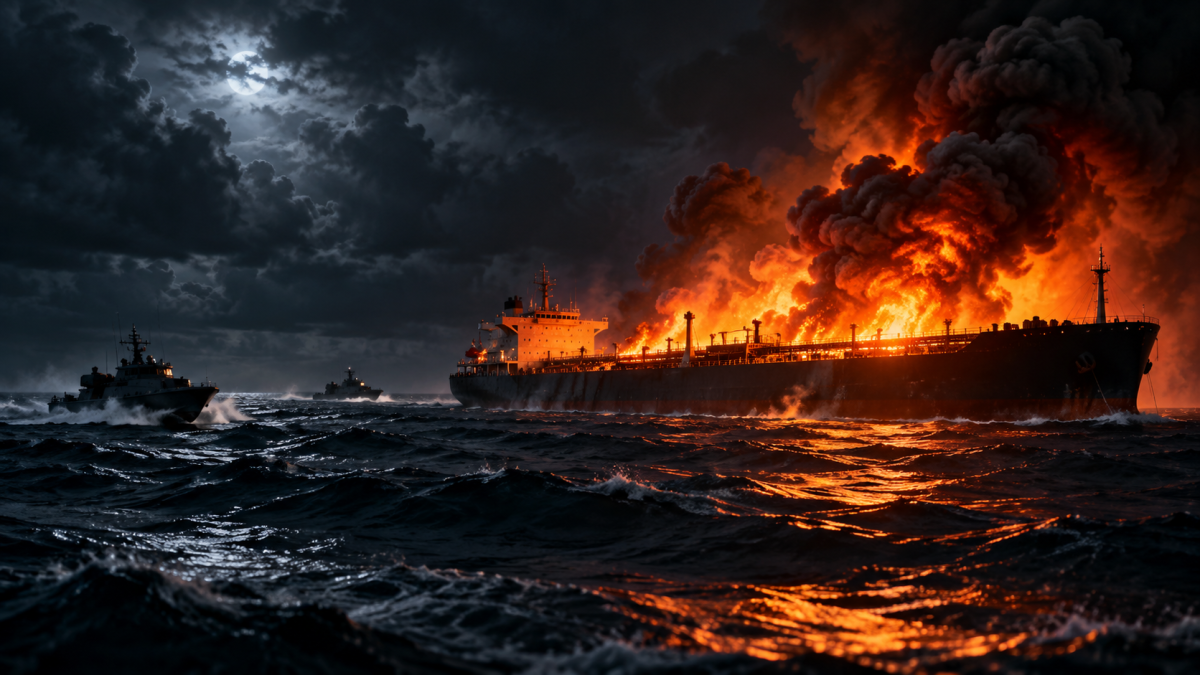
Table of Contents
Strait of Hormuz tensions intensify after Iran says tankers hit mines
Poinews.com – Two oil tankers caught fire and stopped in the Strait of Hormuz after striking mines placed by Iran’s Islamic Revolutionary Guard Corps Navy, the IRGC said, as Tehran raised the prospect of broader action against shipping, communications infrastructure and US forces in the region.
The group said the vessels had travelled through a southern stretch of the waterway near Oman that Iran considers unauthorised. It did not identify either tanker, specify their cargoes or disclose the exact point where the explosions occurred.
“With the explosion of mines laid by the IRGC Navy in the illegal passage south of the Strait of Hormuz, two offending tankers were set on fire and brought to a standstill,” the IRGC said.
Iran does not have internationally recognised authority to decide which ships may pass through the strait. Under the UN Convention on the Law of the Sea, the strategic channel is covered by transit-passage rights, meaning international shipping has legal protections while using it.
Separate account of tanker encounter
The UK Maritime Trade Operations said on Tuesday that it had received information about an incident involving an oil tanker and military forces the previous day. The location given was about 121 nautical miles east of Duqm, a city on Oman’s coast.
UKMTO did not name the ship and said it had received no information indicating damage or casualties. It was not immediately clear whether that account concerned either of the tankers mentioned in the IRGC statement.
The security situation in and around the Strait of Hormuz has become a major concern for commercial crews, energy markets and governments because the narrow waterway is a vital connection between the Persian Gulf and the open ocean. Before the war began, about one-fifth of global oil shipments passed through it.
The conflict began after US-Israeli strikes on Iran in late February. Since then, both Iran and the United States have imposed blockades in the strait, while Iranian forces have repeatedly targeted cargo vessels using the southern route.
Claims over drones and military sites
The IRGC also said its air-defence forces brought down a US MQ-9 drone over the strait on Monday night. A US official speaking to American media rejected that claim as false.
Elsewhere, Iranian domestic outlets, including the state-linked Fars agency, said a US strike on Monday hit a naval base in Konarak, in the southeastern province of Sistan and Baluchistan. The accounts said two military personnel were wounded and that an air-defence installation was targeted. Washington had not commented on those claims.
Iranian officials have signalled that any further US action could trigger a response. Foreign ministry spokesman Esmail Baghaei said Tehran’s record showed it would not ignore an attack.
“In practice we have shown that we absolutely do not leave any blow unanswered,” he said.
Responding to claims that Washington had urged Tehran not to react if Kuh Kalang were struck, Baghaei dismissed the idea that Iran would remain passive.
“A US attack on Kuh Kalang and Iran not responding is fantasy and empty talk,” Baghaei said.
Threats to cables and plans for new weapons
IRGC spokesperson Hossein Mojabi said on Monday that Iran could target undersea internet cables in the Gulf and the Strait of Hormuz. He also said “new weapons will be unveiled,” framing those measures as part of an effort to remove US military forces from the region.
Any interference with seabed cables would carry consequences beyond maritime trade. Such infrastructure supports international telecommunications and data links, making it important to businesses and communities far beyond the Gulf. The threat adds another layer of uncertainty to an already hazardous route for civilian vessels and their crews.
Arsenio Dominguez, secretary-general of the International Maritime Organisation, said roughly 6,000 seafarers have been left stranded in the strait since the war started. He criticised shipowners that continue to send personnel into the affected zone, underscoring the human impact behind the disruption to oil and cargo movements.
Uncertainty over diplomacy and US deployments
The IRGC-linked Tasnim news agency quoted an unnamed Iranian security source as saying that uncertainty about who holds decision-making influence in Washington was making negotiations more difficult. The source named Vice President JD Vance, Secretary of State Marco Rubio, and Trump administration negotiators Steve Witkoff and Jared Kushner as officials whose responsibilities appeared unclear to Iranian counterparts.
American media have previously said the Pentagon was preparing to send the USS Theodore Roosevelt carrier strike group and the 13th Marine Expeditionary Unit to the Middle East. Those plans would add about 10,000 sailors and Marines to the region by the end of November. Washington has not confirmed the deployment.
The latest claims, counterclaims and threats leave shipping companies facing a rapidly shifting security picture. With tankers, naval forces and commercial crews operating in close proximity, even incidents with limited confirmed details can have an immediate effect on navigation decisions through one of the world’s most consequential maritime corridors.
Related Reading
Frequently Asked Questions
What is IRGC mines set tankers ablaze as Tehran?
IRGC mines set tankers ablaze as Tehran is the main topic of this guide. The article explains the context, practical details, and next steps readers should understand.
Why does IRGC mines set tankers ablaze as Tehran matter?
IRGC mines set tankers ablaze as Tehran matters because readers are looking for a useful answer, not just a short summary. Good content should match search intent and help them decide what to do next.