AI helps scientists decipher papyrus scroll burnt in Vesuvius eruption
AI Unlocks Secrets of a 2,000-Year-Old Papyrus Scroll Reviving Ancient Texts Without Damaging Them AI helps scientists decipher papyrus scroll - A papyrus

AI Unlocks Secrets of a 2,000-Year-Old Papyrus Scroll
Reviving Ancient Texts Without Damaging Them
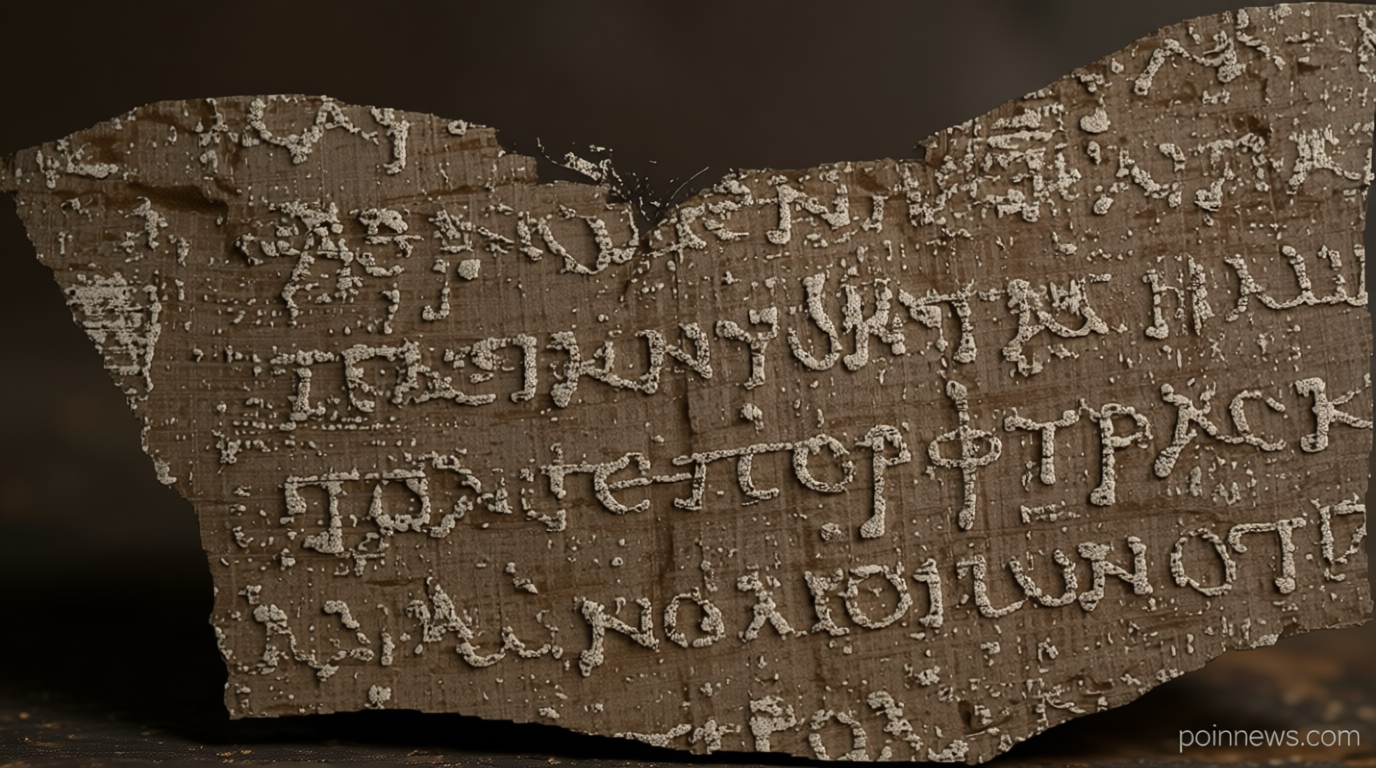
Poinews.com – A papyrus scroll, preserved by the 79 AD eruption of Mount Vesuvius, has finally been decoded using artificial intelligence. The breakthrough came after researchers avoided the traditional method of unrolling the fragile manuscript, which could have caused it to disintegrate. Instead, they employed cutting-edge technology to reveal its contents—a philosophical text exploring ethics, human nature, and moral development.
The scroll, designated PHerc. 1667, was among thousands of carbonized manuscripts discovered in the 1750s in the Roman town of Herculaneum. These fragments were safeguarded under the rubble of a wealthy villa, allowing them to survive the volcanic destruction. The collection represents the sole intact library from the Greco-Roman era, offering a rare glimpse into ancient thought.
The Vesuvius Challenge: A New Approach to Deciphering
For centuries, the scrolls remained a mystery due to their delicate state. Opening them risked destroying the text, so scientists relied on advanced imaging and AI to reconstruct the hidden words. In 2023, the Vesuvius Challenge transformed this intellectual puzzle into a global competition, awarding cash prizes for innovative solutions. Contestants used computer vision and machine learning to achieve remarkable results.
One notable success came when a 21-year-old computer science student claimed the $40,000 prize by identifying the word “purple” from an unopened scroll—a milestone in two millennia of scholarly effort. This month, a collaborative team from European and American universities completed the full transcription of PHerc. 1667’s text, marking a major step forward in the project.
“PHerc. 1667 started as a dark, compact mass of charred papyrus,” said the Vesuvius Challenge. “We used high-resolution X-rays to scan it, reconstructed the layered structure, flattened it digitally, and applied machine learning to enhance the faint ink traces.”
The scroll’s content, recovered from a surviving 8cm section of its original 19–24cm size, references Stoic philosophy and likely dates to the 2nd century BC. It also mentions Aristocreon, a relative and follower of the philosopher Chrysippus. The discovery of a new work by Epicurean philosopher Philodemus from another scroll highlights the project’s growing impact.
“For nearly two millennia, these texts were physically intact but intellectually silent,” remarked Brent Seales, co-founder of the Vesuvius Challenge. “Today, through interdisciplinary collaboration and AI, we’re not only reading them but also beginning to grasp their meaning.”
Despite this progress, hundreds of scrolls remain sealed, their contents yet to be uncovered. The successful decoding of PHerc. 1667 demonstrates how modern technology can revive ancient voices, bridging the gap between past and present. The journey is far from complete, but the first breakthroughs offer hope for further revelations.