The Sun and the Moon: Saatchi Gallery’s ambitious new summer show turns its gaze to the sky
llery's Bold Summer Exhibition Explores Celestial Inspiration The Sun and the Moon - Since ancient times, humans have gazed at the heavens, weaving meaning

The Sun and the Moon: Saatchi Gallery’s Bold Summer Exhibition Explores Celestial Inspiration
Poinews.com – Since ancient times, humans have gazed at the heavens, weaving meaning from the celestial dance of light and shadow. This year’s summer showcase at the Saatchi Gallery, titled The Sun and The Moon, seeks to encapsulate this enduring fascination by spanning nine rooms across two floors, featuring over 170 creators who interpret the sun and moon through their art. It follows the gallery’s previous hit, FLOWERS, which delved into the cultural and artistic significance of flora.
A Journey Through Time and Light
Curated by Katherine Benson, the exhibition is designed as a full 24-hour narrative, guiding visitors from the first light of day to the final glow of night. Each gallery space mirrors a distinct phase of the day, accompanied by the cultural and historical narratives tied to it. The opening room showcases works by Patrick Caulfield, Barbara Hepworth, and Sinta Tantra, setting the tone for a deeper exploration of how early civilizations perceived the sun and moon as cosmic forces.
“It’s a 24-hour journey through the eyes of artists and creators,” Benson explains to Euronews Culture during the press preview. “These celestial bodies have shaped human life for millennia, and we wanted to highlight the countless ways they’ve inspired imagination and expression.”
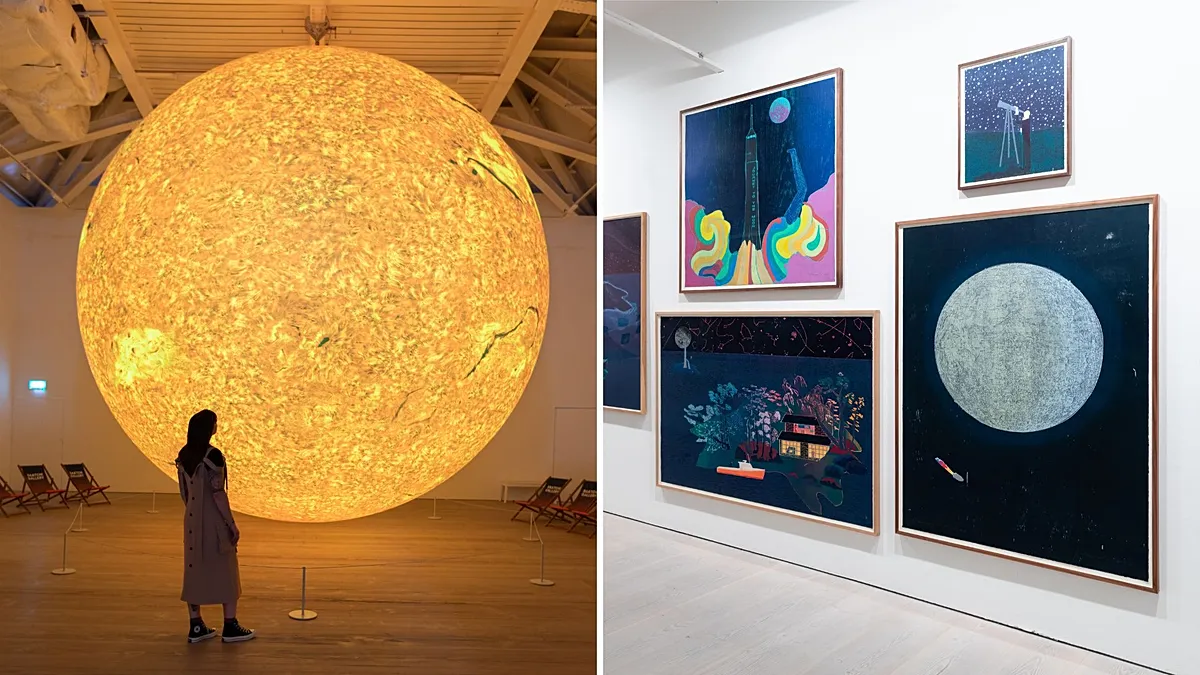
As the exhibition progresses, it delves into the sun’s role in timekeeping and agriculture, then shifts to the rituals and traditions of summer culture. The highlight of the first half is Helios, a six-metre illuminated sphere by Luke Jerram. Crafted from 400,000 photographs of the sun, captured by astrophotographer Dr Stuart Green and NASA, the installation invites visitors to recline beneath it, gazing upward as it slowly radiates light. A soundscape by Duncan Speakman and Sarah Anderson complements the experience, enveloping the space in an ambient atmosphere.
“I hope the artwork will inspire awe and wonder,” Jerram remarks. “It’s a chance to reflect on the sun’s vital role—its light, warmth, and energy, as well as its influence on culture and religion throughout history.”
The second half transitions to the moon, beginning with its phases and historical observations. A dedicated section, Walking on the Moon, celebrates the cultural impact of the Apollo missions, uncovering lesser-known stories behind the lunar landings. Central to this part is Moon Landing, a collaborative masterpiece between textile artist Margot Selby and composer Helen Caddick. The piece honors Navajo women who crafted integrated circuits and workers at Raytheon who contributed to Apollo 11’s memory cores—achievements long overshadowed by male figures.
Caddick’s composition mirrors the logic of weaving, with her score structured around binary code. “Margot used binary in her weaving, which intrigued me,” she notes. “I composed for two harps, two cellos, and two violins, making them function like a coded rhythm. Often, when the first harp rests, the second takes over.”
Meanwhile, Kay Gasei, a British Zambian mixed-media artist and 2021 Soho House Art Prize winner, offers a personal take on the moon through his Moonlight Series Number Four: Boy by the Pool. This painting blends family memories with mythological themes, evoking childhood adventures under the stars. “It’s about mischievousness and nighttime play,” Gasei shares. “I ran away as a kid, chasing the moon’s glow, and this piece captures that feeling.”
Visitors can explore the entire exhibition, which seamlessly intertwines past and present, from ancient artifacts to modern interpretations. A link to listen to or download Caddick’s composition is available for those wishing to engage further with the lunar theme.