Pope Leo XIV calls for national reconciliation on his first day in Spain
Pope Leo XIV Calls for National Reconciliation on First Day in Spain Pope Leo XIV calls for national - On the first day of his visit to Spain, Pope Leo XIV

Pope Leo XIV Calls for National Reconciliation on First Day in Spain
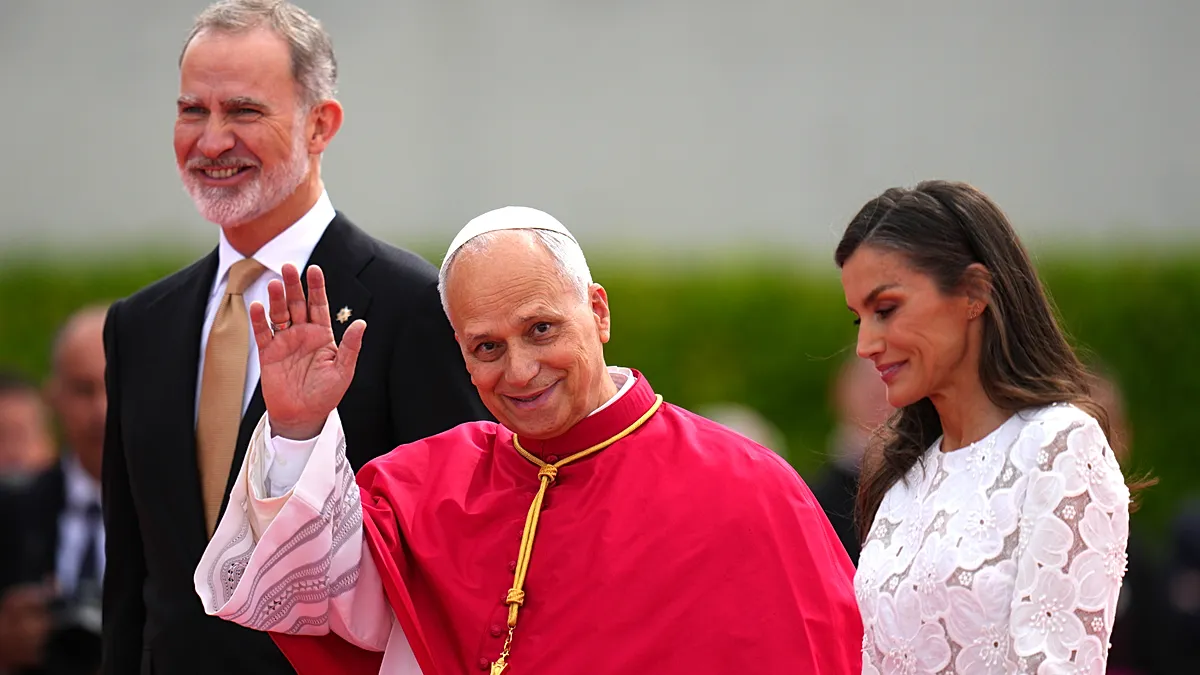
Poinews.com – On the first day of his visit to Spain, Pope Leo XIV took center stage, emphasizing the importance of national reconciliation in a speech delivered at the Royal Palace in Madrid. His remarks, which followed a dramatic arrival at Adolfo Suárez Madrid-Barajas Airport, set the tone for a six-day tour that will traverse the nation’s capital, Barcelona, and the Canary Islands. The Pope’s visit marks a significant moment in Spain’s political and religious landscape, as it is his first trip to the country since ascending to the papacy on May 8, 2025, and the first by any pope in 15 years, since Benedict XVI’s 2011 World Youth Day pilgrimage.
The Pope’s presence in Spain immediately drew widespread attention, with King Felipe VI and Queen Letizia welcoming him in a grand gesture that underscored the nation’s reverence for the Catholic Church. Massive crowds gathered in the city center, estimated at over 130,000 spectators, to witness the Pope’s first public engagement. As his popemobile passed through iconic locations like Plaza de España and Calle de la Princesa, the pace was deliberately slowed to allow for personal interactions, a testament to the Pope’s commitment to connecting with the people. This event was not only a celebration of faith but also a symbolic step toward healing the nation’s internal divisions.
Reaffirming Spain’s Role in Global Affairs
Pope Leo XIV’s address at the Royal Palace highlighted Spain’s historical significance as a cultural crossroads and its modern role in international diplomacy. In his speech, he underscored the importance of unity, urging citizens to embrace the complexities of their shared history rather than succumb to simplistic narratives. He specifically referenced Alfonso X, the 13th-century monarch who established a renowned translation school, as an example of Spain’s ability to bridge cultural and ideological gaps. The Pope’s remarks were seen as a subtle yet powerful endorsement of Spain’s approach to global issues such as the conflict in Gaza, the Ukraine war, and its migrant policies, which have been a topic of debate among European nations.
“Let us move beyond divisions and recognize the richness of our shared heritage. The path to true national reconciliation lies in understanding, dialogue, and the courage to confront the past with humility,”
the Pope said, drawing applause from the audience. His emphasis on “national reconciliation” resonated with both the clergy and the public, who viewed it as a call to mend fractures within Spanish society, particularly those rooted in historical events like the Civil War and the transition to democracy.
A Historic Opportunity for Unity
Leo XIV’s visit is being closely watched by political leaders and civil society groups, many of whom see it as a chance to foster national unity. The Pope’s choice of themes—ranging from cultural heritage to social cohesion—has been interpreted as a deliberate effort to align with Spain’s current challenges. His presence in Madrid, a city that has long been a hub for political discourse, signals a desire to engage with the nation’s diverse voices. Analysts note that this tour is particularly timely, given the recent polarization over issues such as regional autonomy, immigration, and economic inequality.
Despite the Pope’s focus on reconciliation, some critics have raised questions about the absence of planned meetings with sexual abuse survivors in his official itinerary. While the Vatican confirmed that such discussions will take place during his stay, specific details have yet to be released. This oversight has sparked debate among religious and political figures, with some arguing that the Pope’s message of unity should include addressing the Church’s past failures. Nevertheless, his commitment to national reconciliation remains a central theme, as evidenced by his repeated calls for collaboration and mutual respect in the face of division.
As the Pope’s tour progresses, the focus on “national reconciliation” is expected to become more pronounced. His next stop, the Cedia centre in Madrid, will provide an opportunity to engage with marginalized communities, including the homeless, further reinforcing his message of inclusivity. The planned youth gathering in Plaza de Lima, with over 240,000 participants registered, will also highlight the Pope’s efforts to connect with Spain’s younger generation. These events are designed to showcase the Pope’s vision for a united Spain, one that honors its diverse history while moving forward as a cohesive nation.
The Pope’s engagement with migrant reception facilities in Gran Canaria and Tenerife is another key element of his itinerary, continuing a tradition initiated by his predecessor Pope Francis. This focus on migration reflects the growing importance of the issue in Spain’s political discourse and the Pope’s belief in its role in fostering national solidarity. The estimated cost of the visit, at 25 million euros, is seen by many as a worthwhile investment in the long-term benefits of promoting unity and cultural exchange. Tourism experts predict that the economic impact of the Pope’s visit could surpass 150 million euros, a figure that underscores the global significance of the event.