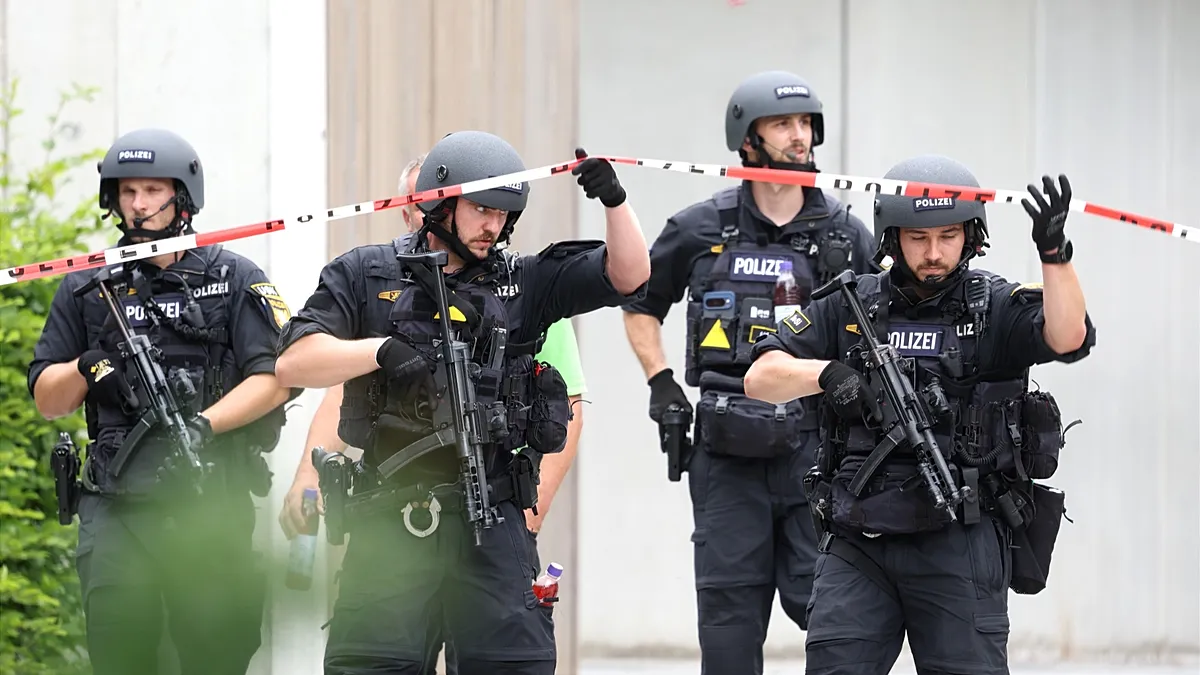
Why the Baltics are pushing back against new fears of a Russian attack
European capitals along NATO's eastern border have moved in unison to push back against speculation that Moscow is preparing a conventional strike against an

Table of Contents
Baltic and Eastern European Leaders Reject Imminent-Attack Narrative After Moscow Trip Stirs Alarm
Poinews.com – European capitals along NATO’s eastern border have moved in unison to push back against speculation that Moscow is preparing a conventional strike against an alliance member. The wave of reassurance came roughly a week after CIA Director John Ratcliffe made an unannounced visit to Moscow, a trip that quickly fed anxieties across the continent that Russia might be testing the alliance’s cohesion. From Helsinki to Bucharest to Riga, governments have made clear they see no intelligence pointing toward a direct military confrontation, even while they continue to reinforce their own defensive postures and warn that the broader Russian threat is intensifying.
“Preparing Is Not Predicting”
Officials across the eastern flank have drawn a sharp distinction between readiness and expectation. The argument, articulated in various forms from Tallinn to Warsaw, is that strengthening borders, sharing signals intelligence, and rehearsing rapid-response scenarios does not amount to anticipating an invasion. It is, they insist, simply prudent posture management against a neighbour that has already demonstrated its willingness to redraw borders by force.
John Hardie, deputy director of the Russia Program at the US-based Foundation for Defence of Democracies, offered a layered reading of what Ratcliffe’s Moscow visit may have signalled. In his assessment, the trip likely carried multiple messages simultaneously.
“My own view is that a conventional Russian military attack against a NATO member remains highly unlikely, especially while the Ukraine war continues,” Hardie said. “However, even while that scenario remains unlikely overall, there are reasons to see the risk ticking up a bit.”
Hardie pointed to two structural factors that nudge the probability upward: the Iran conflict, which has stretched American military readiness, and what he described as deliberate ambiguity under the Trump administration about Washington’s political commitment to European defence. He also noted a string of recent incursions into NATO airspace that could have been designed to gauge how quickly and how firmly the alliance would react. On the question of what Putin might do if he felt cornered in Ukraine, Hardie saw a second round of Russian mobilisation as the more probable escalation path than a strike on a NATO state.
Finland Dismisses the Crystal-Ball Scenario
Finnish President Alexander Stubb went further than most in publicly rejecting the premise. Speaking to Germany’s Bild newspaper over the weekend, Stubb said he saw neither evidence nor facts supporting predictions that Russia could be ready to attack a NATO country within the next few years.
“If anyone has a crystal ball like that – that’s great. I simply see neither evidence nor facts to support it,” Stubb said, adding that the intelligence available to him supported his assessment. “It makes no sense for any power in the world to test the resolve of this alliance.”
Finland’s rhetoric, however, sits alongside concrete military action. Helsinki is reinforcing its defences along the 1,340-kilometre frontier with Russia, and Sweden has approved a Finnish request to deploy Gripen fighter jets and a naval vessel to bolster territorial surveillance along that same border. Finnish officials frame these steps as deterrence measures aimed at countering drones, airspace violations, and incremental escalation – not as preparations for an imminent full-scale assault.
Romania: Constant Sharing, No Indication of Attack
Defence Minister Radu Miruță told Romanian broadcaster Digi24 on Sunday that Bucharest and its partners were in continuous intelligence exchange and had received “no indication” that Russia intended to strike a NATO member.
“I don’t think Russia has any intention to attack a NATO member country,” Miruță said.
The Romanian position carries particular weight given geography: Bucharest shares a 614-kilometre border with Ukraine and has repeatedly recorded Russian drones crossing into its own airspace. Yet even that proximity has not produced, in Miruță’s reading, any signal of a planned conventional operation against the alliance.
The Baltics: Low Invasion Risk, High Hybrid Alert
Latvian Prime Minister Andris Kulbergs was the most explicit of the eastern-flank leaders in separating two distinct risk categories. In a statement posted on X, he said the country’s military threat level had not changed and that the probability of a direct Russian invasion remained low. Latvia nonetheless maintains heightened vigilance against cyber operations, sabotage, provocations, and drone incursions, while reinforcing its eastern frontier alongside NATO partners.
“Readiness for a possible threat is not the same as an immediate threat,” Kulbergs said. “These two things must not be confused.”
Lithuania, Estonia, and Latvia collectively rank among NATO’s largest military spenders relative to the size of their economies, a fact that underscores how seriously the three states take the long-term deterrence calculus even while publicly downplaying the short-term invasion scenario.
Poland and the Hybrid-Warfare Dimension
Polish Prime Minister Donald Tusk, speaking after a briefing from NATO Secretary-General Mark Rutte over the weekend, acknowledged that escalation from Russia’s side is progressing and that provocations against an alliance member cannot be ruled out.
“The next six months will be decisive, and we must be prepared as Poland and NATO for various scenarios,” Tusk said.
Tusk’s framing highlights a second axis of Europe’s threat assessment: even if a conventional attack is not imminent, Russian aggression is already unfolding in other forms. European governments have accused Moscow of sustained cyber campaigns, sabotage operations, and hostile activities across the continent, while Russian aircraft and drones have repeatedly breached NATO airspace. Estonian Foreign Minister Margus Tsahkna argued on X that labelling such activities merely “hybrid warfare” understates their significance, responding to remarks by Estonia’s foreign intelligence chief Kaupo Rosin that had drawn attention to the scale of ongoing operations.
The cumulative picture emerging from Helsinki, Bucharest, Riga, Vilnius, Tallinn, and Warsaw is therefore not one of panic but of calibrated vigilance. Leaders across the eastern flank are telling their publics the same core message: the alliance’s deterrence architecture is working, no intelligence points to an imminent conventional strike, and the appropriate response to a growing Russian threat is sustained preparedness rather than alarm.
Related Reading
Frequently Asked Questions
What is Why the Baltics are pushing back?
Why the Baltics are pushing back is the main topic of this guide. The article explains the context, practical details, and next steps readers should understand.
Why does Why the Baltics are pushing back matter?
Why the Baltics are pushing back matters because readers are looking for a useful answer, not just a short summary. Good content should match search intent and help them decide what to do next.