Collateral damage: How Cognac is paying the price for Europe’s trade wars
In the vineyards surrounding France’s Charente River, the end of the Cognac harvest brings little relief this year. Growers and trading houses are confronting

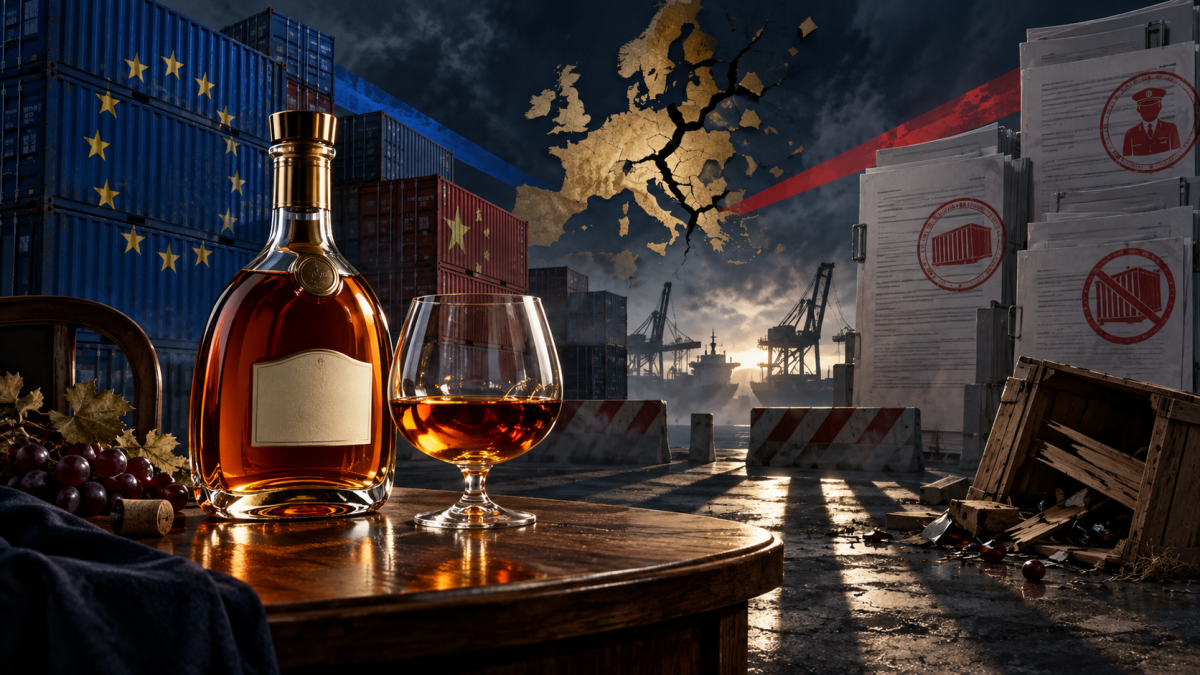
Table of Contents
Cognac Producers Face a Shrinking Market on Two Fronts
Poinews.com – In the vineyards surrounding France’s Charente River, the end of the Cognac harvest brings little relief this year. Growers and trading houses are confronting a difficult mix of weaker overseas demand, trade barriers in crucial markets and a drought-reduced crop.
The famous amber spirit is made only in the Cognac region, yet its fortunes depend overwhelmingly on customers beyond Europe. Some 98% of production is exported outside the European Union. That exposure has left the sector highly vulnerable as political disputes between major trading powers have disrupted sales in China and the United States.
Sales have fallen sharply since 2023, dropping from 230 million bottles to 140 million. The region’s four biggest houses — Rémy Martin, Hennessy, Martell and Courvoisier — have cut back orders from local winegrowers after customers cancelled contracts.
For growers, a smaller harvest has created an uncomfortable form of balance. Drought has diminished the volume of grapes available, bringing supply closer to a market where demand has weakened dramatically.
“We thought the harvest was going to be promising, but in the end the drought took its toll,” said Matthieu Augier, a winegrower in Gondeville. “Compared with a typical year, we’re looking at a 30 to 40% reduction in the harvest in economic terms. You could say in a way that nature helps regulate our surpluses.”
A product caught in a dispute over electric vehicles
China, Cognac’s second-largest market after the United States, accounts for roughly one quarter of exports. Its importance made the industry an especially visible casualty of the EU-China dispute that began in 2023 over Chinese electric vehicles.
France strongly backed EU action over concerns that Chinese manufacturers benefited from state subsidies that could disadvantage European carmakers. Beijing responded by turning its attention to European brandy, placing Cognac in the middle of a conflict that had little to do with wine or spirits.
In 2024, China introduced provisional duties of as much as 34.8% on European brandy. The measure came days after the EU imposed tariffs reaching 35.3% on Chinese electric vehicles. China later maintained its restrictions while allowing large Cognac producers to avoid the duties if they agreed to sell at undisclosed minimum prices.
Even with that exemption mechanism, the commercial effects had already spread through the market. Buyers and distributors became more cautious, while Cognac’s association with European and French policy created a reputational problem among consumers.
“We have been collateral damage in the trade war which started in 2023 between Brussels and Beijing over Chinese electric vehicles, a symbolic product for the EU market,” said Raphaël Delpech, director of the National Interprofessional Cognac Bureau, known as the BNIC.
“Once the Chinese government singled us out and associated us with an anti-Chinese European and French policy, consumers started to distance themselves,” Delpech said. “The distributors stopped buying our bottles and stopped putting our products on their shelves.”
US tariff uncertainty adds to the pressure
The American market presents an even larger concern. Around half of Cognac exports go to the United States, making any change in US import policy consequential for the entire production chain, from growers to bottlers and merchants.
Cognac had already experienced US tariffs during Donald Trump’s first administration, when French Cognac was hit during the prolonged Boeing-Airbus trade dispute. Those duties were subsequently suspended during Joe Biden’s presidency.
Trade tensions returned after Trump imposed broad tariffs on US trading partners in April 2025. In July, the EU and the US reached an agreement in Turnberry, Scotland, that established a 15% tariff on most European exports to America, including Cognac.
Europe’s wine and spirits sector has pressed for an exemption, arguing that the tariff threatens a significant export business. But uncertainty has remained a burden in the US, where inflation has also increased prices. Trump has repeatedly raised the possibility of much steeper duties on French wines and spirits amid broader political disagreements.
“It created an extremely anxiety-inducing environment for all our importers in the US, who, just as in China, eventually came to the conclusion that it was better to bet on something safer than Cognac,” Delpech said.
There was a potential opening in July 2026, when EU lawmakers approved the removal of the bloc’s remaining tariffs on US goods covered by the Turnberry agreement. Washington then agreed to resume talks on possible exemptions from its 15% tariff. Yet Cognac producers have seen little tangible progress.
“I get the impression that not much is moving forward,” said French MEP Eric Sargiacomo of the Socialists and Democrats group, deputy chair of the European Parliament’s intergroup on wines and spirits. “The only ones who have managed to make clear progress on this issue are the British.”
The United Kingdom obtained the removal of US tariffs on whisky in May, and Irish whiskey received comparable treatment in mid-September. French Cognac remains subject to the 15% charge.
A historic European industry under strain
The setback carries particular symbolism for Europe. Jean Monnet, widely regarded as one of the EU’s founding figures, came from a Cognac-producing family and worked in that family business. Three centuries after Cognac became established as a regional product, the industry is now struggling with the consequences of disputes conducted far beyond the Charente.
For local growers, the difficulty is not merely lower bottle sales. Reduced orders affect the demand for the wines used in Cognac production, while lost shelf space and cautious importers can be hard to win back. The simultaneous pressure in China and the United States means producers cannot easily offset weakness in one major market with strength in the other.
Until trade negotiations produce a clearer outcome, Cognac’s recovery will depend on whether importers regain confidence, distributors return the spirit to shelves and overseas consumers return to the category. For now, a product deeply tied to one small part of southwestern France is paying the price for conflicts between much larger economies.
Related Reading
Frequently Asked Questions
What is Collateral damage?
Collateral damage is the main topic of this guide. The article explains the context, practical details, and next steps readers should understand.
Why does Collateral damage matter?
Collateral damage matters because readers are looking for a useful answer, not just a short summary. Good content should match search intent and help them decide what to do next.