UzNIF’s international IPO shifts focus from fundraising to corporate governance
UzNIF's International IPO Shifts Focus to Corporate Governance UzNIF s international IPO shifts focus - UzNIF's international IPO shifts from fundraising to

UzNIF’s International IPO Shifts Focus to Corporate Governance
Poinews.com – UzNIF’s international IPO shifts from fundraising to governance, signaling a pivotal transformation in how Uzbekistan’s state-owned enterprises engage with global markets. This landmark offering, which saw nearly $700 million in capital raised and over $2.8 billion in investor interest, is reshaping the economic landscape by prioritizing institutional accountability over immediate financial gains. As international investors now hold stakes in key sectors such as energy, telecommunications, and banking, the IPO is not only a financial milestone but also a strategic move to align Uzbek corporate practices with international standards.
Reimagining State-Owned Enterprise Management
Established by presidential decree in August 2024, the National Investment Fund of Uzbekistan (UzNIF) now manages minority shares in 13 major state-owned firms. This consolidation allows international participants to diversify across multiple sectors, marking a departure from earlier models where state companies operated with limited oversight. The IPO introduces a new framework for corporate governance, ensuring that these enterprises are subject to the same transparency and accountability mechanisms as private firms. This shift is expected to foster greater investor confidence and set a precedent for future reforms.
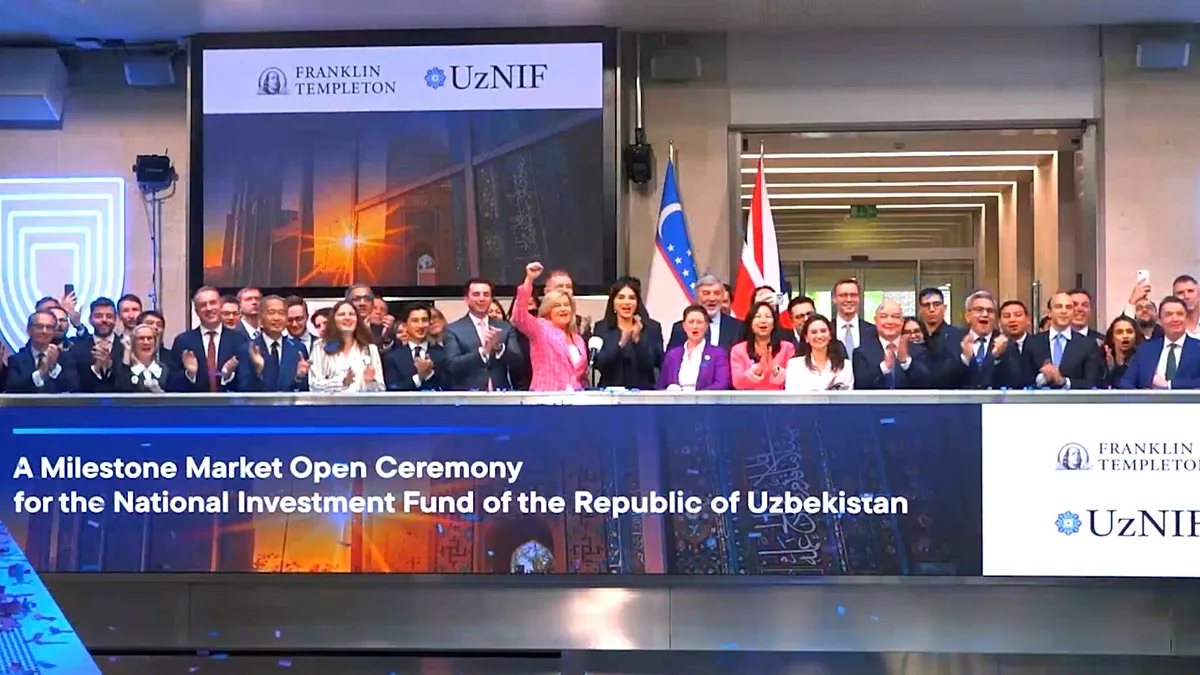
“UzNIF’s international IPO shifts focus to corporate governance, which is essential for long-term economic stability,” said Saida Mirziyoyeva, Head of the Presidential Administration, during the London listing ceremony. “By inviting global scrutiny, we are embedding accountability into the heart of Uzbek business operations.”
Experts highlight that this transition is more than a financial strategy—it represents a commitment to modernizing state-owned enterprises. Quinn Martin, president of Bluestone, emphasized that the IPO enables over 150 funds to actively engage in governance, ensuring commercial efficiency and accountability. “The main goal wasn’t necessarily the money,” noted Bekzod Khashimov, an economist at New York University in Abu Dhabi. “Public listing requires regulation, transparency, and governance practices to ensure the state can’t dominate day-to-day operations.”
Global Integration and Market Expansion
The dual listing on London and Tashkent markets underscores Uzbekistan’s ambition to integrate with international financial systems. This move positions the country as a growing player in the global capital market, with significant implications for its economic trajectory. According to Khurshed Mustafoev, Uzbekistan’s Deputy Minister of Economy and Finance, the IPO is a stepping stone toward further private sector participation. “The fund is designed to introduce best-in-class international corporate governance standards to state-linked companies, paving the way for future private sector participation and further corporate listings,” he added.
“This IPO shifts focus from fundraising to governance, which is critical for building sustainable growth,” stated Jenny Johnson, CEO of Franklin Templeton. “By aligning with global practices, Uzbekistan is setting a new benchmark for corporate responsibility.”
Meanwhile, Fayzulla Tashov, chairman of the Republican Stock Exchange “Toshkent,” framed the dual listing as a milestone in the country’s financial evolution. “UzNIF’s international IPO shifts the capital market’s role from a domestic entity to a global participant,” he explained. “Growing contacts with exchanges like Hong Kong and Singapore demonstrate Uzbekistan’s readiness to engage with international financial centers.”
Economic Impact and Strategic Vision
The IPO’s success is a testament to the confidence investors have in Uzbekistan’s economic reforms. With nearly $700 million in capital raised, the initiative provides critical resources for infrastructure development and technological upgrades. However, its broader impact lies in the governance changes it triggers. By subjecting state-owned enterprises to public market pressures, the IPO encourages better financial reporting, shareholder engagement, and operational efficiency.
“UzNIF’s international IPO shifts the focus to governance, which is vital for attracting long-term investment,” remarked Julia Hoggett, CEO of the London Stock Exchange. “This unified platform managed by Franklin Templeton allows global investors to access Uzbekistan’s economic backbone while holding institutions to higher standards.”
Analysts suggest that this approach could lead to a more competitive domestic market, where state-owned enterprises are incentivized to perform like private sector counterparts. “The shift from fundraising to governance creates a ripple effect,” said Quinn Martin. “It compels companies to prioritize value creation over short-term gains, which strengthens the overall economy.”
Future Prospects and Challenges
As UzNIF’s international IPO shifts toward governance, the next phase will focus on maintaining this momentum. The fund’s structure is designed to support ongoing reforms, with a clear emphasis on transparency and accountability. However, challenges remain, including ensuring consistent corporate governance practices across all 13 listed firms and managing the expectations of global investors. “The key is to balance governance with growth,” said Khurshed Mustafoev. “We must continuously adapt to meet international benchmarks while nurturing Uzbek domestic markets.”
Despite these hurdles, the IPO is widely regarded as a transformative step. By leveraging the expertise of Franklin Templeton and other international partners, Uzbekistan aims to position itself as a hub for investor confidence and sustainable development. The transition from fundraising to governance is not just a strategic pivot—it’s a commitment to building a more resilient and transparent economic framework for future generations.