At least two killed and 81 injured after explosions at Bolivian army base
A pair of massive explosions tore through a Bolivian army maintenance facility on Friday, killing at least two personnel and sending more than 80 others to

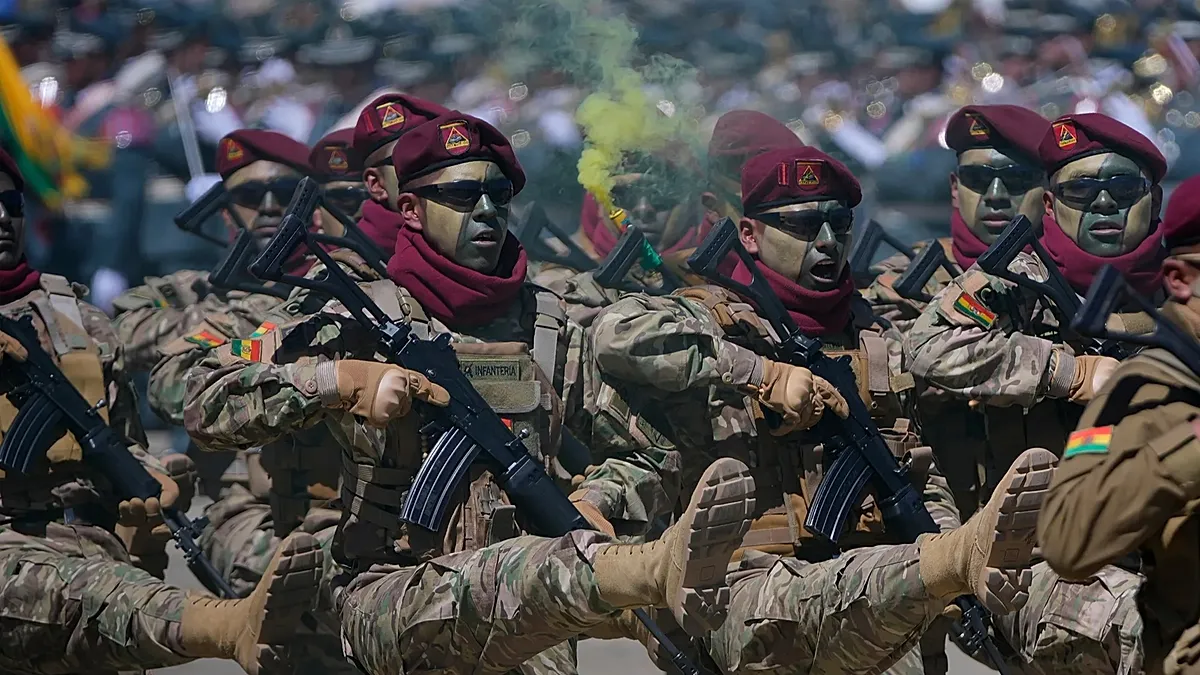
Table of Contents
Double Blast Rocks Bolivian Military Depot: Two Dead, Over 80 Wounded, Seven Still Missing
Poinews.com – A pair of massive explosions tore through a Bolivian army maintenance facility on Friday, killing at least two personnel and sending more than 80 others to hospitals in the surrounding region. Seven individuals remained unaccounted for as rescue crews worked through the night, according to official statements released in the hours after the incident. The blasts struck the RAM-2 “Bolívar” General Maintenance Center in Viacha, a town situated southwest of La Paz, Bolivia’s administrative capital, and sent a towering column of smoke visible across the valley.
The facility in question is not a combat post but a logistical hub where the armed forces keep pyrotechnic supplies — the kind of black-powder charges, flash compositions, and signaling agents used in ceremonial displays, training exercises, and field operations. Defence Minister Ernesto Justiniano confirmed that the site’s primary inventory consisted of such pyrotechnic material and stressed that no conventional weaponry had been detonated during the event.
Sequence of the Explosions
Preliminary findings, as outlined by Justiniano in a press briefing held shortly after the blasts, indicated that the first explosion was triggered by black powder contained within pyrotechnic stockpiles stored at the depot. The second detonation, which the minister described as “much larger,” had not yet been fully characterized and remained under active investigation. Footage that spread rapidly across social media platforms captured at least one of the two events, showing a blinding flash followed by a dense, billowing plume of smoke rising well above the surrounding terrain.
The scale of the injuries — 81 people reported wounded — suggests that the blasts generated significant overpressure and shrapnel effects across the compound. In a facility where pyrotechnic charges are kept in concentrated quantities, even a single ignition event can cascade into a secondary explosion if adjacent stores are compromised, a dynamic that investigators will need to establish or rule out in the coming days.
Official Response and Search Operations
Justiniano framed the immediate priority in blunt operational terms, telling assembled reporters:
“The most important thing tonight is to protect people, attend to the injured, continue the search for those who have not yet been located, and ensure that families can return to their homes only when conditions are safe.”
He confirmed that seven personnel had not yet been located as of the briefing and that search-and-recovery teams were still combing the damaged sections of the site. The minister also reiterated that no firearms, artillery rounds, or other conventional ordnance had been involved, a distinction intended to reassure the public that the incident was confined to the pyrotechnic stores rather than a broader arsenal.
Presidential Reaction and Call for Accountability
Bolivian President Rodrigo Paz took to the social platform X within hours of the blasts to voice what he called his “deepest sympathy” for the families of those killed and for the injured. He went further, announcing that he had directed a formal inquiry into the circumstances surrounding the explosions:
“I have also ordered a thorough, technical, and transparent investigation into what happened. We must establish with absolute clarity the causes of this incident, verify compliance with safety protocols, and determine who is responsible.”
The president’s language — particularly the insistence on identifying responsibility — signals that the government intends the inquiry to go beyond a routine accident report. In a country where military logistics have historically received less public scrutiny than frontline operations, a transparent technical review of storage procedures, ventilation standards, and ignition-prevention measures could set a precedent for how the armed forces account for depot-level safety.
Context and Broader Implications
Viacha sits in the dense urban sprawl that has grown around La Paz over the past two decades, meaning that a depot explosion of this magnitude does not occur in isolation from civilian life. Neighbouring residential blocks, schools, and commercial streets would have felt the overpressure wave, and the 81 injured likely include both military personnel and civilians caught near the perimeter. Local hospitals in the La Paz metropolitan area were expected to receive a surge of burn and blast-injury patients in the hours following the event.
Pyrotechnic storage, while lower-risk than conventional munitions, still demands strict separation distances, humidity and temperature controls, and periodic inventory audits. Black powder — a mixture of charcoal, sulfur, and potassium nitrate — is stable under normal conditions but can ignite from friction, static discharge, or a small spark if packed in sufficient quantity. When thousands of such charges share a warehouse, a single ignition can propagate through adjacent racks, producing the kind of secondary, larger blast that Justiniano said was still under investigation.
The incident will likely prompt a review of how Bolivia’s armed forces manage pyrotechnic depots in close proximity to populated areas, and whether existing safety-protocol documentation was followed at the RAM-2 facility. Until the technical investigation concludes, the full causal chain — from initial ignition to the second, larger detonation — will remain unresolved, and the seven missing personnel will remain the most urgent human question facing Bolivian authorities.
Related Reading
Frequently Asked Questions
What is At least two killed and 81 injured?
At least two killed and 81 injured is the main topic of this guide. The article explains the context, practical details, and next steps readers should understand.
Why does At least two killed and 81 injured matter?
At least two killed and 81 injured matters because readers are looking for a useful answer, not just a short summary. Good content should match search intent and help them decide what to do next.