Macron and Carney vow closer France-Canada ties amid strained US relations
France and Canada used a summit in Saint Pierre and Miquelon to signal a stronger political, economic and security partnership at a time when both countries

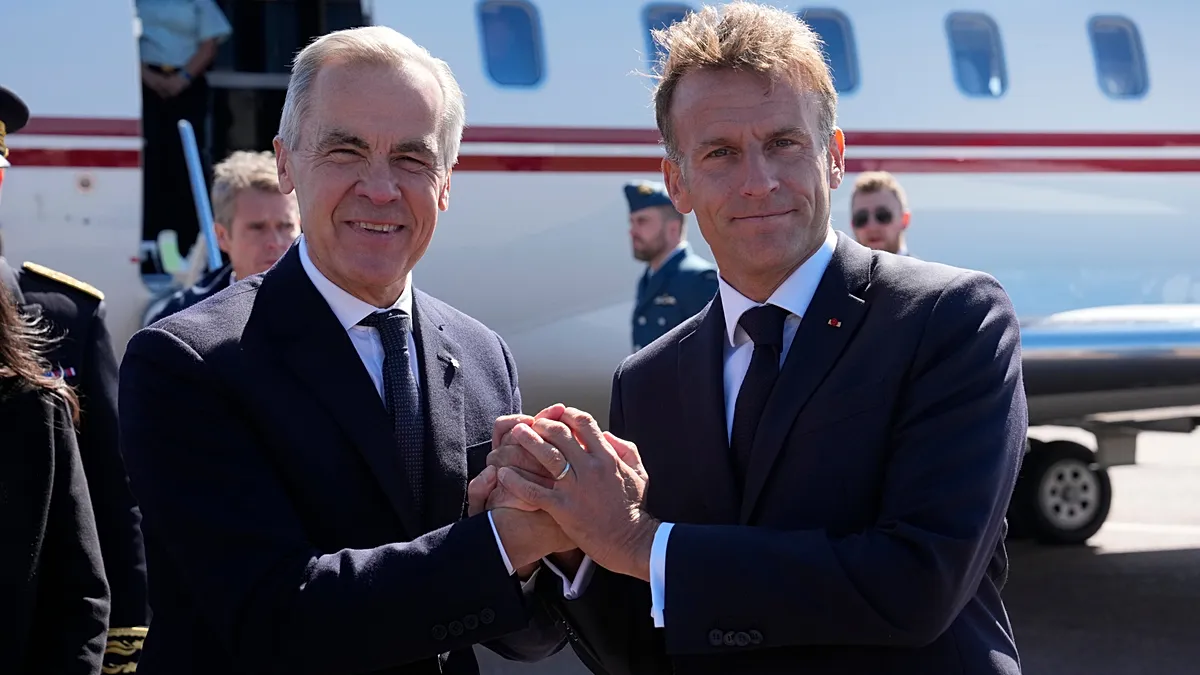
Table of Contents
France and Canada move to deepen strategic partnership
Poinews.com – France and Canada used a summit in Saint Pierre and Miquelon to signal a stronger political, economic and security partnership at a time when both countries face growing uncertainty in their dealings with the United States.
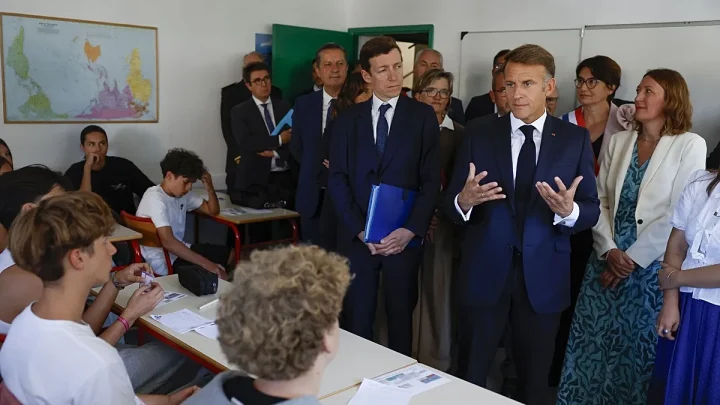
French President Emmanuel Macron and Canadian Prime Minister Mark Carney met on Sunday in the French territory near Canada’s Atlantic coast, holding talks that ranged from energy and fisheries to advanced technology, defence and regional security. The location itself underlined the close geographic and historical links between France and Canada, while the discussions focused on how those ties could become more consequential in a shifting international environment.
At a joint news conference, Macron described the two countries as partners committed to protecting their autonomy.
“Two great independent nations who want to stay that way.”
Carney said the moment called for a substantial strengthening of Canada’s relationship with France and with the European Union more broadly. His remarks followed recent meetings in Brussels and Strasbourg, where the European Commission formally put forward a proposal for Canada to receive “associate member” status within the bloc.
A European opening for Canada
The proposed EU status would reflect Canada’s effort to build closer links with European institutions at a time when its traditional dependence on the United States is under renewed pressure. Ottawa has been seeking broader commercial, diplomatic and security relationships as tensions with Washington intensify.
US President Donald Trump’s tariffs, demands for economic concessions and recurring comments about Canada becoming the 51st US state have all added urgency to that strategy. For Canada, closer engagement with European partners offers a way to widen its options in trade, energy, technology and defence without abandoning its existing relationship with its southern neighbour.
France, meanwhile, sees Canada as an important Atlantic partner with significant natural resources, industrial capacity and technological expertise. Macron said the discussions would help reinforce economic connections as well as defence cooperation.
“This is an important moment,” Macron said after arriving on Saturday.
He also pointed to the value of the meetings for strengthening the countries’ business links and security relationship. The summit came after a working lunch and several senior-level discussions held earlier on the island.
Energy and critical minerals at the centre of talks
Energy security featured prominently in the leaders’ agenda. The continuing war in Iran has disrupted global energy markets and raised concerns about persistently higher costs for fuel and other essential goods. European governments are seeking dependable supplies as the conflict creates new volatility.
Canada’s reserves and export capacity place it in a potentially valuable position for Europe. The country is a major producer of oil and natural gas and has extensive supplies of critical minerals and rare earth elements, materials that are increasingly important for energy systems, manufacturing and advanced technologies.
“Canada is a country with significant resources of critical minerals and rare earths. It is also a major oil and natural gas producer,” Macron said. “What we want to do is conclude agreements to secure more liquefied natural gas that can be shipped to Europe’s Atlantic coast.”
Macron said Sunday’s negotiations were connected to wider European work aimed at ensuring stable energy access. Liquefied natural gas from Canada could provide another source for European Atlantic ports, although turning political commitments into dependable long-term supply arrangements would require coordination on infrastructure, shipping and commercial agreements.
Beyond natural resources, the Canadian prime minister’s office said the two governments explored opportunities in aerospace, energy, critical minerals and advanced technological fields. Those areas include quantum computing, satellites and supercomputing, sectors where research capacity, secure supply chains and shared standards have become strategic concerns for governments.
Technology cooperation and AI governance
Carney also looked beyond the bilateral relationship by suggesting a four-party framework involving Canada, France, the United States and China to guide the development and governance of artificial intelligence. The proposal reflects the challenge of managing a technology whose leading companies, researchers and users are spread across competing major powers.
A cooperative format including Washington and Beijing would face major political obstacles, but the idea highlights Canada’s interest in pursuing a role in international AI policy alongside its economic and technology partnerships. France has likewise sought to position itself as an influential European voice in debates over artificial intelligence, regulation and technological sovereignty.
Macron and Carney agreed to develop cooperation on fisheries and regional security as well. These subjects carry particular relevance in the North Atlantic, where maritime resources, shipping routes, strategic infrastructure and the security interests of NATO members increasingly overlap.
Greenland agreement eases a separate dispute
The summit took place shortly after Trump announced an agreement concerning Greenland. The arrangement will expand the American military presence on the island while keeping Danish sovereignty intact, bringing an end to months in which the US president had threatened to take control of the semi-autonomous Danish territory.
Macron welcomed that outcome publicly on Saturday, framing it as a positive development for international stability and for relations among NATO allies.
“Danish sovereignty is being respected; international law is being respected,” Macron stated. “Anything that helps ease tensions is a good thing.”
For France and Canada, the meeting in Saint Pierre and Miquelon offered a chance to demonstrate that their partnership is not limited to ceremonial diplomacy. Their agenda linked immediate concerns about energy markets and trade pressure with longer-term questions over artificial intelligence, mineral supplies, defence and Europe’s relationship with North America.
The leaders’ emphasis on independence does not mean either country is stepping away from cooperation with the United States. Instead, it points to a shared desire for greater room to act as global alliances, energy flows and technology competition are reshaped by economic pressure and geopolitical uncertainty.
Related Reading
Frequently Asked Questions
What is Macron and Carney vow closer France?
Macron and Carney vow closer France is the main topic of this guide. The article explains the context, practical details, and next steps readers should understand.
Why does Macron and Carney vow closer France matter?
Macron and Carney vow closer France matters because readers are looking for a useful answer, not just a short summary. Good content should match search intent and help them decide what to do next.