Orange lips and a froglike roar: New monkey discovered after 18-year search in Congo rainforest
Orange Lips and a Froglike Roar: New Monkey Species Found in Congo Rainforest After 18-Year Search Orange lips and a froglike roar - Scientists have uncovered

Orange Lips and a Froglike Roar: New Monkey Species Found in Congo Rainforest After 18-Year Search
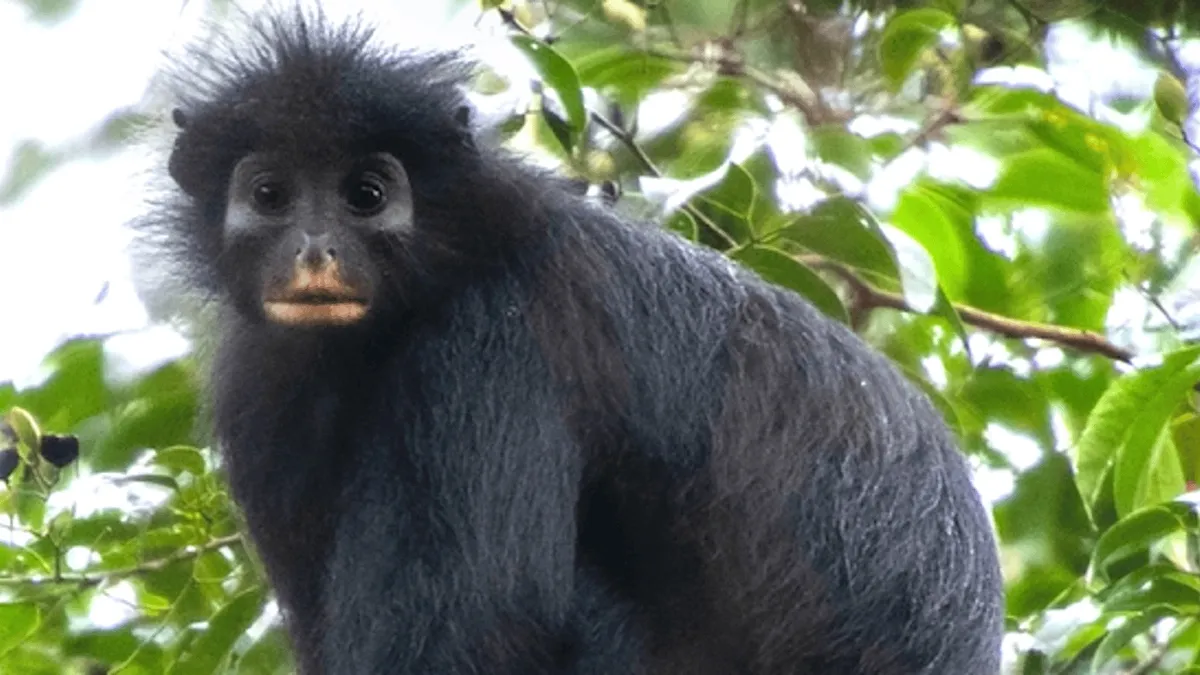
Poinews.com – Scientists have uncovered a groundbreaking discovery in the Congo rainforest: a previously unknown primate species with striking orange lips and a distinctive froglike roar. After an 18-year search, the creature was finally classified as a new member of the Colobus genus, earning the scientific name *Colobus congoensis*. This rare find, made in the dense canopy of Lomami National Park, adds to the growing list of unique wildlife in one of the world’s most biodiverse regions. The species’ unique features—its vivid orange mouth and haunting vocalizations—have captivated researchers and highlighted the untapped potential of the rainforest as a hotspot for undiscovered life.
The Unique Traits That Set Likweli Apart
What makes *Colobus congoensis* stand out is not just its physical appearance but also its behavior. Local communities in the region have long referred to the monkey as “Likweli,” a name that translates to “the one with the big mouth,” reflecting its most notable characteristic. The animal’s orange lips, which contrast sharply with its otherwise dark fur, are a key identifier, though researchers believe they may serve a dual purpose—both as a visual cue for mates and as a warning signal to predators. Its vocalizations, described as a deep, resonant roar similar to that of a frog, have puzzled experts, prompting further study into its communication patterns and evolutionary adaptations.
Julia Arenson, a postdoctoral fellow at Yale’s Department of Anthropology and the Yale Institute for Biospheric Studies, was instrumental in the study that confirmed the species. “The combination of physical and behavioral traits was unlike anything we had seen before,” she said. “The orange lips and froglike roar are not just random features—they likely evolved as a response to the specific ecological pressures of the Congo rainforest.” The team analyzed genetic data, behavioral observations, and audio recordings, all of which pointed to Likweli being a distinct and separate species. This discovery underscores the importance of long-term field research in uncovering hidden biodiversity.
“Only after a decade of exploring the Lomami Forest did we gather enough clear footage and genetic evidence to confirm this new monkey’s existence,” said co-author Terese Hart. “It wasn’t just new—it was rare, and its habitat was so isolated that even the most experienced researchers had trouble locating it.”
Challenges and Breakthroughs in the Search
The quest to identify Likweli began in the early 2000s, when initial sightings were dismissed as misidentifications of known species. Researchers faced significant challenges, including the dense vegetation of the rainforest, which made tracking the monkey difficult, and the remote location of Lomami National Park, where access was limited. However, the breakthrough came in 2018 when a team of scientists, working in collaboration with Congolese naturalists, captured high-quality footage of the species using advanced camera traps and acoustic monitoring equipment.
Over the next four years, the team meticulously documented 114 sightings across approximately 1,700 square kilometers of forest. Only eight of the 52 surveyed villages reported encounters with Likweli, suggesting its population was both small and highly localized. “The fact that such a unique species existed in such a narrow range was a surprise,” noted Dr. Arenson. “This highlights the need for more in-depth studies of remote ecosystems, where species can evolve in isolation for centuries.” The research also revealed that Likweli’s diet and social structure differ from those of its close relatives, further cementing its classification as a separate species.
“This discovery wouldn’t have been possible without the Congolese naturalists who first spotted the unusual behavior,” said study leader John Hart. “Their ability to recognize the monkey’s distinct characteristics and persist in documenting it was critical. Without their local expertise, we might have missed this species entirely.”
Published in the journal *PLOS ONE*, the findings emphasize the importance of preserving the Congo rainforest’s fragile ecosystems. Researchers warn that deforestation, illegal logging, and hunting are already threatening the survival of many primate species, and Likweli’s small population makes it particularly vulnerable. “We recommend that the species be listed as endangered to ensure immediate conservation action,” said Eric Sargis, a Yale anthropology professor. “Lomami National Park is a crucial refuge, but its future depends on sustained protection and community involvement.”
Further studies are now underway to better understand Likweli’s role in the rainforest’s ecological web. Scientists are also working with local communities to develop conservation strategies that balance economic needs with environmental preservation. The discovery has reignited interest in the Congo’s biodiversity, with researchers now calling for expanded efforts to catalog and protect its hidden inhabitants. As the world continues to uncover new species, the orange lips and froglike roar of *Colobus congoensis* serve as a reminder of the untold stories still waiting to be told in the heart of Africa’s wilderness.