Pompeii unveils reconstructed frescoed banquet hall ceiling, as restoration continues
Archaeologists at Pompeii have unveiled a remarkable achievement in cultural heritage preservation: the partially reconstructed frescoed ceiling of an ancient

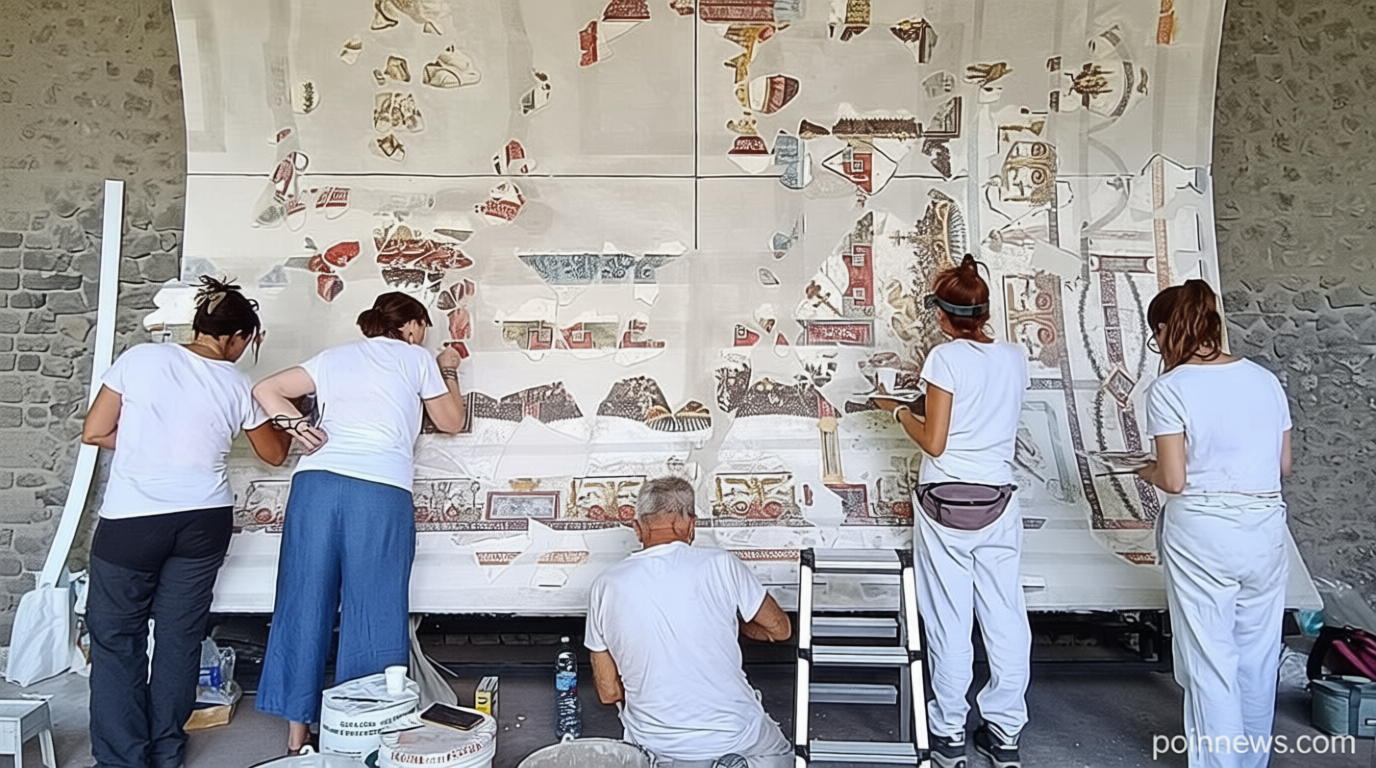
Table of Contents
Pompeii unveils reconstructed frescoed banquet hall ceiling
Poinews.com – Archaeologists at Pompeii have unveiled a remarkable achievement in cultural heritage preservation: the partially reconstructed frescoed ceiling of an ancient banquet hall. This stunning architectural feature, which showcases scenes from Greek mythology, represents one of the most significant restoration milestones in recent years. The Pompeii Archaeological Park announced on Friday that experts employed an innovative technique to reconstruct the ceiling, which is believed to have adorned the upper floor of a residential building with an adjoining bakery. The careful positioning of fresco fragments onto a curved support structure has successfully replicated the vault’s original architectural form.
The ongoing restoration work has already brought more than a quarter of the original ceiling back to life. Park officials explained that this flexible approach allows additional sections to be incorporated as new fresco fragments are uncovered and restored. The curved vault was formally presented on Thursday during the closing ceremony of an international workshop dedicated to new discoveries and restoration methodologies at Pompeii. Gabriel Zuchtriegel, director of the Pompeii excavations, emphasized the significance of this achievement for Italian cultural heritage.
“Italy is a world leader in archaeological restoration, and Pompeii, with its team of restorers, plays a central role in that effort,” Zuchtriegel told the Italian news agency ANSA.
Broader context and historical significance
The director further noted that sharing these conservation project results with the global community creates valuable opportunities for research and international exchange. This particular restoration initiative forms part of Pompeii Archaeological Park’s comprehensive 2026 programme, which focuses on themes related to Dionysus. The project builds upon recent groundbreaking discoveries at the House of Thiasos in Regio IX, where archaeologists uncovered one of the most significant large-scale frescoes ever found at the site. This magnificent artwork depicts a ceremonial procession dedicated to the Greek god of wine and celebration.
Recent archaeological activity at Pompeii has yielded multiple important findings beyond the banquet hall ceiling. Last June, excavations in a bakery area of Pompeii’s House of the Chaste Lovers complex revealed an equid skeleton, adding another layer to our understanding of daily life in the ancient Roman city. These discoveries collectively demonstrate the richness of archaeological potential that remains within the buried metropolis.
Pompeii’s transformation from a thriving Roman urban center into a landscape buried beneath volcanic ash following the catastrophic eruption of Mount Vesuvius in AD 79 has preserved an extraordinary window into ancient civilization. The city’s unique preservation conditions have allowed archaeologists to study everything from architectural details to domestic artifacts with remarkable precision.
Today, the UNESCO World Heritage Site stands as one of Italy’s most visited tourist attractions, drawing millions of visitors annually who come to witness the preserved splendor of Roman life. The continued restoration efforts, including the work on the banquet hall ceiling, ensure that future generations will be able to appreciate these archaeological treasures for centuries to come.