Fake article claims Mbappé made sexual harassment allegations against Macron
Fake Article Alleges Mbappé Made Sexual Harassment Claims Against Macron Fake article claims Mbappé made sexual - A recent fake article has circulated online

Fake Article Alleges Mbappé Made Sexual Harassment Claims Against Macron
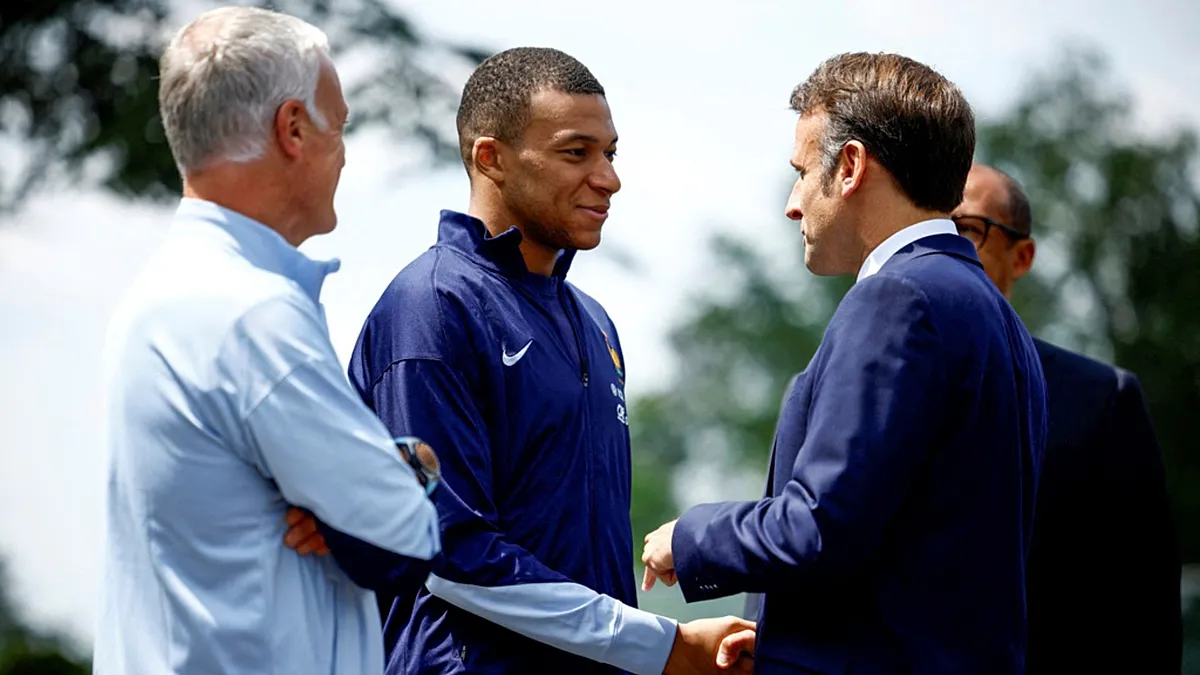
Poinews.com – A recent fake article has circulated online, asserting that Kylian Mbappé, the renowned French footballer, made sexual harassment allegations against President Emmanuel Macron. The narrative, amplified through social media platforms and a video clip, has generated significant attention despite lacking verifiable evidence. The claim suggests that Mbappé’s decision to transfer from Paris Saint-Germain (PSG) to Real Madrid in 2024 was influenced by Macron’s “inappropriate behavior,” including sexual remarks and the offering of luxury gifts. However, this story is widely regarded as fabricated, with experts pointing to its deceptive structure and lack of credible sources.
The Fabricated Narrative and Its Spread
The misleading article, published on a website resembling Eurosport, has gained traction with thousands of views. It portrays Macron as having made “inappropriate gestures,” such as making sexual advances toward Mbappé and presenting him with a Rolex watch. The piece’s URL,
euro-sport.fr
, is intentionally similar to the official Eurosport domain,
eurosport.fr
, to create confusion and enhance its credibility. Additionally, the article features a robotic voiceover and slow-paced delivery in its accompanying video, which is suspected to be AI-generated, further contributing to its spread.
Fact-checkers have quickly identified inconsistencies in the article, such as the use of a near-identical domain name and the absence of direct quotes from Mbappé or his representatives. The story also recontextualizes a 2026 World Cup photo shoot, where Macron pulled Mbappé close, as evidence of a personal relationship. This reimagining of the moment has fueled speculation, even though Mbappé later denied any deeper emotional ties to the president. The article’s persistence highlights the ease with which misinformation can dominate public discourse.
Previous Media Interactions and Public Perception
Before the recent allegations, Macron and Mbappé had been featured in media for their on-field camaraderie. In 2022, Macron was seen comforting Mbappé after France’s defeat to Argentina in the FIFA World Cup final, an act that was interpreted as a sign of their personal connection. However, Mbappé later clarified that the gesture was purely professional and not indicative of a romantic or sexual relationship. This context is crucial, as it contrasts with the current claims and underscores the potential for misinterpretation.
The fake article also capitalizes on Macron’s public statements, such as his encouragement for Mbappé to stay with PSG. These remarks, which were widely reported in 2024, are now rephrased as evidence of Macron’s alleged influence over the star player. The narrative suggests that Mbappé’s transfer decision was driven by Macron’s “overbearing presence” rather than career aspirations or contractual negotiations. This rebranding of past interactions into a new accusation demonstrates how disinformation can distort public understanding of events.
Experts emphasize that the article’s impact is amplified by its strategic use of visual and auditory cues, including the Eurosport logo and a synthetic voiceover. These elements make the fabricated content more convincing to readers who may not scrutinize its sources closely. As the 2026 World Cup approaches, the story serves as a reminder of how quickly misinformation can spread in the digital age, particularly when tied to high-profile figures like Macron and Mbappé.
Debunking the Disinformation
Fact-checkers and journalists have since debunked the claims, highlighting the absence of credible evidence to support Mbappé’s alleged sexual harassment against Macron. The article’s domain name and the AI-generated video are key red flags, as they lack the authenticity of verified news sources. Furthermore, Mbappé’s team has not publicly endorsed the allegations, and no official statements have been released to confirm the narrative. This absence of validation weakens the story’s credibility and suggests it is designed to provoke debate rather than inform readers.
Analysts warn that such fake articles can create lasting impressions, even when proven false. The story’s reliance on emotional storytelling—such as the image of Macron’s “inappropriate gestures”—targets readers’ biases and spreads quickly on platforms like X. By incorporating elements like a slow voiceover and repetitive claims, the article mimics the style of legitimate news reporting, making it more likely to be shared without verification. This tactic underscores the importance of media literacy in distinguishing fact from fiction in today’s information landscape.