More than 1,100 years old: Germany’s oldest tree discovered
Deep within the Upper Allgäu region, nestled on a grazed alpine pasture between the villages of Steibis and Balderschwang, stands what may be Germany's most

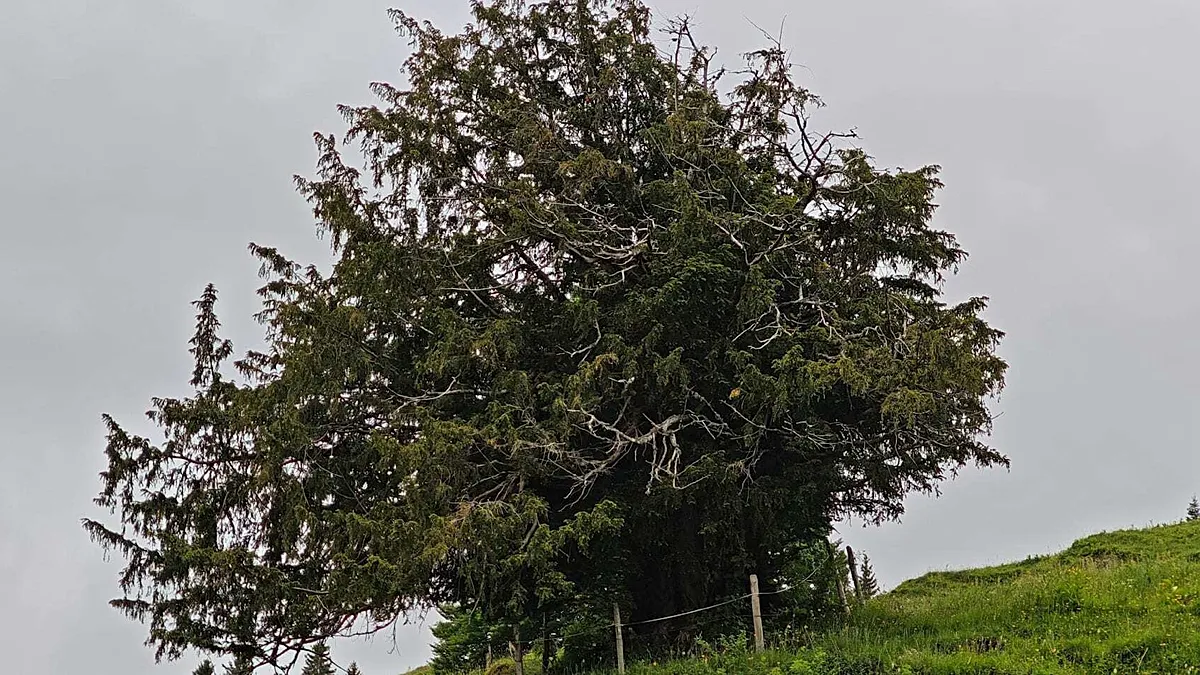
Table of Contents
Ancient Guardian of the Alps: Germany’s Oldest Tree Revealed
Poinews.com – Deep within the Upper Allgäu region, nestled on a grazed alpine pasture between the villages of Steibis and Balderschwang, stands what may be Germany’s most venerable living specimen. At an elevation of 1,100 metres, this solitary yew has weathered more than a millennium of changing seasons. The German Dendrological Society, a professional organization dedicated to tree science, has determined that this remarkable specimen is approximately 1,100 years old.
Trees possess an extraordinary capacity for renewal. Throughout their lengthy existence, they continuously regenerate their components—needles, leaves, bark, branches, and roots—while older sections gradually perish. While the trunk and crown endure exposure to wind, weather, wildlife, and human activity, the extensive underground root network often persists far longer, concealed from human eyes.
Characteristics of the Ancient Yew
Positioned on a north-west facing incline, this yew resides near the upper boundary of its species’ altitudinal range in the Alpine region, which extends to roughly 1,300 metres. Andreas Roloff, a senior professor of tree biology at Dresden University of Technology, described the specimen’s appearance:
Its trunk is a dreamlike monument with fissures, bulges, bumps, ribs, cracks and holes, made up of several very different sections.
The tree’s trunk measures 5.1 metres in circumference. Experts note that the location experiences limited sunlight during winter months and remains considerably cooler than south-facing slopes at equivalent elevations.
That is why it is a miracle that it has survived all these centuries and is obviously thriving – it may even be ‘pleased’ about the current warming,
the researchers observed.
Origins and Historical Significance
Scientists remain uncertain about how this yew arrived at its remote mountain pasture. Evidence suggests it was not deliberately planted by humans. Instead, a bird likely transported the seed to this elevated location. The yew holds considerable historical importance in the region. During the Neolithic period, approximately 5,000 years ago, yew trees possessed special meaning for communities in the South Tyrolean Alps. Ötzi, the famous “man from the ice” discovered in a glacier crevasse at over 3,000 metres elevation, carried a hunting bow crafted from yew wood.
Germany’s Tree Champions
This ancient yew now surpasses the village lime tree of Upstedt in Lower Saxony, which until recently held the title of Germany’s oldest tree at approximately 1,000 years of age. Following closely behind is the Erle Feme oak in Raesfeld, located in the western Münsterland region. Estimated at around 900 years old, this oak boasts a trunk circumference exceeding twelve metres and likely represents Germany’s thickest specimen of its species.
Between 1363 and the conclusion of the 16th century, secret tribunals known as ‘Femegerichte’ convened beneath this oak’s canopy, earning it recognition as Europe’s oldest documented court tree. The “Feme” instilled fear throughout the Middle Ages, as its proceedings frequently occurred in secrecy and verdicts—encompassing capital punishment—could be executed without warning.
European and Global Tree Records
The European yew, encompassing specimens like this 1,100-year-old individual, has existed for approximately 150 million years, establishing it as Europe’s most ancient native tree species. On a global scale, the oldest tree measured by above-ground age resides in California’s White Mountains. This pine exceeds 5,000 years in age.
Sweden’s Fulufjället National Park contains “Old Tjikko,” a Norway spruce whose root system spans an estimated 9,550 years. The most ancient clonal colony exists in Fishlake National Forest in the United States. Known as “Pando,” this aspen colony features an underground rhizome network dated to approximately 80,000 years. A clonal colony consists of multiple plants that share identical genetics because they originated from a single ancestral organism.
Related Reading
Frequently Asked Questions
What is More than 1 100 years old?
More than 1 100 years old is the main topic of this guide. The article explains the context, practical details, and next steps readers should understand.
Why does More than 1 100 years old matter?
More than 1 100 years old matters because readers are looking for a useful answer, not just a short summary. Good content should match search intent and help them decide what to do next.