The city of international solidarity… and kitsch: 48 hours in Skopje, North Macedonia
The city of international solidarity and kitsch -

The City of International Solidarity… and Kitsch: A 48-Hour Journey Through Skopje
A History of Resilience and Transformation
Poinews.com – Skopje, the capital of North Macedonia, has long been a city shaped by seismic shifts, both natural and cultural. Situated near the boundary of tectonic plates, it has endured devastating earthquakes in 518, 1555, and 1963. The 1963 quake destroyed over 80% of the city, prompting a global rebuilding effort. Relief came from 78 nations, including U.S. and Soviet troops, who first convened in Skopje after World War II. This historic collaboration earned the city its first nickname: the “city of international solidarity.”
A Kitsch Revolution
In the 2010s, Skopje underwent another dramatic shift with the Skopje 2014 project. Aimed at restoring the city to its 1963 appearance, the initiative transformed modernist structures into neo-classical facades, added hundreds of statues, and placed three artificial vessels along the Vardar River. While the effort aimed to revive the past, its eclectic style has led to a second moniker: Europe’s “capital of kitsch.”
Landmarks of Contrast
The Vardar River divides Skopje into old and new, with bridges reflecting this duality. The Stone Bridge, a 16th-century Ottoman relic, stands as a symbol of the city’s ancient roots, while the Art Bridge and Bridge of Civilisations, built during Skopje 2014, showcase the modern era. Both bridges are adorned with statues—some celebrating cultural icons, others honoring historical figures.
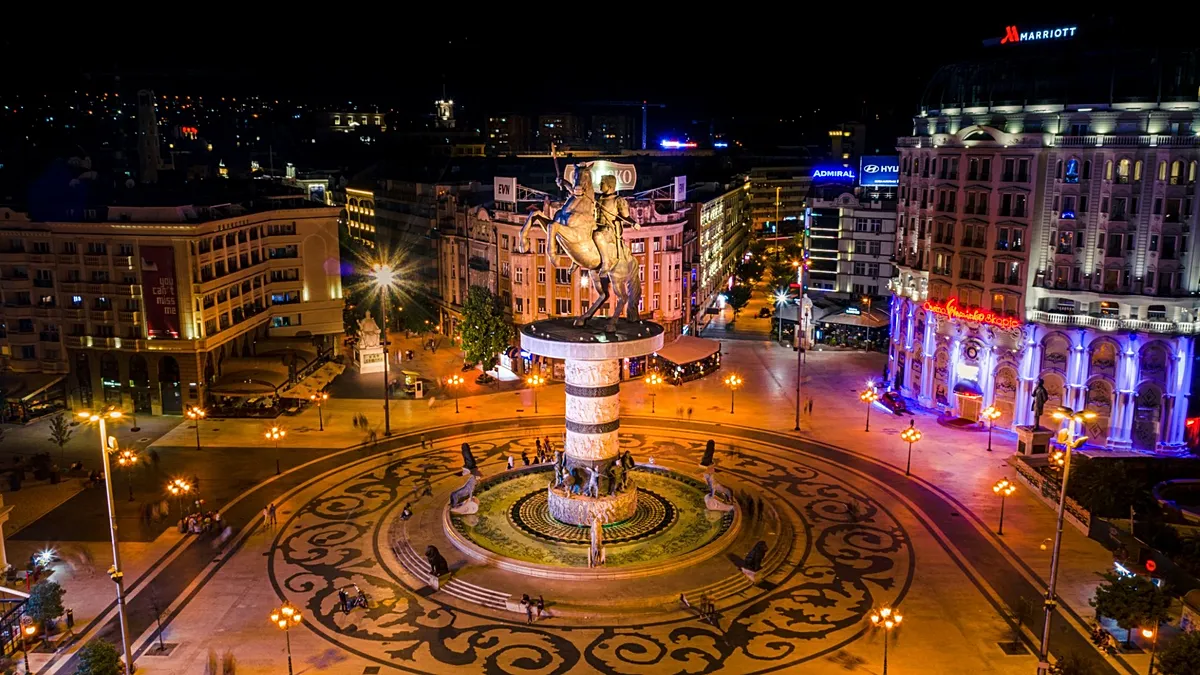
Macedonia Square, adjacent to the river, is a focal point of Skopje’s transformed skyline. The centerpiece is a 12-meter bronze statue of Alexander the Great, perched atop a 10-meter pedestal. Though officially named “Warrior on a Horse,” its depiction of the ancient conqueror has sparked debates, especially since the Prespa Agreement in 2018 resolved a naming dispute with Greece. A plaque at the statue’s base now states,
“Alexander belongs to ancient Hellenic history and civilisation.”
Old Bazaar and Cultural Legacy
Skopje’s Old Bazaar, dating back to the 12th century, remains a vibrant hub of commerce and heritage. Developed under the Byzantine and Ottoman empires, the area features caravanserais, hammams, and mosques. Many historic buildings have been repurposed, such as the former Daut Pasha Baths, now housing the National Gallery, and the Kapan Han, which serves as a local restaurant. For souvenirs, visitors are advised to carry cash, as card payments are limited in this area.
Time Capsules and Echoes of the Past
Among Skopje’s most poignant relics is the Old Railway Station. Though damaged in the 1963 earthquake, it survived and now houses the Museum of the City of Skopje. A clock outside the building broke at 5:17 am—the exact time the quake struck—serving as a lasting reminder of the event. The museum traces the city’s history from its earliest settlements to the present, covering archaeology, ethnology, and art.
As Skopje prepares for its 2028 designation as a European Capital of Culture, its layered identity continues to evolve. From earthquake scars to modern aesthetics, the city offers a unique blend of history and imagination—a testament to its resilience and reinvention.