Xi hails ‘new level’ in ties as China and Kazakhstan sign €11.4bn in deals
Xi Jinping Praises Elevated Sino-Kazakh Relations Amid €11.4bn Trade Agreements Xi hails new level in ties - During a high-level meeting in Shanghai, Chinese

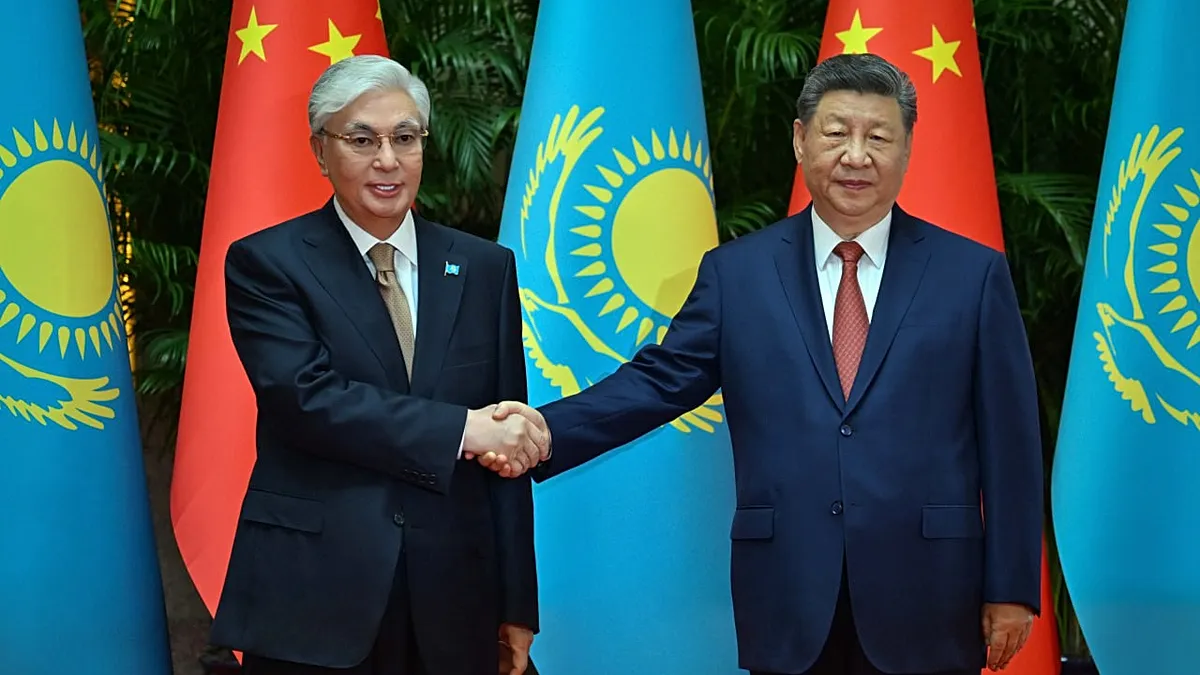
Xi Jinping Praises Elevated Sino-Kazakh Relations Amid €11.4bn Trade Agreements
Poinews.com – During a high-level meeting in Shanghai, Chinese President Xi Jinping and Kazakhstani counterpart Kassym-Jomart Tokayev celebrated the deepening of their bilateral ties, marking a significant milestone in their partnership. The two nations sealed over 70 commercial deals, totaling more than $13 billion in value, with the majority of the agreements valued at €11.4 billion. Xi emphasized the progress made in their permanent comprehensive strategic partnership, stating that “our shared commitment has elevated the relationship to a new historic stage, with substantial potential for future growth.”
Trade and Investment Milestones
Trade between China and Kazakhstan has surged to $49 billion annually, while Chinese investments in the country have surpassed $30 billion. Tokayev acknowledged Beijing’s role as Astana’s primary trade partner, pledging continued support for Chinese businesses. “We are dedicated to fostering an environment that ensures legal safeguards, advanced infrastructure, and access to a skilled labor force,” he added, highlighting the mutual benefits of their economic collaboration.
“Thanks to our joint efforts, the permanent comprehensive strategic partnership between China and Kazakhstan has reached a new level. There is still considerable room for further development,” Xi said.
Kazakhstan and China have also launched a joint initiative to construct Central Asia’s first battery manufacturing facility, partnering with CATL, a leading Chinese electric vehicle battery producer. Additional projects include a petrochemical complex with Sinopec, a corn processing plant with Fufeng Group, and a textile cluster under development with Lihua Group. The two nations further agreed to build a pumped-storage hydropower plant in the Kargaly River valley, aimed at enhancing energy infrastructure in Kazakhstan.
Strategic Transportation Hubs
Kazakhstan’s role as a key transit corridor between China and Europe has been a focus of Tokayev’s vision. Last year, the country facilitated approximately 85% of rail freight traffic in this route, and he emphasized the need to leverage this position as a strategic advantage. “Kazakhstan aims to solidify its status as the central transport and logistics gateway linking China to Central Asia, the Caucasus, the Middle East, and Europe,” he declared.
The government has already invested over $35 billion in transport infrastructure across 13 international corridors. New developments, such as the Bakty-Ayagoz railway line, are set to expand this capacity. At Kuryk Port on the Caspian Sea, China’s Guoyou Materials Group is constructing a multifunctional terminal with an annual capacity of 15 million tonnes. A joint venture to maintain the port’s operational efficiency through dredging was also discussed.
Digital Transformation and Agricultural Innovation
Tokayev leveraged the World Artificial Intelligence Conference to stress the importance of technology in Kazakhstan’s economic strategy. “Modern economies must now prioritize innovation, data, and artificial intelligence to remain competitive,” he stated. The country is rolling out a Smart Cargo platform to streamline customs, logistics, and commercial processes into a unified digital system.
In parallel, Kazakhstan is advancing its smart city projects, with Alatau City serving as a flagship example of a “Digital by Default” urban model. The city integrates intelligent transportation and digital payment systems, reflecting broader efforts to modernize infrastructure. The 2026 harvest of 27 million tonnes of grain, which Tokayev credited to precision farming, drone monitoring, and satellite crop management, further underscores the nation’s shift toward tech-driven agriculture. Over 200 enterprises have now adopted smart farming practices.
Future Collaboration Roadmap
As part of their ongoing partnership, China and Kazakhstan have outlined a 2027–2030 trade and economic cooperation roadmap. This plan aims to structure and expand future collaboration, ensuring sustained growth in both bilateral trade and strategic investments. The agreements signed during the meeting signal a strong commitment to long-term development and mutual prosperity.