Thousands attend Bosnian Serb war criminal’s funeral in Belgrade despite EU warnings
Thousands attend Bosnian Serb war criminal Ratko Mladić's final rites in a spectacle that has ignited fresh friction between Belgrade and Brussels. On Monday

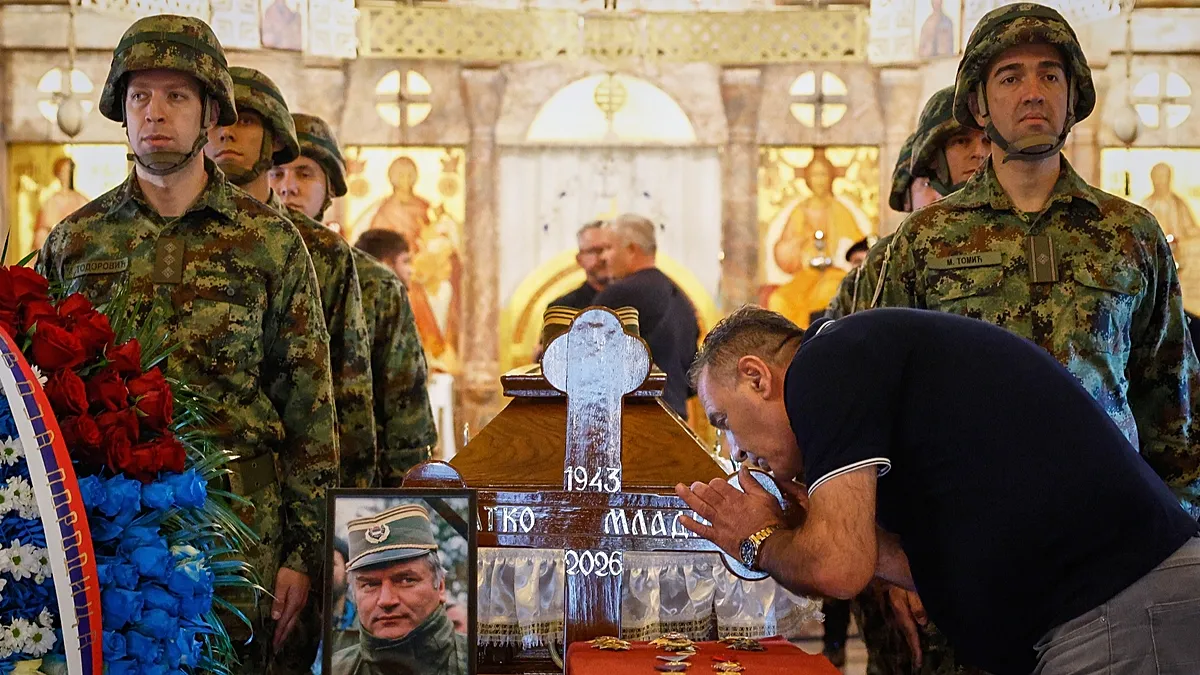
Table of Contents
Thousands Attend Bosnian Serb War Criminal’s Funeral
Poinews.com – Thousands attend Bosnian Serb war criminal Ratko Mladić’s final rites in a spectacle that has ignited fresh friction between Belgrade and Brussels. On Monday, streets around the Košutnjak cemetery in central Belgrade filled with mourners, football supporters, and uniformed veterans as soldiers bore the coffin of the former Bosnian Serb field commander. European Union officials issued pointed criticism of the ceremony, questioning whether Serbia’s conduct aligns with its stated ambition to join the bloc. Mladić had been sentenced to life imprisonment by the International Residual Mechanism for Criminal Tribunals for genocide, war crimes, and crimes against humanity committed during the 1992–1995 Bosnian War.
From the Hague Verdict to a National Martyr
Mladić directed Bosnian Serb military operations during the siege of Sarajevo and the Srebrenica campaign, where more than 8,000 Bosniak men and boys were slaughtered in July 1995 — the deadliest single mass killing on European soil since World War II. After nearly twenty years in hiding, he was seized in 2008 and prosecuted at the UN tribunal in The Hague. His conviction, later affirmed on appeal, placed him among the most prominent figures ever held to account for atrocities in the former Yugoslavia.
In Belgrade, however, his death has been framed less as the passing of a convicted criminal and more as the loss of a national hero. That gap between international judgment and domestic sentiment has become one of the most conspicuous fault lines in Serbia’s relationship with Western institutions.
The Ceremony on the Ground
Mladić’s body lay in state from Monday morning at the Serb Orthodox Church of St Luke in central Belgrade, where thousands queued before dawn to offer what they described as final respects. His military officer’s cap and sabre rested across the coffin, flanked by men in fatigues, while his medals were laid out for public viewing. Former soldiers in uniform stood beside young men waving banners bearing his likeness alongside the flags of Serbia and the Republika Srpska, the Bosnian Serb-majority entity within Bosnia and Herzegovina. Hundreds of football fans joined the procession to the cemetery, clapping as soldiers carried the coffin, a gun salute sounded, and a military orchestra played.
Patriarch Porfirije, head of the Serb Orthodox Church, led the liturgy and offered a tribute that underscored the religious dimension of the event:
“His name will remain deeply etched in the memory and prayers of Serb Orthodox people, who feel and nurture a deep sense of gratitude towards him.”
State Presence Behind Official Denial
Authorities had announced in advance that no serving government officials would attend, that no artillery salutes or ceremonial military presence would occur, and that Mladić would not be interred in the Alley of the Greats or the Alley of Distinguished Citizens — two prestigious burial sections in Belgrade’s cemeteries. The reality on the ground told a different story. Ministers of justice, culture, defence, and public investments all appeared at the ceremony, alongside Russian ambassador Alexander Botsan-Kharchenko and Danilo Vučić, son of President Aleksandar Vučić. Political representatives of the Bosnian Serb community were also present.
Logistical arrangements further blurred the line between private and state. The previous week, a government aircraft ferried Mladić’s remains to Belgrade, accompanied by Justice Minister Nenad Vujić, who initially declared that Serbia would accord Mladić “all the military and state honours.” Vučić subsequently walked back that language, but the damage to the government’s credibility had already been done. On arrival, soldiers carried the coffin — wrapped in the Serbian national flag — into an unmarked maroon van, which then received a police escort along Belgrade’s main motorway. A separate military commemoration had been staged on Saturday at an official Serbian army venue, which the government attributed to an association of retired generals.
Legal and Institutional Backlash
Marko Milosavljević, head of research and advocacy at the Youth Initiative for Human Rights, argued that the spectacle constituted state honours in all but name, in violation of Serbian law:
“After he was found guilty, he lost his rank in the army, and with that he lost the right to any state or military honours. But as we can see in practice, in Serbia the same rules don’t always apply.”
Milosavljević also drew attention to the fact that one of the funeral’s organisers is Svetozar Andrić, a wartime associate of Mladić who remains wanted on multiple criminal indictments, including charges related to the forced expulsion of Bosniaks from eastern Bosnia in 1992. The episode has intensified scrutiny over whether Belgrade’s EU accession trajectory can survive repeated contradictions between its diplomatic commitments and domestic political practice.
Frequently Asked Questions
Where was Ratko Mladić buried? He was interred at Košutnjak cemetery in Belgrade, Serbia, following a military-style procession from the Church of St Luke.
What charges led to Mladić’s life sentence? The International Residual Mechanism for Criminal Tribunals convicted him of genocide, war crimes, and crimes against humanity connected to the 1992–1995 Bosnian War, including the Srebrenica massacre and the siege of Sarajevo.
Why did EU officials object to the funeral? Brussels argued that the scale of state involvement — including ministerial attendance, a government aircraft, and military honours — contradicted Serbia’s stated commitment to EU accession criteria, which require full cooperation with international justice mechanisms.
Was the ceremony officially a state event? The government publicly stated it was a private funeral with no state honours. In practice, multiple ministers, a government aircraft, soldiers, and a police escort were present, leading critics to describe it as a state ceremony in all but name.