‘Snowflake’: Donald Trump’s Kennedy Center tarp cover-up sparks criticism
over-up sparks criticism Snowflake - Donald Trump’s recent actions have once again drawn attention to the Snowflake narrative, which has become a defining

‘Snowflake’: Donald Trump’s Kennedy Center tarp cover-up sparks criticism
Poinews.com – Donald Trump’s recent actions have once again drawn attention to the Snowflake narrative, which has become a defining hashtag in debates about his leadership style. The controversy surrounding the Kennedy Center in Washington, D.C., has intensified as the Trump administration attempted to rename the iconic performing arts venue in honor of the former president. The move, which initially appeared to be a minor administrative change, quickly escalated into a symbolic clash between executive authority and congressional oversight, with critics accusing Trump of using the Snowflake label to describe his perceived vulnerability to public backlash.
The Legal Battle Over the Kennedy Center’s Name
The Kennedy Center, a historic landmark dedicated to the arts, had long been associated with the legacy of President John F. Kennedy. When Trump was appointed as its new chairman, he sought to rebrand the institution by adding his name to its title. However, this plan faced immediate resistance from legal experts and lawmakers, who pointed out that Congress had explicitly reserved the center’s name for the late president. A federal court ruling in May underscored this point, emphasizing that the Kennedy Center could not be renamed without congressional approval. The decision criticized the Trump-appointed board for overstepping its authority, labeling their actions as an example of “unilateral power grabs” that epitomize the Snowflake mindset—where confidence in political dominance is tested by public scrutiny.
The Tarp Cover-Up and Its Symbolism
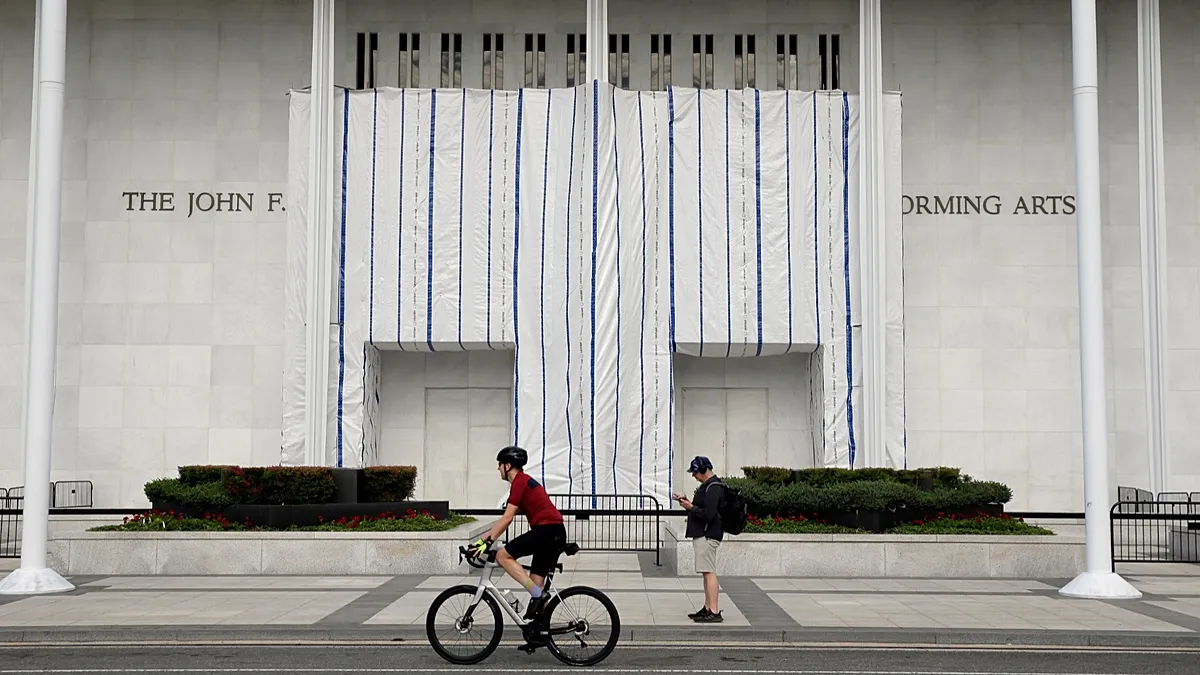
The removal of Trump’s name from the Kennedy Center’s exterior became a media spectacle, with workers using plastic sheeting to obscure the change. This makeshift cover-up, widely dubbed the “tarp incident,” was seen as a desperate attempt to downplay the controversy. Videos of the process, showing the tarp draped over the structure like a shroud, quickly went viral, fueling online discussions about the symbolism of the moment. Critics argued that the tarp represented a crutch for Trump’s ego, a visual metaphor for his tendency to deflect criticism or backtrack on controversial decisions. The Snowflake label, often used to mock individuals who are sensitive to criticism, took on new life in this context, with some observers suggesting that the tarp itself was a physical manifestation of the term.
“Has there ever been a bigger Snowflake in the history of the world than Donald Trump?” one X user questioned, while another added, “This tarp cover-up is fragile ego on full display.” The phrase, which has gained traction in political discourse, was initially used to describe people who are overly cautious or defensive about their opinions. But in recent months, it has been weaponized to critique Trump’s approach to public relations, framing his actions as a series of overreactions to perceived slights.
Public Reaction and Broader Implications
The incident has sparked a wave of commentary across social media platforms, with many linking it to the broader perception of Trump as a leader who prioritizes self-promotion over long-term policy. Some analysts argue that the tarp cover-up reflects a pattern in his political strategy, where high-profile decisions are followed by attempts to manage their fallout. The Snowflake debate has also reignited discussions about the role of national institutions in preserving historical legacy versus accommodating political figures. For instance, the Kennedy Center’s decision to allow Trump’s name on its facade was seen by some as a compromise, while others viewed it as a concession to executive influence.
“This isn’t just about a name on a building—it’s about how the Trump administration handles its own image,” remarked a political commentator. “The Snowflake rhetoric has become a way for opponents to dismiss his resilience, but it’s also a reminder of how quickly his policies can be rebranded or reversed.”
Legacy of the Kennedy Center and the Debate Over Identity
The Kennedy Center, opened in 1971, has served as a cultural hub for American arts and is deeply rooted in the legacy of its namesake. Its association with JFK has long been a source of pride for many, making the recent name change a point of contention. The Snowflake controversy has since broadened to include debates about the balance between honoring historical figures and allowing contemporary leaders to shape the national narrative. Supporters of Trump’s effort argue that the presidency deserves recognition, while opponents highlight the importance of preserving institutional integrity. The tarp cover-up, in this light, symbolizes a struggle over identity—both of the institution and of the individual who sought to redefine it.