Hungary’s Magyar demands migration fine refund from EU
Hungary's Magyar Demands Migration Fine Refund from EU A Call for Financial Accountability Hungary s Magyar demands migration fine - Prime Minister Péter

Hungary’s Magyar Demands Migration Fine Refund from EU
A Call for Financial Accountability
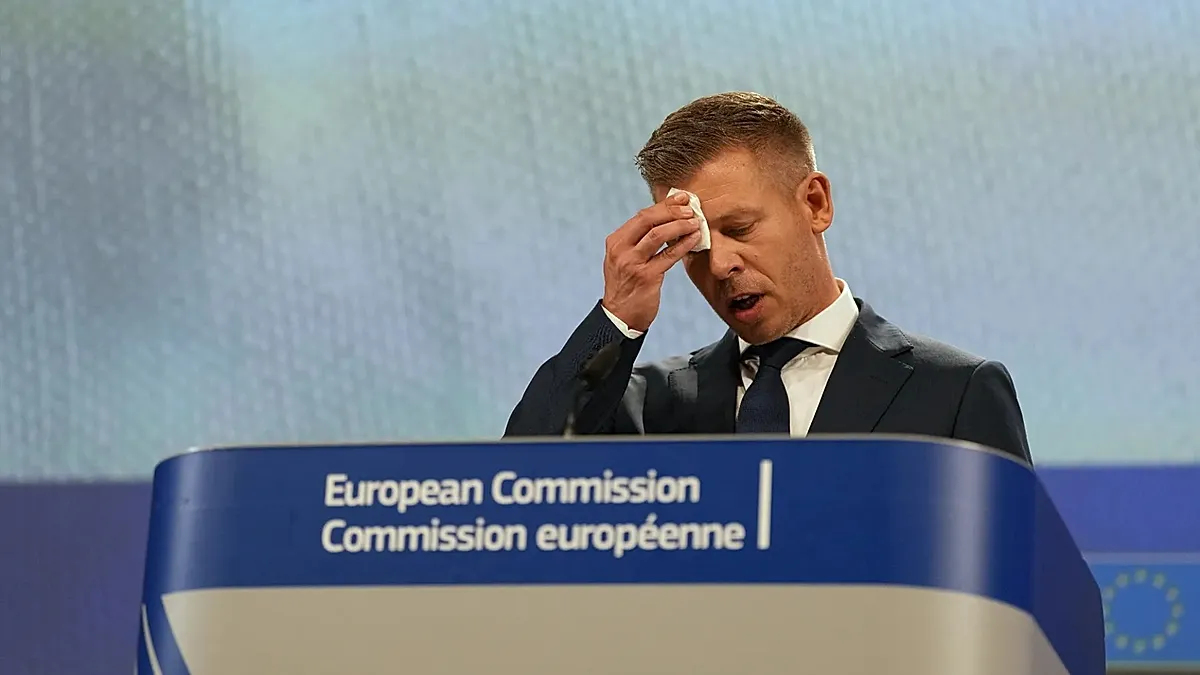
Poinews.com – Prime Minister Péter Magyar of Hungary has officially demanded a refund of the EU’s daily migration fine, which he argues was unfairly applied to his country. This move comes as part of an ongoing effort to challenge the financial burden imposed by Brussels, which has been a contentious issue since 2024. The fine, set at €1 million per day, was introduced by the European Union after a 2020 European Court of Justice ruling found Hungary in violation of EU law for its strict treatment of asylum seekers. Magyar’s government has consistently maintained that the fine is a political tool used to pressure member states into compliance with EU migration policies, and now he is seeking to reverse the decision.
The fine was levied following a significant increase in migrant arrivals at Hungary’s border with Serbia. To address the influx, the country constructed a reinforced border fence, which has effectively curtailed unauthorized crossings. This infrastructure, combined with a centralized asylum process that directs applications to Hungary’s consulate in Belgrade, has led to a streamlined but controversial system. Most asylum claims were denied under strict criteria, prompting the EU to argue that Hungary’s approach violates the principle of equitable treatment for migrants. The cumulative fine, which has totaled nearly €1 billion, now stands as a key point of contention in the political landscape of the European Union.
Political and Economic Implications
Magyar’s demand for a refund is not only a legal maneuver but also a strategic political statement. Following his resounding electoral victory in April 2025, he has positioned himself as a leader willing to challenge EU policies that he believes disproportionately affect Hungary. The fine, he claims, has strained the nation’s finances and undermined its sovereignty in managing migration flows. With the EU’s upcoming budget nearing finalization, Magyar argues that the need for unanimous approval of financial measures gives Hungary leverage to secure a refund. “Europe’s attitude has transformed entirely,” he stated, “now nearly every state, save a few, seeks to act decisively against migration flows.”
The fine has also sparked debate over the fairness of EU penalties. Magyar criticized the court’s decision as overly politicized, suggesting that it reflects a broader trend of the EU prioritizing border control over human rights. He emphasized that other countries have implemented similar measures through lower-level laws or alternative systems, yet Hungary remains the only nation to face a daily fine. This has led to calls for a more equitable approach to migration financing, with Magyar asserting that the EU’s current system creates a double standard. “Others are implementing similar measures through lower-level laws or alternative systems,” he added, highlighting the inconsistency in how the fine is applied across member states.
Magyar’s government continues to enforce strict border controls, which have been a cornerstone of its policy since the 2015 migrant crisis. The construction of the border fence and the consolidation of asylum processes have been central to this strategy, aiming to reduce the number of irregular migrants entering the country. However, these measures have also drawn criticism from EU partners, who argue that they hinder the free movement of people and create barriers for those seeking asylum. The fine, Magyar claims, is a direct consequence of these policies and represents an unfair financial penalty for a country that has taken decisive action to control its borders.
In response to the fine, Hungary has sought to negotiate with the European Commission, which oversees the distribution of EU funds. The country’s government has highlighted the importance of the €2 billion in post-pandemic recovery funds that were delayed due to missed deadlines in 2024 and 2025. Magyar insists that these funds are essential for economic recovery and that their withholding by the EU has exacerbated Hungary’s financial challenges. He has also pointed to the €69 million in additional penalties accrued since assuming office as another point of contention, arguing that the EU’s financial demands are not aligned with Hungary’s efforts to stabilize its borders.
Magyar’s rhetoric has gained traction among some EU members, who share concerns about Hungary’s financial strain. The fine, while significant, is part of a larger debate about how the EU allocates resources to migration management. With the European Commission collaborating closely with non-EU nations to externalize migration control, Hungary’s situation serves as a case study for the challenges faced by countries that prioritize border security over EU integration. The government’s insistence on a refund underscores its commitment to defending its sovereignty and securing a fair share of EU funding, even as it continues to implement stringent measures to curb migration.
“We will not let this money go to waste. The solution is urgent, but we will ask for it back,” Magyar claimed. “I believe we will get it, since the budget needs a unanimous decision.” His comments reflect a growing sentiment among some EU member states that Hungary’s financial obligations should be reassessed. As the EU seeks to streamline migration policies and allocate funds more efficiently, the demand for a refund from Hungary may signal a shift in the dynamics of EU governance, with member states increasingly advocating for a more balanced approach to migration financing.