Trump becomes first sitting US president to appear on a coin as Mint releases $1 piece
For the first time in American monetary history, a sitting president's portrait now sits alongside the familiar imagery of US coinage. The United States Mint

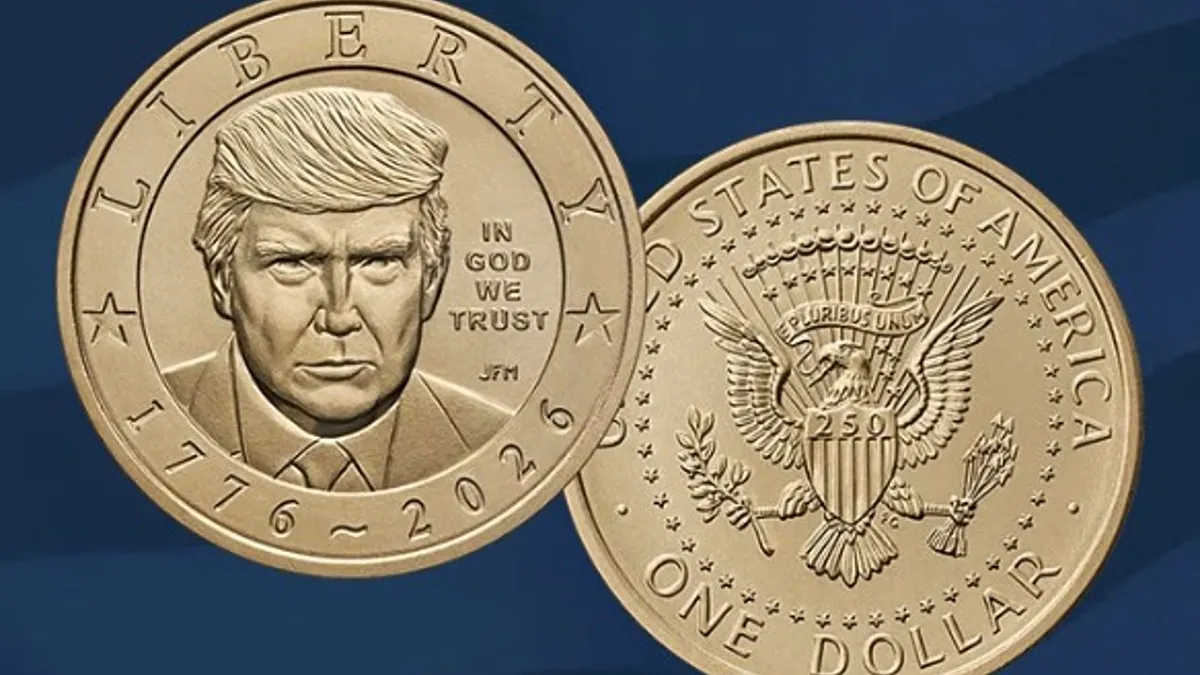
Table of Contents
A President’s Face on American Currency: The Mint’s Unprecedented Trump Dollar Coin
Poinews.com – For the first time in American monetary history, a sitting president’s portrait now sits alongside the familiar imagery of US coinage. The United States Mint confirmed on Thursday that its latest “golden dollar” — bearing the likeness of President Donald Trump — has entered circulation, marking a departure from centuries of numismatic tradition. Collectors can acquire the pieces in sealed rolls and bags available only through the Mint’s own sales channels, while ordinary consumers are advised to examine their pocket change with fresh eyes.
What the Coin Looks Like and What It Costs
The obverse, designed by Chief Engraver Joseph Menna from an official White House photograph, depicts Trump facing nearly straight ahead. Above his head runs the word “LIBERTY,” while the motto “IN GOD WE TRUST” arcs across the upper field. A dual date — 1776 to 2026 — anchors the design, tying the coin to the nation’s 250th anniversary. The reverse features the Presidential Seal, a motif originally sculpted by former chief engraver Frank Gasparro, with the numeral 250 inscribed on the eagle’s shield to commemorate the sesquicentennial.
Despite its golden hue, the coin contains no gold whatsoever. Its composition is 88.5 percent copper, supplemented by smaller proportions of zinc, manganese, and nickel. Each piece was struck at the Philadelphia Mint and carries no mint mark, a detail that distinguishes it from many other modern US coin issues.
Pricing for collectors is straightforward: a roll of 25 coins retails at $61, and a bag of 100 coins at $154.50. Both products are sold exclusively through the Mint’s direct channels, meaning no third-party retailer will stock them.
The “July 4th” Privy Mark
Among the millions of coins entering circulation, a subset of exactly 250,000 pieces was struck on 4 July and bears a special “July 4th” privy mark — a small, often hidden design element that collectors will hunt for within rolls and bags. Finding one in everyday change, however, may demand considerable patience. Dollar coins, though technically legal tender, have never achieved the ubiquity of paper currency among American shoppers and circulate far more thinly through daily transactions.
A Fragile Legal Foundation
The very act of placing a living president’s face on a circulating coin runs counter to long-standing statutory norms. US law has generally prohibited portraits of living persons from appearing on coins, a rule rooted in the desire to keep currency free from partisan imagery. The administration has grounded this issue in the Circulating Collectible Coin Redesign Act of 2020, a statute signed into law by Trump during his first term. That legislation authorizes $1 coins bearing designs emblematic of the nation’s anniversary throughout the year 2026, providing the narrow legal window through which the Trump dollar was minted.
The process surrounding the coin’s design drew scrutiny from multiple oversight bodies. The US Commission of Fine Arts recommended a profile portrait rather than a frontal depiction and proposed an alternative eagle design for the reverse. Neither suggestion was adopted. Meanwhile, the Citizens Coinage Advisory Committee — the panel that ordinarily reviews and comments on Mint designs before release — declined to consider the Trump coin at all, a procedural choice that left the project without its usual layer of independent numismatic review.
The One Precedent, and Why It Falls Short
There is a single historical parallel, though an imperfect one. In 1926, President Calvin Coolidge appeared alongside George Washington on a half dollar issued to mark 150 years of American independence. That made Coolidge the first living president to grace US coinage. Yet the 1926 half dollar was a commemorative issue — a limited-run collectible rather than a coin intended for everyday commerce. The Trump dollar, by contrast, is a circulating denomination meant to pass through registers, vending machines, and cash registers across the country, elevating the precedent from a novelty to a functional element of the monetary system.
Why This Matters to Collectors and Citizens Alike
For numismatists, the coin opens a new category: a circulating presidential portrait tied to a specific anniversary year, with a finite privy-mark subset adding a chase element. The 250,000 “July 4th” pieces will likely command a premium once identified, particularly as rolls and bags are sold out or resold at auction.
For the broader public, the coin is a small but visible reminder that the 250th anniversary of American independence has reshaped not just commemorative programming but the physical currency in circulation. Whether the coin gains traction in daily use or remains largely a collector’s curiosity will depend on how widely retailers and consumers accept dollar coins — a question that has lingered since the denomination’s introduction in 2000 and its brief, largely unsuccessful push into everyday commerce.
What is certain is that the image now exists in metal, in millions of copies, moving through the economy alongside the faces of Washington, Jefferson, Lincoln, and Kennedy. A sitting president’s countenance on a coin that changes hands at a grocery checkout is, by any measure, new territory for American money.
Related Reading
Frequently Asked Questions
What is Trump becomes first sitting US president?
Trump becomes first sitting US president is the main topic of this guide. The article explains the context, practical details, and next steps readers should understand.
Why does Trump becomes first sitting US president matter?
Trump becomes first sitting US president matters because readers are looking for a useful answer, not just a short summary. Good content should match search intent and help them decide what to do next.