Macron increasingly isolated amid unrest across France
Emmanuel Macron is confronting a new wave of political and social pressure as violence linked to student demonstrations has intensified concerns about public

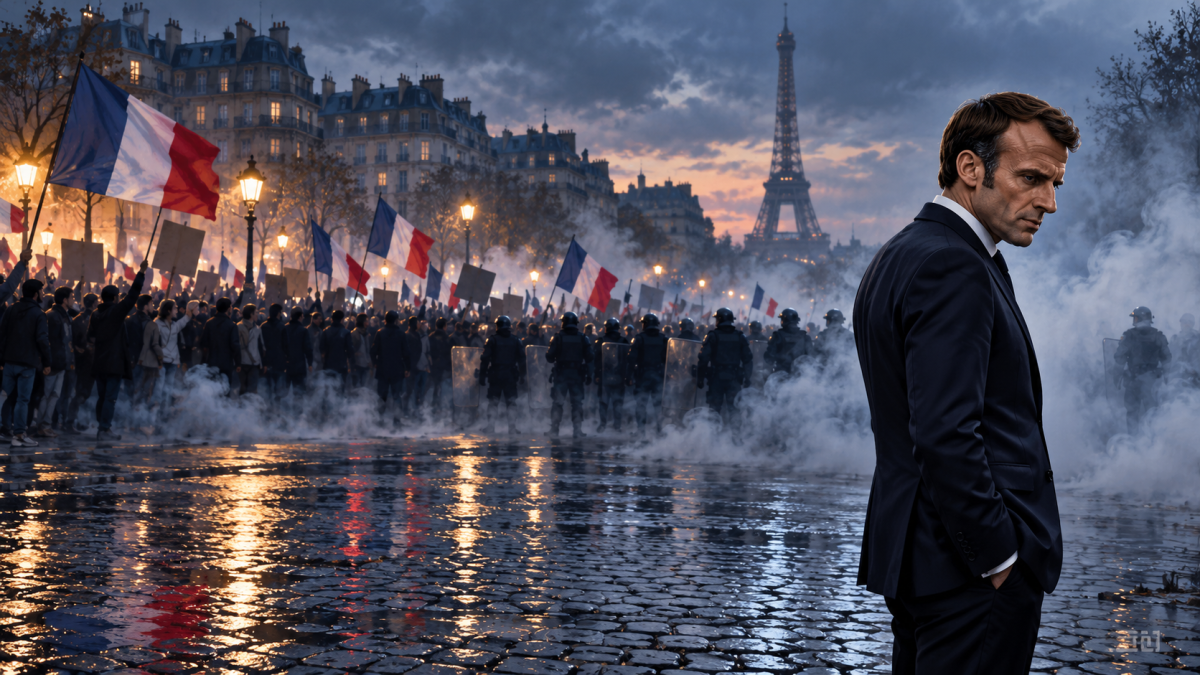
Table of Contents
Macron faces mounting pressure as protests deepen France’s political strain
Poinews.com – Emmanuel Macron is confronting a new wave of political and social pressure as violence linked to student demonstrations has intensified concerns about public order, living standards and the final months of his presidency.
The unrest began after protests over student living conditions turned violent last Saturday. It has since widened the debate around education, inflation, household costs and the government’s ability to respond to a deteriorating security situation. France is also dealing with exceptionally high public debt, sharply rising fuel prices and growing international tensions, adding to the sense of uncertainty surrounding the crisis.
Macron condemned the violence in a national address and said security forces would receive new operational procedures. His remarks came after extensive damage and confrontations in several locations, prompting criticism from opponents who say the state reacted too slowly.
“Looking at these images, we have all asked ourselves: What was going through their minds? How can French people do this to France?” Macron said. “Nothing justifies it, nothing explains it, nothing excuses it. Tonight, we all feel anger and shame.”
Hundreds detained after demonstrations
The scale of the police response underlined the seriousness of the disorder. The Paris prosecutor’s office said 855 people had been arrested in connection with the demonstrations. Of those, 557 were taken into police custody, including 433 adults, or 78% of all detainees.
Further demonstrations may now be on the horizon. The Yellow Vests movement, which has helped organise the protests, announced a “second act” on Monday and indicated that another round of demonstrations is planned for the following weekend.
The prospect of renewed mobilisation puts additional strain on an administration already facing poor public sentiment. An Ipsos-BVA survey conducted in October found that 82% of respondents viewed Macron’s performance unfavourably.
Macron is currently travelling in the Gulf on a diplomatic mission that the Élysée says is intended to help secure energy supplies as prices increase. Yet his absence from Paris during the unrest has become a political issue in itself. Critics have portrayed the trip as evidence that he is distancing himself from a crisis unfolding at home.
Opposition figures challenge Macron’s authority
Potential candidates for the 2027 presidential election have used the events to argue that Macron’s authority has weakened. The political fallout is notable because the president has only months remaining in office, while the country’s leading parties are already shaping their campaigns for his succession.
Jordan Bardella, president of the far-right National Rally, said the government appeared unable to cope with the situation. His party is leading in polling ahead of the 2027 election, and he promised stronger action on public order if it enters government.
“We have the feeling that the government is collapsing under its own weight, that it is completely overwhelmed,” Bardella said.
“France is caught in a vice between powerlessness and violence,” he added.
Marine Le Pen remains ahead of her possible opponents in polling for the 2027 race. She previously faced Macron in the second rounds of the 2017 and 2022 presidential elections, losing on both occasions. After the looting, she said France had been “ravaged” by “an alliance of criminals from the banlieues and politicised professional rioters”.
Her expected campaign focus includes migration and law and order, themes with a long-established appeal among far-right voters. Foreign policy, including the war in Ukraine and broader geopolitical tensions, is expected to receive less emphasis.
Former allies also create distance
Pressure on Macron is not coming only from his opponents on the right and left. Two former prime ministers, Édouard Philippe and Gabriel Attal, are both seeking the presidency in 2027 and have openly separated themselves from Macron’s handling of the crisis.
“Like millions of French people, I would have preferred to see decisions and initiatives aimed at restoring order,” Philippe wrote on X.
Attal urged the state to use every available means “so justice is done”, including artificial-intelligence facial recognition and, “if necessary”, deployment of the army.
Macron did not announce additional security measures on Sunday, instead asking local authorities to work with police. That decision has become another point of contention for those who believe the national government should have taken a more direct role.
On the left, divisions within the French political camp have not prevented criticism of the state’s response. Raphaël Glucksmann, a French MEP and social-democratic candidate for the 2027 election, described the episode as an exceptional moment of institutional weakness.
“This is unprecedented in its gravity,” Glucksmann said. “I had the feeling that France was dissolving, that the Republic was disintegrating, that the state no longer existed.”
Bruno Retailleau, a conservative Les Républicains presidential hopeful, also accused Macron of failing to use the full authority of the state. He pointed to an arson attack on Limoges town hall and vandalism at Marseille’s town hall as signs of the disorder confronting local institutions.
Macron is “completely out of his depth, incapable of deploying the full force of the state against the chaos threatening the Republic”, Retailleau said.
A test for the final stage of Macron’s presidency
Senior figures inside government have admitted that the response was flawed. Interior Minister Laurent Nuñez said on Monday that preparations had suffered from a “lack of anticipation”. He offered his resignation because he felt responsible for what had happened.
The immediate challenge for Macron is to prevent another weekend of demonstrations from bringing further violence while responding to grievances that extend beyond policing. The longer-term stakes are equally high: public order, economic pressure and the perception of presidential authority are now likely to shape debate as France moves closer to the 2027 election.
Related Reading
Frequently Asked Questions
What is Macron increasingly isolated amid unrest across?
Macron increasingly isolated amid unrest across is the main topic of this guide. The article explains the context, practical details, and next steps readers should understand.
Why does Macron increasingly isolated amid unrest across matter?
Macron increasingly isolated amid unrest across matters because readers are looking for a useful answer, not just a short summary. Good content should match search intent and help them decide what to do next.