Spain win World Cup for second time after thrilling final against Argentina
Spain Wins World Cup for Second Time in Thrilling Final Against Argentina Spain win World Cup for second - Spain’s historic second World Cup triumph was

Spain Wins World Cup for Second Time in Thrilling Final Against Argentina
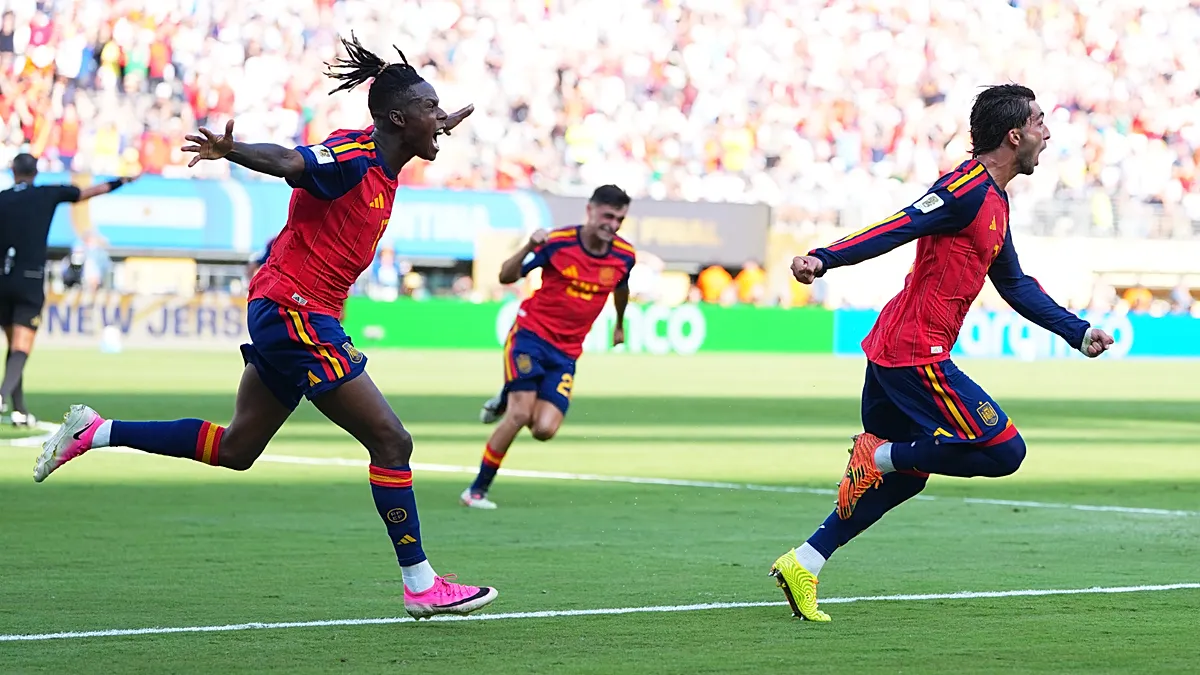
Poinews.com – Spain’s historic second World Cup triumph was secured in a nail-biting final against Argentina, marking a defining moment in the nation’s football legacy. The match, which culminated in a dramatic extra-time goal by Ferran Torres, showcased the resilience and tactical brilliance of the Spanish squad. This victory not only cemented Spain’s status as one of the world’s elite football teams but also underscored their ability to dominate on the global stage. With the focus keyword “Spain win World Cup for second” embedded in the opening paragraph, the narrative sets the stage for a deeply engaging story of triumph and perseverance.
Spain’s Strategic Mastery and Argentina’s Tenacious Fight
The tournament was a testament to Spain’s evolving football philosophy, blending technical precision with relentless pressing. In the final, Spain’s coach Luis de la Fuente deployed a system that emphasized control, counterattacks, and high-intensity transitions. From the outset, the Spanish midfield, anchored by Rodri, dictated the tempo, while the attacking trio of Oyarzabal, Cucurella, and Olmo created constant pressure on Argentina’s defense. The early moments saw a clash of styles: Spain’s fluidity against Argentina’s physicality, as the latter sought to exploit gaps in the Spanish backline.
Key moments in the first half included a trademark Yamal-Olmo link-up, which led to a close-range save by Emiliano “Dibu” Martínez. Spain’s goalkeeper, Unai Simón, was instrumental in maintaining the lead, making several crucial interventions that thwarted Argentina’s attempts to break through. Meanwhile, Argentina’s Lionel Messi and Julián Álvarez pushed for equalizers, but Spain’s disciplined defense held firm. The first half ended with Spain ahead, setting the tone for a gripping second half.
Intense Battles and Tactical Adjustments
As the match progressed, the physicality intensified, with both teams adapting to the sweltering conditions and a challenging pitch. Referee Slavko Vinčić had to manage several incidents, including a strong challenge by Nicolás Tagliafico on Yamal, which sparked a moment of tension. Argentina’s Lisandro Martínez received a yellow card for a tackle during Spain’s counterattack, prompting Scaloni to make a tactical substitution before halftime. Nicolás Otamendi replaced Martínez, shifting Argentina’s midfield balance and adding defensive solidity.
Spain’s strategy evolved in the second half, with De la Fuente introducing Pedri and Torres to freshen the attack. The change proved decisive, as Torres’s movement and clinical finishing became central to Spain’s late surge. Argentina, despite their efforts, struggled to generate consistent chances, relying heavily on isolated plays from Messi and Álvarez. The Spanish midfield’s dominance, particularly from Rodri and Koke, ensured that the team maintained control of the game, even as Argentina’s physical approach tested their stamina and composure.
Extra Time and the Defining Moment
The match reached a fever pitch in extra time, with both teams pushing for a decisive breakthrough. Spain’s defense—led by Cubarsí, Aymeric Laporte, and Simón—was put to the test as Argentina’s counterattacks grew bolder. A critical turning point came when Enzo Fernández was shown a second yellow card for a reckless challenge on Cubarsí, reducing Argentina to ten men and shifting the momentum in Spain’s favor. The Spanish attackers capitalized on the numerical advantage, with Torres’s composure and timing ultimately delivering the winner in the 106th minute.
The final goal, scored by Torres after a precise Yamal pass, was a masterclass in Spanish football’s philosophy. It highlighted the team’s ability to blend creativity with precision, even under pressure. Fans and analysts alike praised the performance, with many hailing it as Spain’s most complete World Cup campaign to date. The victory not only solidified their place in football history but also marked the end of a thrilling tournament that saw Spain win World Cup for second time in a memorable final against Argentina.
Legacy of Spain’s Second World Cup Triumph
Spain’s second World Cup win is a milestone that will be celebrated for decades. The nation’s previous triumph in 2010, led by Xavi and Iniesta, remains a legendary chapter in football history. This time, the team’s success is attributed to a new generation of players, including Ferran Torres, who rose to prominence during the final. The victory underscores Spain’s ability to evolve while retaining the core principles of their style of play. For fans, it symbolizes the enduring legacy of a footballing nation that continues to challenge and redefine global standards.
Throughout the tournament, Spain demonstrated their adaptability, outplaying opponents with both technical skill and tactical discipline. Their ability to win World Cup for second time in such a high-stakes final highlights the team’s depth and resilience. The match against Argentina was not just a contest of talent but also of mental strength, as both sides battled through fatigue and pressure. The Spanish squad’s victory is a testament to their cohesive teamwork and the strategic vision of their coach, Luis de la Fuente, who guided them to a well-earned title.
“This win for Spain is a celebration of our hard work and belief. To win World Cup for second time against a team like Argentina is a dream come true,” said Spain’s captain, Sergio Ramos, after the match. His words encapsulated the pride and determination that defined the tournament, leaving fans in awe of Spain’s relentless pursuit of excellence.
Spain’s World Cup win for second time will be remembered as a pivotal moment in international football. The final against Argentina, filled with dramatic twists and tactical brilliance, will go down as one of the most iconic matches in the tournament’s history. As the celebrations continue, the focus remains on the future—a new era of Spanish football that promises more triumphs to come. This victory not only rewards years of dedication but also sets a new benchmark for success in the global game.